

After opening the day in the green, share markets in India witnessed volatile trading activity throughout the day and ended the day on a negative note with a positive bias. Sectoral indices traded mixed, with stocks in the energy sector and stocks in the consumer durables sector, leading the losses.
At the closing bell, the BSE Sensex stood lower by 179 points (down 0.5%) and the NSE Nifty closed down by 82 points (down 0.8%). The BSE Mid Cap index ended the day down 1.6%, while the BSE Small Cap index ended the day down by 1.5%.
The rupee was trading at Rs 68.76 against the US$ in the afternoon session. Oil prices were trading at US$ 77.91 at the time of writing.
Asian stock markets finished mixed. As of the most recent closing prices, the Hang Seng was up by 0.5% and the Shanghai Composite was down by 0.9%. The Nikkei 225 was down by 0.1%. Meanwhile, European markets, too were trading on a mixed note. The FTSE 100 was up by 0.1%. The DAX, was down by 0.8% while the CAC 40 was down by 0.3%
In news from stocks in the auto sector. Tata Motors share price and Mahindra & Mahindra share price were in focus today as electric vehicles (EV) delivered by the companies face rejections from government employees.
Senior government officials have refused to use electric cars made by the companies due to poor performance and low mileage.
In less than a year after state-run Energy Efficiency Services Ltd (EESL) floated a tender for 10,000 electric cars amid much fanfare, India's EV growth story seems to be headed in a wrong direction.
A reason for this could be the smaller battery sizes in these vehicles. Both models have 17 kilowatts (kW) battery packs, while the global standard is 27-35kW. Notably, both the Tata and M&M models failed to run even 80-82km on a single charge within city limits.
Reportedly both companies are working on revised versions for further deployment.
Notably, Tata Motors and Mahindra were to supply 350 units and 150 units, respectively, to the Union government in the first phase. Subsequently, the automakers are to give another 9,500 units of electric vehicles to EESL.
Tata Motors share price ended the day down by 2.7%. While M&M share price ended the day up 1.8%.
Is India Prepared to Meet the Ambitious Battery Car Target?
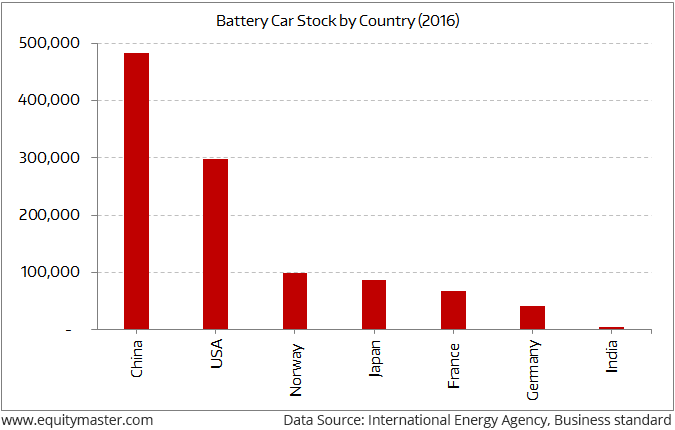
Currently, electric vehicle sales are low in India, rising 37.5% to 22,000 units in the year ended 31 March 2016 from 16,000 in 2014-15. Only 2,000 of these were cars and other four-wheelers, according to automobile lobby group society of Indian Automobile Manufacturers (Siam).
The government wants to see 6 million electric and hybrid vehicles on Indian roads by 2020 under the National Electric Mobility Mission Plan 2020.
The government is targeting to have all cars propelled by electric engine by 2030. The target is more daunting than in many advanced countries.
According to the industry, the 2030 target would require eight to ten times the global stock of such vehicles. India would need to sell more than 10 million electric cars in 2030, compared to 5,000 electric vehicles India had on the road in 2016.
As you can see from the chart above, India is barely visible compared to other developed countries when it comes to battery cars.
As an article in Business Standard suggests, such a big jump in scale for the auto industry in 13 years seems difficult. The basic infrastructure is missing. There are not enough charging stations. For this massive shift, the charging stations will need to be as ubiquitous as petrol pumps.
Another issue is the price of the lithium-ion battery, which constitutes 30% to 40% of the cost of the car. For this plan to succeed, the price of the battery needs to come down.
The auto industry is already facing regulatory headwinds. The shift from BS-IV emission norms to BS-VI has been two years ahead of schedule without an intermediate stage. The government, if it is serious about such ambitious targets, should offer the necessary infrastructure support and do its bit for a smooth transition.
Moving on to news from stocks in the pharma sector. Lupin share price was in focus today after the company entered into a partnership with US drug maker Mylan to market a biosimilar drug.
The alliance is to market the biosimilar drug, Etanercept in Europe, Australia, New Zealand and Asia as both the companies look at expanding their presence in the next wave of the drug business.
Etanercept is indicated to treat certain autoimmune diseases, including rheumatoid arthritis, psoriatic arthritis, plaque psoriasis among others.
According to IQVIA sales data, Etanercept had annual sales of around US$11.6 billion in the US.
Under the terms of the agreement, Lupin will receive an up-front payment of $15 million and potential commercial milestones together with an equal share in net profits of the product.
The company has successfully completed its Phase 3 clinical trial in February 2018 and has filed the product with the European Medicines Agency with plans to file the product in other jurisdictions.
This is the second Indian partnership for Mylan, almost a decade ago it partnered with Bangalore based Biocon for six biosimilar drugs including Etanercept.
However, in January this year, Biocon and Sandoz signed an agreement to market Etanercept for regions like Europe. So all these four companies will be competing against each other over the same product.
Lupin share price ended the day up 0.3%.



Comments
Log in or sign up to join the conversation.