

After opening the day in the red, share markets in India witnessed negative trading activity throughout the day and ended the day in the red. Sectoral indices ended the day mixed, with stocks in the banking sector and stocks in the auto sector leading the losses.
At the closing bell, the BSE Sensex stood lower by 33 points and the NSE Nifty closed down by 15 points. The BSE Mid Cap index ended the day up 0.4%, while the BSE Small Cap index ended the day up by 0.3%.
Asian stock markets finished mixed. As of the most recent closing prices, the Hang Seng was up by 0.3% and the Shanghai Composite was down by 0.3%. The Nikkei 225 was up by 0.2%. Meanwhile, European markets were trading on a negative note. The FTSE 100 was down by 0.6%, The DAX, was down by 0.4% while the CAC 40 was down by 0.2%.
The rupee was trading at Rs 70.78 against the US$ in the afternoon session. Oil prices were trading at US$ 76.45 at the time of writing.
By the way, it's Warren Buffet's birthday today. The Oracle of Omaha turns 88 today. We at Equitymaster are big fans of Mr. Buffet.
In news from stocks in the pharma sector. Lupin share price was in focus after it received approval from the US Food and Drug Administration (USFDA) market its generic Gabapentin tablets used for the treatment of postherpetic neuralgia in the American market.
The approved product is a generic equivalent of Pfizer's Neurontin tablets and is indicated for the treatment of postherpetic neuralgia in adults and adjunctive therapy in the treatment of partial onset seizures.
Quoting IQVIA MAT data, the company said the estimated market size of Neurontin tablets is US$180 million for the twelve months ending June 2018.
Lupin Pharma share price ended the day up 0.7%.
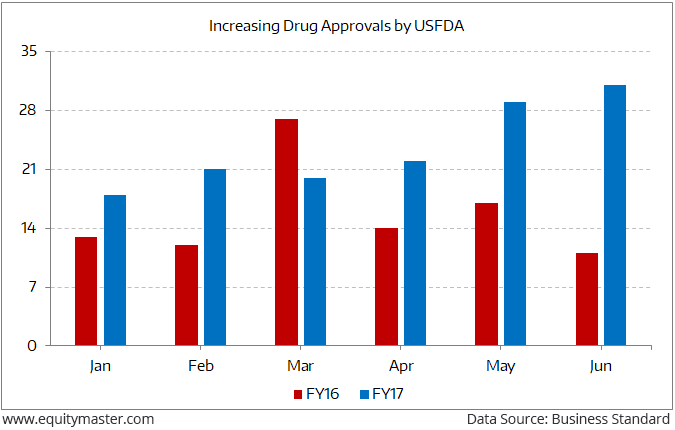
Indian pharma companies catering to international markets, and especially the US markets are breathing a sigh of relief. After being adversely affected by import bans and the suspension of new drug approvals from manufacturing facilities in the past three years, there has been a sharp pick-up in new drug approvals in FY17.
However, note that USFDA alerts on Indian pharma companies have increased over the past few years. Regulators used to visit the plants every two years. Now they come every eight months. Increasing inspections have led to a total of 41 import alerts in the past eight years - 33 of them (80%) in just the last four years (2013-16). This clearly signifies increased USFDA scrutiny on Indian pharma firms. If that wasn't enough, increasing pricing pressure in the generics segment has dented realizations.
However, the recent development of USFDA expediting the drug approval process can bring some respite for Indian pharma companies. This comes as drug approvals for Indian companies have gone up 50% in the period from January to June 2017 compared to the same period last year, as can be seen from the chart below:
Expediting Drug Approval Process to be a Positive for Industry
While short-term pain is expected, companies with strong R&D capabilities and compliant plants will do well over the long term. The uncertainties make it important to be stock specific in the sector. It is important to look for companies that have the competence and staying power to overcome the challenges.
Moving on to news from the IPO space. According to a leading financial daily, the government is set to approve the initial public offering (IPO) of UTI Asset Management Company (UTI AMC).
The developments came after T. Rowe Price, the largest shareholder of UTI AMC called a truce with the government and the markets regulator after the finance ministry agreed to issue a no-objection (NOC) letter for UTI AMC's initial share sale.
Accordingly, the government will ask Life Insurance Corp. of India (LIC), State Bank of India (SBI), Punjab National Bank (PNB) and Bank of Baroda (BoB) to slash their stakes in UTI AMC from 18.25% to 10% each, within a deadline. T. Rowe Price owns 26% in UTI AMC, but the four government institutions together command a majority on its board.
According to the report, UTI AMC is set to come out with a Rs 50 billion IPO.
Comments
Log in or sign up to join the conversation.