

After opening the day on a strong note, Indian share markets erased most of the gains and turned highly volatile in the afternoon session.
Benchmark indices erased gains in the last hour of trading but still ended on a positive note.
Sectoral indices ended on a mixed note with stocks in the oil & gas sector and IT sector witnessing buying interest.
Meanwhile, healthcare stocks witnessed selling pressure.
After rising more than 600 points in early trade today, the BSE Sensex ended the day up by 83 points.
Meanwhile, the NSE Nifty stood higher by 25 points.
SGX Nifty erased all the gains and was trading at 10,172, down by 9 points, at the time of writing.
The BSE Mid Cap index and the BSE Small Cap index ended up by 0.2% and 0.9%, respectively.
Asian stock markets ended on a positive note today as US jobs data released on Friday showed an unexpected jump, spurring hopes of economic recovery from the coronavirus pandemic.
As of the most recent closing prices, the Hang Seng was down 0.2% and the Shanghai Composite stood higher by 0.2%. The Nikkei ended up by 1.4%.
European stock markets traded slightly lower today as markets weigh an economic recovery from the coronavirus pandemic and ongoing global protests against racism.
Gold prices are trading up by 0.6% at Rs 45,964 per 10 grams.
The rupee is trading at 75.55 against the US$.
Speaking of the current stock market scenario, the Unlock 1.0 phase has been surprisingly positive for the stock markets.
Around two months back the Nifty was close to the 7,500 marks. Earlier this month on June 3, the Nifty crossed the 10,000-mark.
Most have justified the sharp run of the last few sessions on the grounds that all negative news is already priced in.
Moving on, market participants were tracking IndusInd Bank share price.
Shares of IndusInd Bank surged over 9% intraday today after the private sector lender said its promoters would acquire additional shares of the bank from the secondary market.
Currently, the promoters, IndusInd International Holdings Ltd. and IndusInd Ltd. hold 14.68% of the paid-up share capital of IndusInd Bank.
In news from the pharma sector, the market regulator has strongly "censured" AstraZeneca Pharma's promoter and Elliot Group for professional misconduct and following unfair trade practices during the company's delisting plan in 2014.
In a 65-page order, the regulator said that AstraZeneca Pharma India's promoter AstraZeneca Pharmaceuticals AB Sweden (AZPAB), and Elliott Group, which held 15.52% stake in the company, had a 'private arrangement' to sail through the delisting process.
The regulator said it "strongly censure the notices (AZPAB and Elliott Group) for displaying such gross professional misconduct and fraudulent trade practice and trying to arrive at a private arrangement amongst them so as to help the company sail through the delisting procedure".
It further said that the entire procedure was intended to dilute the reverse book building mechanism for discovery of the delisting price of the scrip as per stipulations in the (Delisting of Equity Shares) Regulations, thereby jeopardising the interests of retail public shareholders and investors of the company at large.
In other news, British pharma company AstraZeneca Plc has advanced the proposition for a potential merger to an American biopharmaceutical company, Gilead Sciences Inc.
Reportedly, the UK-based firm informally contacted Gilead last month to gauge its interest in a possible tie-up.
AstraZeneca, valued at US$ 140 billion, is the UK's biggest drugmaker by market capitalization and has developed treatments for conditions from cancer to cardiovascular disease.
Gilead, worth US$ 96 billion at Friday's close, is the creator of a drug that's received US approval for use with coronavirus patients.
Shares of AstraZeneca Pharma, AstraZeneca Plc's Indian arm, rallied to touch an all-time high of Rs 3,498 on back of the above news.
Moving on to news from the oil & gas sector, shares of oil marketing companies (OMCs) witnessed buying interest today after petrol and diesel prices were hiked by 60 paise per liter for a second straight day, thus ending an 83-day hiatus in rate revision.
Shares of Indian Oil Corporation (IOC) gained over 6% intraday while BPCL rose over 7%.
Petrol price in Delhi was hiked to Rs 72.46 per liter from Rs 71.86 on Sunday, while diesel rates were increased to Rs 70.59 a liter from Rs 69.99, according to a price notification of state oil marketing companies.
While oil PSUs have regularly revised ATF and LPG prices, they had since March 16 kept petrol and diesel prices on hold, on account of extreme volatility in the international oil markets.
IOC, the nation's largest oil firm, has said that Unlock 1.0 will revive fuel sales soon, owing to the resumption of economic activities.
Meanwhile, OPEC, Russia and allies agreed on Saturday to extend record oil production cuts until the end of July, prolonging a deal that has helped crude prices double in the past two months by withdrawing almost 10% of global supplies from the market.
Initially, in April, OPEC+ had agreed that it would cut supply by 9.7 million barrels per day (bpd) during May-June to prop up prices that collapsed due to the coronavirus crisis.
Reacting to the above news, oil prices rose more than 2% in the early trade today. Brent crude climbed to as high as US$ 43.41 a barrel.
US West Texas Intermediate (WTI) crude gained 83 cents, or 2.1%, to US$ 40.38 a barrel.
Speaking of crude oil, on a year-to-date (YTD) basis, crude oil prices are down about 38%.
Crude Oil Prices Fall Sharply
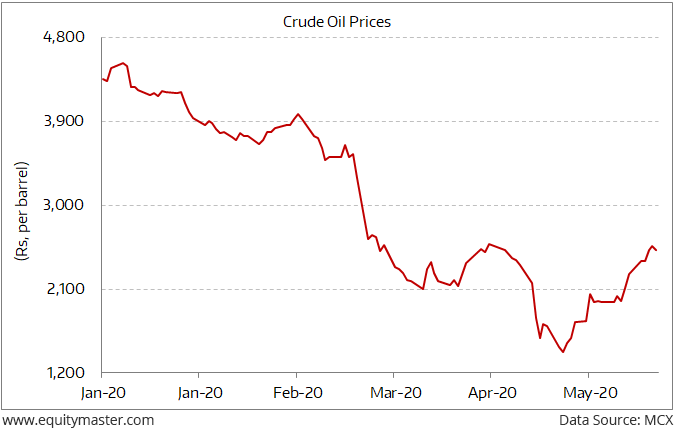
Crude oil witnessed selling during the start of the year due to oversupply concerns amid subdued demand.
Prices crashed further in March in what was the worst price dip since the 1991 Gulf War with Brent prices plunging to US$ 31 per barrel.
In April, crude oil futures crashed and briefly went to negative prices, implying that investors would need to pay buyers to take delivery of crude oil amid dwindling storage space.
What effects crude oil prices have on Indian stock markets and the Indian economy remains to be seen. Meanwhile, we will keep you updated on the latest developments from this space.



Comments
Log in or sign up to join the conversation.