

After opening the day in red, share markets in India witnessed negative trading activity throughout the day and ended the day in red. Sectoral indices traded mixed, with stocks in the power sector and stocks in the metal sector, leading the losses.
At the closing bell, the BSE Sensex stood higher by 267 points (up 0.7%) and the NSE Nifty closed up by 70 points (up 0.6%). The BSE Mid Cap index ended the day down 0.2%, while the BSE Small Cap index ended the day up by 0.4%.
The rupee was trading at Rs 68.70 against the US$ in the afternoon session. Oil prices were trading at US$ 77.80 at the time of writing.
Asian stock markets finished in red. As of the most recent closing prices, the Hang Seng was down by 1.1% and the Shanghai Composite was down by 1%. The Nikkei 225 was down by 0.3%. Meanwhile, European markets were trading on a mixed note. The FTSE 100 was down by 0.3%. The DAX, was down by 0.1% while the CAC 40 was up by 0.2%
In news from stocks in the pharma sector. Aurobindo Pharma share price was in focus after it received approval from the US Food and Drug Administration (USFDA) to manufacture painkiller drug Ibuprofen.
The approved product is a generic equivalent of Pfizer's Advil Liqui-Gels Capsules. The product will be launched in September 2018.
Ibuprofen is used to relieve pain from various conditions such as a headache, dental pain, muscle aches, or arthritis. It is also used to reduce fever and to relieve minor aches and pain due to the common cold or flu. Ibuprofen is a non-steroidal anti-inflammatory drug (NSAID).
Quoting Neilsen data, the company said the estimated market size of ibuprofen capsules OTC is US$164 million for the twelve months ending March 2018.
The pharma company said it has now a total of 373 ANDA (Abbreviated New Drug Application) approvals (340 final approvals, including 17 from Aurolife Pharma LLC and 33 tentative approvals) from the USFDA.
Aurobindo Pharma share price ended the day down 0.2%.
Indian pharma companies catering to the US markets are breathing a sigh of relief. After being adversely affected by import bans and the suspension of new drug approvals from manufacturing facilities in the past three years, there has been a sharp pick-up in new drug approvals in FY17.
With an aim to lower the overall healthcare costs in the country, the US Food and Drug Administration (FDA) approved a record 763 generic drugs for the financial year ending 30th September. As per Mint Analysis, Indian pharma companies received 295 approvals accounting for 40% of the overall approvals during the year.
Generic Drug Approvals Hit the Roof
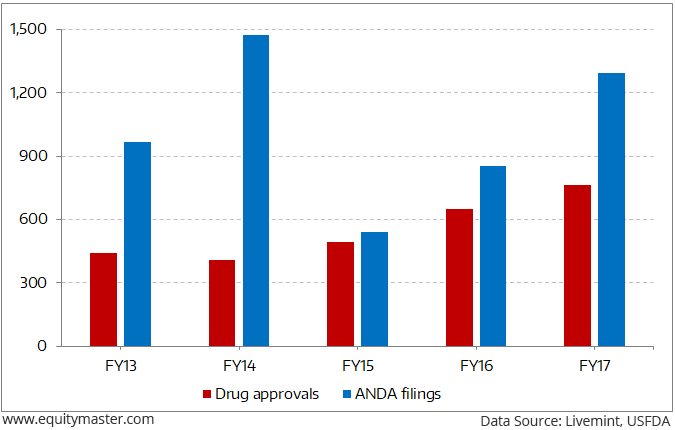
Even the total filings of abbreviated new drug applications (ANDAs) for generic drugs rose to 1,292 in FY17 from 852 in the previous year. While, faster approvals expedite the commercialization of product pipelines of domestic pharma companies spurring growth. At the same time, however, it has raised the intensity of competition resulting in pricing pressures. The price erosion has been further compounded by a consolidation among US distributors and the decline in the number of products going off-patent over the past few years.
In other words, acceleration in generic drug approvals is like a double-edged sword. The growth boost can be quickly offset by the ensuing pricing pressures. Pharma companies that invest in creating a pipeline of complex generics or building competencies in alternative dosage forms are better equipped to tackle the changing dynamics in the US generics market.
Therefore, despite a lot of pessimism surrounding pharma stocks on regulatory uncertainty, we have stocks in open positions in StockSelect and have remained bullish on pharma stocks in our long-term service, ValuePro.
Moving on to news from stocks in the FMCG sector. ITC share price was in focus today after the company revealed plans to explore every possible consumer category and launch 30-40 new products each year in its effort to become the country's biggest fast-moving consumer goods (FMCG) company.
ITC has set itself a target of Rs 1 trillion in revenue by 2030, and is strengthening its existing categories and venturing into newer ones to achieve the target.
ITC's FMCG business includes cigarettes, packaged food, personal care, stationery, safety matches and agarbattis. The company will launch more products in the packaged food space since it's the largest FMCG business for ITC. Last fiscal, it launched 30 products, next only to the rapidly expanding Patanjali Ayurved.
The maker of Sunfeast biscuit, Aashirvaad atta and Engage deodorant is also actively scouting for acquisitions to plug portfolio gaps. However, ITC will only acquire brands that can be scaled up using its own distribution network as it would be easier to break even.
To be sure, ITC has some way to go before it can dislodge Hindustan Unilever (HUL) from its longtime perch as India's biggest consumer goods company. In FY18, ITC's non-cigarette FMCG business clocked sales of Rs 113 billion driven by the packaged food business at Rs 86 billion. In contrast, HUL's consolidated total income was over three times more than that of ITC at Rs 366 billion in FY18.
ITC share price ended the day down by 0.3%.
Comments
Log in or sign up to join the conversation.