

Indian share markets witnessed negative trading activity throughout the day and ended deep in the red.
Indian stock markets slipped today tracking weak global cues as fears of a second wave of coronavirus infections compelled investors to ditch risky assets and rush to safe-havens.
Further, a sharp jump in coronavirus cases in India weighed on investor sentiment.
Stocks in the banking sector and realty sector were among the hardest hit. IndusInd Bank, Axis Bank and DLF fell in the range of 5-8%.
On the other hand, energy stocks witnessed buying interest.
At the closing bell, the BSE Sensex stood lower by 552 points, down 1.6%.
Meanwhile, the NSE Nifty closed down by 159 points.
SGX Nifty was trading at 9,819, down by 123 points, at the time of writing.
The BSE Mid Cap index ended the day down by 1.2%, while the BSE Small Cap index ended on a flat note.
Global stock markets plunged as the United States and China grappled with new coronavirus outbreaks, signaling that the pandemic isn't done wreaking havoc on the global economy.
Dow futures plunged more than 800 points extending losses ahead of the opening bell. S&P 500 futures dropped 3%, and Nasdaq futures were down 2.3%.
Asian stock markets also recorded steep declines after Beijing recorded a fresh cluster of the virus originating in the city's largest wholesale food market.
The Chinese capital has recorded 79 new cases since a locally transmitted infection was reported last Friday for the first time in nearly two months.
As of the most recent closing prices, Japan's Nikkei ended down 3.5%, while China's Shanghai Composite declined 1%. Hong Kong's Hang Seng fell 2.2%.
Gold prices are trading down by 1.2% at Rs 46,788.
The rupee was trading at 76.03 against the US$.
In news from the IT sector, shares of Mastek were locked in the 20% upper circuit limit today after the company reported 36.1% quarter-on-quarter (QoQ) growth in revenue in constant currency terms for the quarter ended March 2020 (Q4FY20).
The company said its financials include acquisition of Evosys and, hence, are not comparable.
The company's EBITDA (earnings before interest, taxes, depreciation and amortization) margins improved 350 basis points to 17.3% from 13.8% in December 2019 quarter.
The company's consolidated net profit increased by 50% to Rs 389 million, while total income grew 39.9% to Rs 3,542 million.
The company said it added 24 new clients during the quarter. As on Q4FY20, 12-month order backlog was Rs 7,851 million as compared to Rs 4,710 million in Q3FY20, reflecting a growth of 66.7% in rupee terms.
Mastek share price ended the day up by 20%.
Moving on to news from the macroeconomic space, wholesale prices in India witnessed deflation of 3.21% in May due to a sharp decline in prices of fuel and power, even as food articles turned expensive.
In a statement, the commerce and industry ministry said that the annual rate of inflation, based on monthly Wholesale Price Index (WPI) has declined by 3.21% in May against a rise of 2.79% in the year-ago period.
Manufactured products witnessed deflation of 0.42% in May.
Due to the nationwide lockdown imposed since March 25, the ministry had released truncated WPI inflation data for April, with figures of food, primary articles and fuel and power.
However, it has advised its field offices to collect price data through electronic means and the final index for the month would be released next month.
The final print of March WPI inflation stood at 0.42% as compared to its provisional levels of 1% reported on April 14, 2020, the ministry said.
Meanwhile, as per a leading financial daily, India's industrial production contracted 55.5% in April, the sharpest ever, as the COVID-19-induced lockdown almost froze economic activities.
The Index of Industrial Production (IIP) had shrunk 18.3% in March.
Speaking of the coronavirus impact on the Indian economy, note that the Indian economy was grappling with its own issues and Covid-19 has made matters worse.
The industry was facing demand problems, due to which business houses were reluctant to undertake CAPEX plans. Unemployment was at its peak and exports were consistently down for several months.
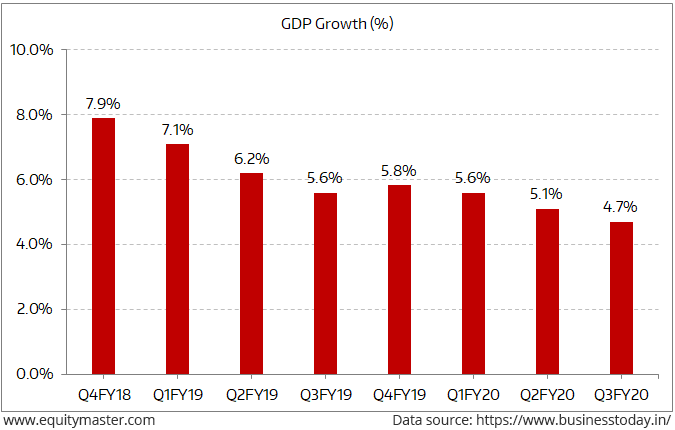
India's GDP growth has been on a consistent decline after peaking out at 7.9% in Q4 of FY18 to 4.7% in Q3 of FY20, as can be seen in the chart below:
Declining GDP Growth for India
Interestingly, there's a silver lining in all this. India can become an outsourcing hub. The global slowdown will mean that countries like the US, will be looking out for low-cost outsourcing destinations like India.
Further, a lot of global buyers have already shifted to India to source ceramics, home appliances, fashion, and lifestyle goods.
Meanwhile, as per the reports, around a thousand foreign manufacturers want to relocate their production to India, a country they see as an alternative to China.


Comments
Log in or sign up to join the conversation.