

After opening their day on a positive note, Indian share markets gave up some of their earlier gains and ended their session marginally higher. Gains were largely seen in the FMCG sector and metal sector, while realty stocks and banking stocks ended the day lower.
At the closing bell, the BSE Sensex stood higher by 305 points (up 0.8%) and the NSE Nifty closed higher by 82 points (up 0.7%). The BSE Mid Cap index ended the day up by 0.6%, while the BSE Small Cap index ended the day down by 0.1%.
Asian stock markets finished on a negative note as of the most recent closing prices. The Hang Seng was down 0.29% and the Nikkei was trading down by 0.27%. The Shanghai Composite stood lower by 0.33%.
The rupee was trading at 72.08 to the US$ at the time of writing.
Stocks of oil marketing companies and airline stocks were witnessing selling pressure today on the back of rising fuel prices.
The rise in prices has also raised criticism of the government not cutting excise duty on the heavily taxed petrol and diesel.
For a more detailed update on oil marketing companies, you can read our Energy sector report and check the latest Energy sector results.
The above rise in fuel prices is seen on the back of rising crude oil prices, which have hit US$ 80 per barrel. This is the highest level seen since November 2014.
In the past one year alone, oil prices have surged more than 50%.
Also note that rising crude oil prices not only affect fuel prices, but also has many other repercussions for the Indian economy.
They can be a big worry for the Modi government as well.
Have a look at the chart below. It shows India's total import bill of crude oil and petroleum products on an annual basis during the Manmohan Singh regime and the Narendra Modi regime.
It is clearly evident that the Modi government has been a big beneficiary of lower crude oil prices.
As Ankit Shah wrote in a recent edition of The 5 Minute WrapUp...
- During the UPA II regime, India's average annual oil import bill was US$ 133 billion. In fact, in the last three years of Manmohan Singh's leadership, the oil import bill exceeded US$ 150 billion. Compare that with an average annual oil bill of US$ 95 billion during the four years of Modi's leadership.
The actual savings would have been even higher, because I believe the consumption of crude oil and petroleum products would have been quite higher in the Modi era than the Manmohan era.
Last Thursday, Brent crude oil prices shot above US$ 80 a barrel.
This is the highest level since 2014. In the past one year alone, oil prices have surged more than 50%.
Now, what if oil prices go back to the levels during the Manmohan Singh regime? What would happen to India's current account and fiscal deficit? What would happen to inflation and RBI's stance on interest rates?
With the next general elections just a year away, rising crude oil prices are going to be a big worry for the Modi government.
It should worry you too...
Apart from that, what does rising crude oil prices mean for stock markets?
Richa Agarwal, editor of Hidden Treasure, tracks the oil and gas sector very closely. She believes the rise in crude oil prices is a bearish sign for stock markets globally. At the same time, any market correction, will throw up interesting buying opportunities in small-cap stocks.
This is what she wrote...
- After hitting a low of US$ 30 per barrel in January 2016, prices have more than doubled now.
The recent news of Saudi Arabia wanting crude oil prices to touch US$ 100 per barrel doesn't help. The 2008 recession was preceded by crude oil touching US$ 150 per barrel. Any movement upwards can result in a possible downturn for the global market.
While the Hidden Treasure team looks for long-term wealth creators, such macro situations can help to recommend such stocks at a bargain. The ones who keeps calm, when everyone else is losing their heads, will gain the most when the tide turns.
How the government handles this situation of rising crude oil and fuel prices remains to be seen. Meanwhile, we will keep you posted on all the developments from this space. Stay tuned.
In the news from macroeconomic space, Indian indices got a boost today after the Indian rupee witnessed a major recovery.
The rupee recovered from its lows as much as 60 paise following reports that Prime Minister Narendra Modi will be holding a meeting over the weekend to review the economic situation and the prolonged rupee depreciation.
As per the news, the reports added that there could be measures rolled out after the meeting.
Note that the rupee has been witnessing selling pressure against the US dollar since the start of this calendar year. This is evident from the chart below, which shows the quantum of US dollars a 100-rupee note can buy and how this rate has been declining over the past few months:
Indian Rupee in a Steep Decline
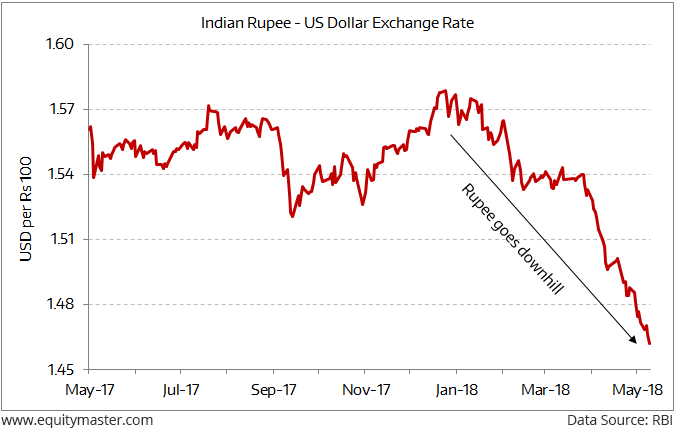
What does the fall in rupee mean for the Indian economy?
A depreciation in rupee means importers buying goods and services at a higher rate that earlier. This doesn't bode well for a developing economy that relies heavily on imports.
Also, India imports most of its oil requirements. So, a fall in rupee leads to a consequent rise in the import bill. The depreciation of the rupee will also add to crude oil's rising cost.
On the corporate side, companies who have taken foreign loans from abroad will be impacted. The repayment obligations in terms of principal and interest will rise, leading to a dent in the cash flows and financials.
Further, companies who import a majority of their raw material requirements will get impacted provided they have not hedged their foreign currency exposure.
Looking at the brighter side, rupee depreciation brings a cheer on the exports front.
A depreciating rupee will provide a much-needed cushion to falling exports. However, a falling rupee will not be the only factor to boost exports. There are certain structural issues too which the government needs to address.
Ankit Shah has explained how the depreciation in rupee is linked to foreign investor outflows and forex reserves in one of his editions of Equitymaster Insider. You can read the entire article here (requires subscription).
Also, companies which import raw material witness pressure on their margins and profitably. Here's an excerpt of what Kunal wrote in a recent edition of The 5 Minute WrapUp:
- So, this looks quite negative on the face of it. So, it's not surprising that markets get volatile when the currency depreciates.
Look at Indian rupee against the dollar from 1990. It has deprecated at a compounded annual rate of 5%.
Yes, the dollar has been on a winning streak from the beginning.
And despite that... the BSE Sensex has returned 14% compounded annually since 1990.
Thus, the falling rupee can bring volatility to the market in the short-term. But in the long-term, our market should be fine.
This is exactly what I keep in mind when picking stocks for Smart Money Secrets subscribers. I cut out the noise of short-term disruptions and look at the long-term picture beyond.
To know what's moving the Indian stock markets today, check out the most recent share market updates here.



Comments
Log in or sign up to join the conversation.