

After opening the day on a strong note, Indian share markets witnessed negative trading activity during closing hours and ended their trading session lower.
Benchmarks indices erased early gains and turned bearish in the last hour of trading, dragged down by banking stocks.
Sentiment dampened after rating firm S&P said that India's fiscal space is expected to be limited, owing to the government's already elevated deficit. S&P added that systemic pressures for Indian banks could rise, owing to the extension of the virus-induced lockdown.
Moreover, concerns over the rise in Covid-19 cases across the nation and worldwide kept domestic investors cautious.
Sectoral indices ended on a mixed note with stocks in the banking sector, realty sector and finance sector witnessing most of the selling pressure, while power stocks witnessed buying interest.
At the closing bell, the BSE Sensex stood lower by 262 points and the NSE Nifty closed down by 88 points.
SGX Nifty was trading at 9,200, down by 39 points, at the time of writing.
The BSE Mid Cap index and the BSE Small Cap index ended their day down by 1%.
Asian stock markets finished on a positive note. The Hang Seng was up 1.2%, meanwhile markets were closed in Japan, China and South Korea.
European stocks rose alongside US equity futures as more economies moved toward easing their coronavirus lockdowns.
Crude oil prices gained for the fifth straight day, on course for its longest winning streak in nine months.
Gold prices are currently trading down by 0.6% at Rs 45,518.
The rupee is currently trading at 75.79 against the US$.
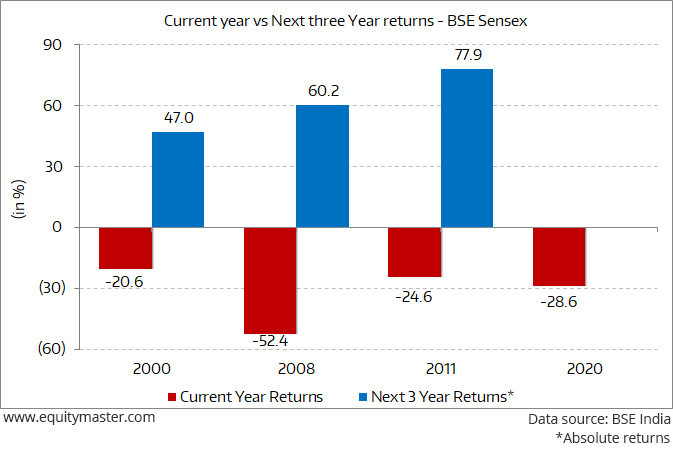
Note that the coronavirus impact has shaken markets worldwide. For the BSE Sensex, FY20 was the second-worst year post FY08, the year of the global financial crisis.
Good Time to Start Investing Now?
Naturally, there is an atmosphere of fear all round.
Is it time to sell stocks now? Will the correction get worse?
History has shown that after years like the one we had just now, the next 3 years are good for the markets. In fact, these corrections are the rare times when you find businesses with solid fundamentals at reasonable valuations.
If you can find good businesses that can survive the current crisis, you will do well in the long run.
Moving on, market participants were tracking Astec Lifesciences share price, Persistent Systems share price, and SBI Life Insurance share price as these companies announced their March quarter results (Q4FY20) today.
In news from the FMCG sector, shares of Marico rose 6% today as the company's margin expanded in the March quarter and earnings met street estimates.
The FMCG firm's net profit declined by 50.6% to Rs 2 billion. Reportedly, this was because of the tax credit in the year-ago period and Rs 100 million of exceptional items in Q4FY20.
It had posted a net profit of Rs 4 billion in the corresponding quarter last year.
Marico's earnings before interest, tax, depreciation, and amortization (EBITDA) margin increased by 58 basis points YoY to 18.9% in Q4FY20 owing to stable input costs and lower advertising spends.
This also contained the impact on the top line, with Marico's pre-tax profit declining 3% YoY to Rs 2.6 billion versus an estimate of Rs 2.7 billion.
The company said it aims to maintain EBITDA margins at over 20% in the India's business over the medium term.
The company clocked its fastest volume growth of 25% in Saffola edible oil as customers stocked up food and essential items in light of the pandemic and the lockdown.
However, the company's major hair oil category witnessed an 8-11% volume decline in Q4, resulting in a 3% fall in the overall domestic volumes.
The FMCG major's international business declined by 6% in constant currency terms with South Africa businesses posting sharp drops, while Bangladesh and Vietnam ended in the green, given relatively limited restrictions imposed in these regions in the month of March.
Marico share price ended the day up by 4.7%.
Moving on to news from the banking sector, as per an article in The Economic Times, public sector banks' non-performing loans are likely to rise by 2-4 percentage points, which will put up to US$ 15 billion recapitalization pressure on the government in FY21.
Here's an excerpt from the article:
- The consolidated fiscal deficit target is likely to overrun by 2 percentage points due to stimulus spends, lower tax receipts and dip in divestments, and will have to look for different ways of raising resources for recapitalization, analysts at Bank of America said.
The government can issue recapitalization bonds, or the RBI's huge reserves of over US$ 127 can also be dipped into to help the state-owned bank's recapitalization needs, it said.
In other news, banks and non-banking finance companies (NBFCs) are likely to get relief in provisioning requirements from the Reserve Bank of India (RBI) with NBFCs in for additional relief in terms of financing.
On Monday, RBI governor Shaktikanta Das acknowledged the role of the financial intermediaries and sought to understand issues facing them.
A chief executive of an NBFC said that the RBI has assured that banks were free to extend a moratorium to finance companies and some have already done so. He added that State Bank of India is also likely to review its stance on extending the moratorium to finance companies.
As per reports, some lenders have already begun offering a moratorium to NBFCs.
The RBI also sought to monitor the liquidity position of the finance companies given the extension of the lockdown. And with the risk-aversion among banks to lend to NBFCs, non-bank lenders have suggested that the RBI route funds through the Small Industries Development Bank of India (Sidbi).



Comments
Log in or sign up to join the conversation.