

Indian share markets witnessed buying interest during closing hours and ended their day on a positive note.
At the closing bell, the BSE Sensex stood higher by 230 points.
Meanwhile, the NSE Nifty stood higher by 77 points. The top gainers in NSE today were Tata Motors, Hero MotoCorp, and IndusInd Bank.
SGX Nifty was trading at 11,545, up by 65 points, at the time of writing.
The BSE Mid Cap index ended up by 0.4%. The BSE Small Cap index ended up by 0.7%.
Sectoral indices ended on a mixed note with stocks in the banking sector and auto sector witnessing maximum buying interest.
Telecom stocks, on the other hand, witnessed selling.
Asian stock markets ended on a mixed note. As of the most recent closing prices, the Hang Seng was flat and the Shanghai Composite stood lower by 1.3%. The Nikkei ended down by 0.03%.
The rupee is trading at 74.29 against the US$.
Gold prices were trading up by 0.1% at Rs 50,982 on MCX at the time of writing.
Speaking of the current stock market scenario, note that markets have moved up sharply since they bottomed out in March. But it seems that they are running out of steam.
In his latest video, Apurva Sheth draws a Plan B if the markets start moving southwards.
Tune in to find out more:
Moving on to stock specific news...
Tata Motors was among the top buzzing stocks today.
Tata Motors share price witnessed buying interest after the company said it proposed to reduce its debt to near-zero levels.
At the annual general meeting of the Tata Motors yesterday, N Chandrasekaran, Chairman of the Tata Group, said the company had a net automotive debt of Rs 480 billion and was targeting to reduce it to near-zero levels in three years.
Tata Motors CFO said that Jaguar Land Rover (JLR) would be cash-positive this year, while India passenger vehicles (PV) business was being subsidiarized to a new legal entity. The focus of the PV business would be entirely on the front-end. It had generated highest ever profitability in FY19, which got impacted by COVID-19.
The stock was also in focus among other automobile companies after Finance Minister Nirmala Sitharaman said the Goods and Services Tax (GST) Council would look into the auto industry's demand for lowering the tax rate on two-wheelers, which are now taxed at the highest slab rate of 28%.
The GST Council, slated to meet on Thursday, has the single-point agenda of compensation to states, but sources familiar with the developments said the meeting on September 17 might take up the two-wheeler rate issue to spur sales ahead of the festive season.
How the above developments pan out remains to be seen. Meanwhile, we will keep you updated on all the news from this space.
Moving on to news from the macroeconomic space...
According to a report by McKinsey Global Institute (MGI), India will have to undertake a slew of reform measures over the next 12-18 months with the aim of increasing productivity and creating jobs.
As per the report, the country's gross domestic product (GDP) needs to rise annually at 8-8.5% to create opportunities in the post COVID-19 era, and the country risks a decade of stagnating incomes and quality of life if urgent steps are not taken to spur growth.
Given the increasing urbanisation and population trends, there will be 90 million additional workers in search of non-farm jobs by 2030 and India will have to triple job creation to 12 million gainful non-farm jobs per year from the 4 million achieved between 2013 to 2018.
On the reforms front, MGI advocated attention to manufacturing, real estate, agriculture, healthcare, and retail sectors, unlocking land which can reduce prices by up to a fourth. It also suggested creating flexible labour markets, enabling efficient power distribution to reduce tariffs for consumers by over 20% and privatizing 30 top state-run enterprises.
From a financial sector perspective, it said reforms and streamlining fiscal resources can deliver US$ 2.4 trillion in investment. It also pushed for creation of a 'bad bank' to take care of the dud assets.
It would be interesting to track if there are any reforms carried out in the above areas in the coming time and how they help the economy.
Also, speaking of the finance sector, note that the market crash impacted all stocks, but finance stocks took the worst hit.
Even as the Sensex has made a comeback to pre-Covid levels, the slowdown and asset quality concerns amid the moratorium extension, is an overhang on the financial sector.
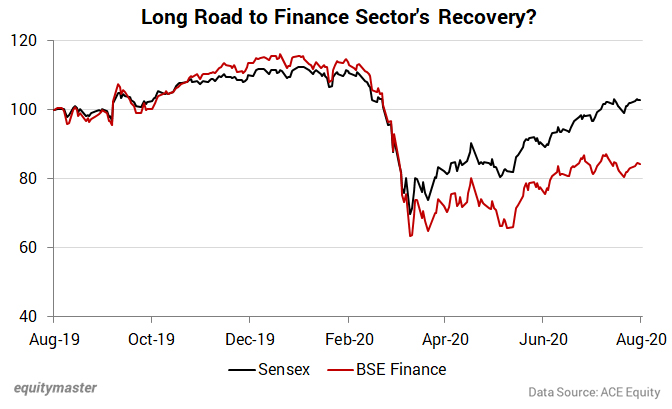
Richa Agarwal, lead Smallcap Analyst at Equitymaster, expects a long road to recovery for this sector.
Here's what she wrote about it in today's edition of the Profit Hunter:
- Just to be sure, being cautious in this sector makes sense to me.
However, I believe it would be folly to paint all financial stocks with the same brush.
Financials, especially NBFCs, have gone through multiple disruptions and challenges in the last few years - demonetisation, the IL&FS crisis, and now...coronavirus and moratoriums.
This has led to a liquidity squeeze for these players, due to a risk aversion attitude among investors and lenders.
The streak of disruptions will force inefficient and unorganised players in this sector to scale back.
I also see a consolidation happening. The survivors and beneficiaries of this shift will be the well capitalised companies with balanced growth and high asset quality.
Investors who identify these stocks now and are willing to be patient with returns, will be rewarded with huge rebound gains.

Comments
Log in or sign up to join the conversation.