

India share markets continued to witness selling but recovered from the day's low in the volatile trade and ended their day on a negative note.
At the closing bell, the BSE Sensex stood lower by 214 points (down 0.6%) and the NSE Nifty stood down by 49 points (down 0.4%).
Both, the BSE Mid Cap index and the BSE Small Cap index, ended their day down by 1.6%.
All sectoral indices except IT sector ended in the red with stocks in the banking sector and realty sector leading the losses.
The rupee was trading at 73.26 against the US$.
Asian stock markets finished on a mixed note. As of the most recent closing prices, the Hang Seng was down by 0.24% and the Shanghai Composite was up by 0.63%. The Nikkei 225 was up 0.08%.
European markets were trading on a positive note. The FTSE 100 was up by 1.41%. The DAX was trading up by 1.03%, while the CAC 40 stood up by 1.20%.
Speaking of the current stock market scenario, market participants are seen taking flight to safety as stock markets see a sharp fall post the Coronavirus impact.
Last week, the Dow Jones (US) fell by 12% - its biggest fall since the 2008 global crisis. Back home, the Indian stock market also saw a weekly fall of 7% last week, its worst in a decade.
In news from the IPO space, the mega initial public offering (IPO) by SBI Cards and Payment Services (SBI) got fully subscribed on third day of the bidding process. The issue has been subscribed 9 times so far despite a weak environment in the secondary market.
The price band for the share sale, which would be open from March 2 to 5, has been fixed at Rs 750-755 apiece.
Incorporated in 1998, SBI Cards is the second-largest credit card issuer in India, with an 18% market share of the credit cards market in terms of the number of cards outstanding.
SBI holds 76% in SBI Cards and the rest of the stake is held by Carlyle Group.
HDFC Bank has the largest credit cards business in the country with 13.3 million cards issued, while ICICI Bank stood third with 7.9 million credit cards, according to data from the Reserve Bank of India.
SBI Card's total credit card spends grew at a compounded annual growth rate of 54.2% over FY17-FY19 compared with an industry average of 35.6%.
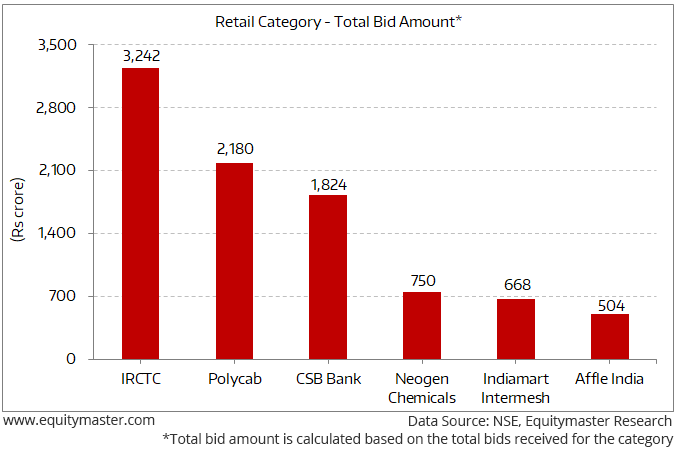
Obviously, all these IPOs were oversubscribed across investor categories. But the level of retail investor enthusiasm differed widely, depending on the overall market sentiments.
This can be seen in the chart below:
Are Retail Investors Back in the IPO Game?
Here's what Ankit wrote about it...
- Clearly, IRCTC witnessed the highest number of bids for the retail category. Factoring in the discount of Rs 10 per share for the retail category, the total bids were worth a whopping Rs 3,242 crore. Over five times the entire IPO size!
Polycab India and the recent IPO of CSB Bank also received a strong thumbs-up from retail investors.
Does this hint that retail investors are coming back to the markets? Could we witness of flurry of IPOs in the coming months?
It would be interesting to see how this trend pans out in 2020.
We will keep you updated on all the developments from this space. Stay tuned!
In news from commodity space, gold continued its uptrend today following an interest rate cut by the US Federal Reserve to calm down coronavirus fears.
Gains were also seen as market participants continued buying safe-haven assets avoiding riskier equities amid rising fears of coronavirus becoming a pandemic.
In the global markets, too, gold prices remained elevated as worries intensified that the rapidly spreading coronavirus could turn into a pandemic and derail global economic growth.
Note that 2019 proved pretty good for gold, as gold surged amid fears of a possible slowdown in global growth and uncertainty surrounding geopolitical crisis in West Asia and Britain's divorce from the European Union.
The same uptrend is also seen in 2020 so far.
Gold prices are seen rising as the rapid spread of coronavirus cases outside of China and its potential negative impact on the global economy are prompting investors to take refuge in safe haven assets like gold.
The international spot gold prices have rallied to seven-year highs while India's domestic gold prices rallied to all-time highs.
Speaking of gold, how lucrative has gold been as a long-term investment in India?
Barring just two years - 2013 and 2015, gold has delivered positive returns in 13 of the last 15 years.
Moving on to news from the macroeconomic space, growth in India's dominant service sector accelerated at a pace not seen in over seven years last month. This was seen on the back of a recovery in foreign demand and solid business confidence.
As per the data, the Nikkei/IHS Markit Services Purchasing Managers' Index climbed to 57.5 in February from January's 55.5. It was the highest reading since January 2013 and comfortably above the 50-mark separating growth from contraction for a fourth month.
As per the data reading, new export business - a proxy of foreign demand - returned to expansion territory last month after contracting for the first time in 11 months in January. However, firms failed to significantly increase the pace of hiring.
A sister survey on Monday showed factory activity growth slowed in February from January's eight-year high due to a modest weakening in demand and output.
However, the composite PMI, which includes both manufacturing and service, rose to 57.6 in February from January's 56.3, its highest in eight years.
Service providers remained optimistic about growth in the year ahead and the expectations index strengthened to a six-month high.
On the price front, growth in both input cost and prices charged weakened only modestly in February, suggesting retail inflation is unlikely to slow significantly anytime soon.
How this trend pans out in the coming months remains to be seen. Meanwhile, we will keep you updated on all the developments from this space.
Comments
Log in or sign up to join the conversation.