

Indian share markets ended their trading session on a positive note today.
At the closing bell, the BSE Sensex stood higher by 147 points (up 0.4%) and the NSE Nifty closed higher by 40 points (up 0.3%).
Both, the BSE Mid Cap index and the BSE Small Cap index ended the day up by 0.4%.
On the sectoral front, gains were seen in the realty sector and metal sector. Telecom sector and consumer durables sector, on the other hand, witnessed selling.
Asian stock markets finished on a mixed note as of the most recent closing prices. The Hang Seng stood up by 0.27% and the Nikkei was trading up by 0.47%, while the Shanghai Composite was trading down by 0.08%.
European markets were trading on a positive note. The FTSE 100 was up by 0.04%. The DAX was trading up by 0.26%, while the CAC 40 was trading up by 0.03%.
The rupee was trading at 71.02 to the US$ at the time of writing.
Speaking of Indian share markets, Indian indices have witnessed a starkly polarised situation since 2018, after the uninterrupted bull rally of 2017 entered a period of correction.
While the Sensex recovered from the correction and went on to hitting new life-time highs, the broader markets - predominantly the small and midcap stocks -haven't recovered much.
Even among the 246 companies that witnessed gains, the major chunk was captured by just a small list of companies.
This can be seen from the chart below...
A Very Small Group of Stocks Captured All the Gains
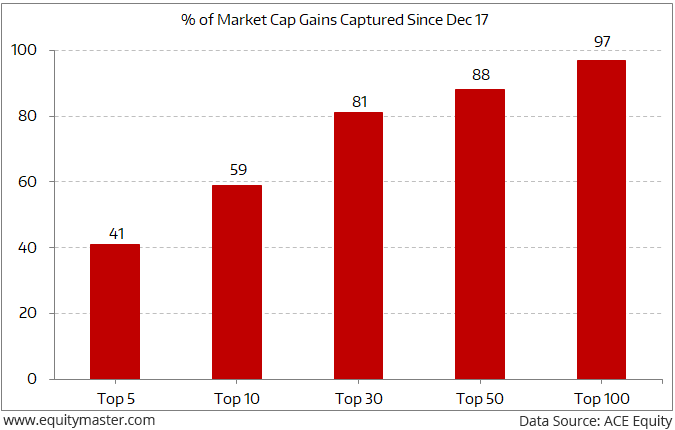
As you can see, the top 5 companies captured 41% of all the gains in market capitalisation over the last two years. In fact, the top 30 stocks captured more than 80% of the gains.
In short, money has been rushing to safety, into large, liquid, bluechips stocks.
This brings the question: Where can you look for such bluechip stocks?
In the news from the IPO space, NSE-backed Computer Age Management Services (CAMS) has filed a draft red herring prospectus (DRHP) with Indian stock market regulator.
The initial public offering (IPO) size is estimated to be anywhere between Rs 15 to 16 billion.
The IPO will be an offer for sale (OFS) of 1,21,64,400 equity shares of face value Rs 10 each. The selling shareholders will include an affiliate of Warburg Pincus namely Great Terrain Investment, NSE Investments, Acsys Investments, HDFC and HDB Employees Welfare Trust.
The offer will have a 50% allocation to qualified institutional buyers, 15% to non-institutional investors and 35% to retail individual buyers.
A portion of up to 1.5% of the post-offer paid up equity share capital will be reserved for an eligible employee.
CAMS is the largest registrar and transfer agent for mutual funds. It offers integrated services for receipt, verification and processing of financial and non-financial transactions for the BFSI sector, largely to the mutual fund industry.
It also offers services such as payment, settlement and reconciliation, dividend processing, record keeping, report generation, intermediary empanelment and brokerage computation and compliance-related services via its proprietary technology platforms and application suites.
The AUM of equity mutual funds serviced by CAMS grew from Rs 2,180 billion in March 2015 to Rs 6,643 billion in March 2019, at 32.1% compounded annual growth rate (CAGR). The same stood at Rs 6,701 billion as of September 2019.
How this IPO sails through remains to be seen. We will keep you updated on all the developments from this space.
Speaking of IPOs, note that the year 2019 didn't see much activity in the IPO market. Since the start of the year, there were just 16 IPOs on the BSE main board.
Even the ones that hit the primary markets were mostly small to mid-sized IPOs. And no mega IPOs.
Very few companies come out with IPOs during bearish market conditions. So, when the IPO market is sluggish, you must take that as an indicator of market sentiment and liquidity conditions.
However, it is interesting to note that despite the tepid market conditions, most of the companies gave positive listing day gains.
In fact, if you had invested in each one of them and held them till now, your gains would have been even better.
So, unlike bull markets wherein selling shareholders do their best to squeeze the highest price, bear markets often offer fantastic opportunities to spot great companies and get onboard early on.
Moving on to the news from the commodity space, the International Energy Agency (IEA) said India's oil demand growth is set to overtake China by mid-2020s.
This will prime the country for more refinery investment but making it more vulnerable to supply disruption in the Middle East.
The agency said that India's oil demand is expected to reach 6 million barrels per day (bpd) by 2024 from 4.4 million bpd in 2017, but its domestic production is expected to rise only marginally, making the country more reliant on crude imports and more vulnerable to supply disruption in the Middle East.
It would be interesting to see how this forecast pans out. We will keep you updated on all the news from this space. Stay tuned.



Comments
Log in or sign up to join the conversation.