

Indian share markets ended their trading session on a positive note today.
At the closing bell, the BSE Sensex stood higher by 137 points (up 0.3%) and the NSE Nifty closed higher by 62 points (up 0.5%).
The BSE Mid Cap index ended up by 1.1% and the BSE Small Cap index ended the day up by 0.1%.
On the sectoral front, gains were seen in the realty sector and auto sector, while IT stocks witnessed selling.
Asian stock markets finished on a mixed note as of the most recent closing prices. The Hang Seng stood up by 0.17% and the Nikkei was trading down by 1.01%, while the Shanghai Composite was trading down by 7.72%.
European markets were trading on a positive note. The FTSE 100 was up by 0.32%. The DAX was trading up by 0.07%, while the CAC 40 was trading up by 0.04%.
The rupee was trading at 71.47 to the US$ at the time of writing.
Speaking of the current stock market scenario, while everyone out there is buzzing about the Union Budget and what it has in store for the stock markets, our analysts at Equitymaster are singing a different tune.
They are encouraging readers to look beyond the short-term blip that the Budget will bring and focus on the long-term trend that will rule the market.
Already, the broader market valuation is looking a lot more attractive than it did a few weeks back.
Some more knee jerk reaction by the stock market and it could turn out to be one the biggest buying opportunities in years.
Also, the smallcap index is rebounding. In fact, it is just 1% below the level it was a year ago.
As per our smallcap analyst Richa Agrawal, you can find a lot of great buying opportunities in the smallcap space and this is a great time to be invested in smallcaps.
In news from the macroeconomic space, the government will soon set up an inter-ministerial group to look at the listing of Life Insurance Corporation (LIC) while stake dilution is unlikely to be more than 10%.
Finance Secretary Rajiv Kumar in an interaction with media persons said that an inter-ministerial mechanism of the department of financial services, Department of Investment and Public Asset Management (DIPAM) and law will work on various parameters of the IPO.
Kumar did not confirm the quantum of dilution, but a government official said it is unlikely to be more than 10%. The IPO is likely in the second half of FY21.
We will keep you updated on all the developments from this space.
Speaking of IPOs, in one of the editions of The 5 Minute WrapUp, Ankit Shah shared how IPOs offer insights into the mood of the stock markets.
He picked the six most successful IPOs of 2019 and checked the retail investor enthusiasm for them.
Obviously, all these IPOs were oversubscribed across investor categories. But the level of retail investor enthusiasm differed widely, depending on the overall market sentiments. This can be seen in the chart below:
Are Retail Investors Back in the IPO Game?
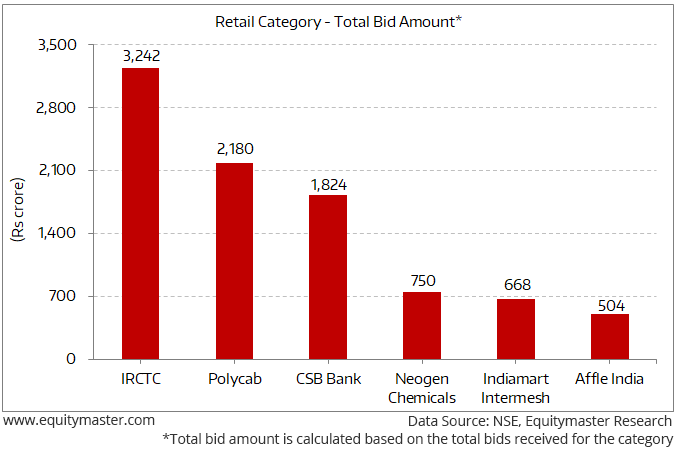
Does this hint that retail investors are coming back to the markets? Could we witness of flurry of IPOs in the coming months?
It would be interesting to see how this trend pans out in the coming months.
In one of his recent articles, he has explained why keeping a tab on the IPO market is vital to your overall investing goals. You can read it here: What I Learnt from IPOs in 2019 (requires subscription).
Moving on to news from the banking sector, the government today reported the non-performing assets (NPAs) of public sector banks (PSBs) stood at Rs 7.27 lakh crore as on September 30, 2019.
Union Minister of State for Finance Anurag Thakur also said in Lok Sabha that scheduled commercial banks and select financial institutions have reported frauds to the tune of Rs 1,133.7 billion in the first half of the current financial year.
Anurag Thakur said as a result of transparent recognition of stressed assets as NPAs, gross NPAs of PSBs, as per the Reserve Bank of India (RBI) data on global operations, rose from Rs 2,790.1 billion as on March 31, 2015, to Rs 6,847.3 billion as on March 31, 2017 and Rs 8,956 billion as on March 31, 2018.
The minister said systematic and comprehensive checking, including of legacy stock of NPAs of PSBs, for frauds under the framework has been taken note of by the RBI in its Financial Stability Report of December 2019, where it has observed that this has helped unearth frauds perpetrated over a number of years.
This is reflected in the increased amount involved in frauds of Rs 1 lakh and above, reported by Scheduled Commercial Banks and select financial institutions, from Rs 239.3 billion in FY17 to Rs 411.6 billion in FY18, Rs 715.4 billion in FY19, and Rs 1,133.7 billion in the first half of the current financial year.
This strict surveillance is surely a step in the right direction and would promote transparency at banks.
How these numbers pan out in the coming months remains to be seen. Meanwhile, we will keep you updated on all the developments from this space.



Comments
Log in or sign up to join the conversation.