

After opening the day flat, Indian share markets witnessed selling pressure and are currently trading in the red. Sectoral indices are trading mixed, with stocks in the IT sector and stocks in the PSU sector witnessing maximum selling pressure.
The BSE Sensex is trading down 100 points (down 0.3%) and the NSE Nifty is trading down 30 points (down 0.3%). Meanwhile, the BSE Mid Cap index is trading down by 0.2%, while the BSE Small Cap index is trading down by 0.1%. The rupee is trading at 63.75 to the US$.
In news from stocks in the banking sector. The government unveiled the first tranche of the massive 2.11 trillion bank recapitalization plan. The government will infuse a total of Rs 881 billion into 20 public sector banks which account for more than 80% of the colossal R s8.4 trillion worth of bad loans.
The money will go to all public sector banks but one - Indian Bank.
11 lenders under the Reserve Bank of India's Prompt Corrective Action will together receive Rs 523 billion or the lion's share of the total amount. These are banks that cannot even meet the regulatory minimum in capital.
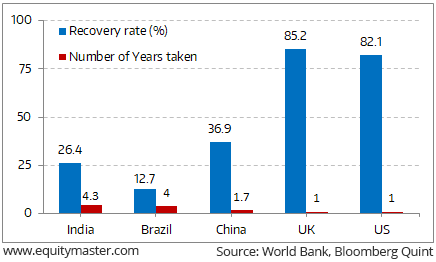
Loan Recovery Data of Major Economies
Public Sector banks (PSB) had a field day on 24th October 2017 after the government's announcement of the recapitalisation plan. Under the plan, it is set to inject Rs 2.11 trillion into public sector banks over a period of two years. State-run bank stocks went up from 30% to 49% in a day.
The government's move was mainly aimed at resolving the long standing non-performing assets (NPA) problem of PSBs. It is expected to shore up the capital of state-run banks, spurring them to clean up the bad loan mess and revive lending.
But if historical data is anything to go by, implementation of such initiatives take a long time, especially in India. Recovery takes the longest time here as compared to other developed nations. India takes an average of 4.3 years to resolve insolvencies as compared to one year in the US. Also, recovery rates in India are amongst the lowest at 26.4%.
Although recapitalisation will benefit PSBs, it appears to be a temporary cure for a recurring disease. The main problem is the lending and corporate governance processes these banks follow. If there is improves in these operational processes, PSBs will continue to underperform in the long term.
Moving on to news from the commodity space. Crude oil prices are growing relentlessly as Brent oil hit the US$ 71 mark for the first time since 2014.
Most of the gains are seen on the back of ongoing support from healthy economic growth as well as from supply restrictions led by a group of producers around OPEC and Russia. These supply cuts are set to last throughout 2018.
Spot Brent crude oil futures, the international benchmark for oil prices, were trading at US$ 71 a barrel.
The rise in crude oil prices was also seen this week after Saudi Arabia, the world's top oil exporter and de-facto leader of the Organization of the Petroleum Exporting Countries (OPEC), said that major oil producers were in agreement they should continue cooperating on production after their deal on supply cuts expires this year.
Note that crude oil prices have been on a rising trend this year. However, this is not good news from India's perspective.



Comments
Log in or sign up to join the conversation.