

Indian share markets witnessed selling pressure in the afternoon session and finished in red for second consecutive session. At the closing bell, the BSE Sensex closed lower by 152 points and the NSE Nifty finished down by 47 points. The S&P BSE Mid Cap finished down by 0.8% while S&P BSE Small Cap finished down by 0.5%. Losses were largely seen in metal stocks, energy stocks and PSU stocks.
Small caps have comfortably outperformed the Large caps and how. The BSE Small Cap Index has returned 21.7% in FY18 compared to 12.5% by BSE 100 and 11.7% by the Sensex.
Small Caps - Outperformers in Current Financial Year
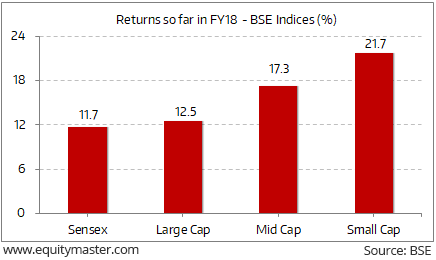
Expectedly, valuations of certain Small cap companies have gone through the roof. It is important to understand the highly volatile nature of these stocks. In a downturn, these stocks tend to move in the opposite direction much faster as well.
While there, undoubtedly, lies hidden opportunities in the small cap space, it is important to focus on fundamentals of these stocks. Next, assess if they have the potential to move on to the 'Safe stock' category in the future.
Asian stock markets finished mixed as of the most recent closing prices. The Shanghai Composite gained 0.06%, while the Hang Seng & the Nikkei 225 fell 0.30% and 0.10% respectively. European markets are mixed to lower. Shares in France are off as the CAC 40 drops 0.07%. The FTSE 100 is down 0.02% while the DAX in Germany is unchanged.
Rupee was trading at Rs 65.06 against the US$ in the afternoon session. Oil prices were trading at US$ 57.09 at the time of writing.
Axis Bank share price gained 3.4% on the reports that the bank was looking to raise as much as US$ 1 billion from a group of investors after an increase in bad loans.
Cipla share price surged 2.1% after the company reported a 17.7% year-on-year increase in consolidated net profit to Rs 4.35 billion in the September quarter, beating market expectations.
In news from the economy, the Fitch group company, BMI Research in its latest report has said that India will remain one of the fastest growing emerging markets, with real Gross Domestic Product (GDP) growth set to average 6.5% over the next five fiscal years, highlighting the ongoing economic reforms and improvements in the business environment to continue to support India's economic growth.
As per the report, insolvency regulation is a positive step in cleaning up the financial system in the country and tax reforms will help strengthen India's fiscal revenues. But it also said that significant bureaucratic inefficiencies are likely to cap the country's growth potential further.
According to the report, India's improvement in the ease of doing business ranking masks the fact that bureaucratic inefficiencies remain rife, as indicated by the stalling of the 2015 Land Acquisition Bill in Parliament and a massive backlog of unresolved cases in courts. BMI Research said that these issues are likely to continue to cap India's growth potential below the 7% level over the coming years, and the country is likely to continue facing challenges in completing large-scale infrastructure projects and establishing a strong manufacturing base.
The report further stated that there has been a surge in foreign investment, which is likely to continue at a as global firm look to tap into India's vast market potential and that pro-business and pro-investor policies are likely to encourage investment.
Moving on to news from engineering sector. As per an article in The Economic Times, Schneider Electric SE, the French industrial multinational along with its consortium partner Temasek, has entered final rounds of negotiations with Larsen and Toubro to acquire its electric and automation division for Rs 150 - Rs 170 billion.
This comes at a time when the company is looking to prune its portfolio and exit non-core areas. The business is relatively short cycle and accounts for only 1% of L&T's US$41bn order backlog (even though it accounts for 6% of core revenue).
Reportedly, In FY17, L&T monetized its stake in its two key IT subs. This, together with the divestment of general insurance business, helped the company to completely fund its investments in Nabha Power and Hyderabad Metro in FY17.
L&T share price finished the day up by 0.6% on the BSE.
Meanwhile, Bharat Heavy Electricals (BHEL) has bagged a major order for setting up two 765 kV substations on EPC (Engineering, Procurement & Construction) basis, in West Bengal. Significantly, valued at over Rs 3.5 billion.
This is the largest value 765kV substation project order for BHEL so far. With this, the company has maintained its undisputed leadership in the 765 kV Power Transmission segment. The order has been placed on the company by Powergrid Medinipur-Jeerat Transmission (PMJTL), a 100% wholly owned subsidiary of Powergrid.
The company is also reportedly aiming at doubling the non-power revenue by 2022 and the projects will be executed on a turnkey basis.
The areas like municipal water, Ganga mission, solar, aerospace, defence and metro and high-speed rail projects have been identified as growth drivers.
BHEL share price plunged 3.4% in today's trade.
In news from automobile sector, Ashok Leyland share price finished down by 2.3% on the BSE after the company reported a standalone net profit of Rs 3.34 billion for the September quarter, fuelled by higher income and increased export volumes, missing street estimates.
The company had posted a net profit of Rs 2.94 billion during the same period of the previous fiscal.
Sales of medium and commercial vehicles in domestic market was up by 22%, the company said adding that volumes of light commercial vehicles were at 9,588 units, an increase of 18%.
In another development, Maruti Suzuki India has reported 6.23% rise in its production to 1,41,269 units in October 2017, as compared to 1,32,980 units in October 2016. Of total, the company manufactured 34,491 vehicles under mini segment in October 2017, as against 35,326 units manufactured in corresponding month previous year.
The company manufactured 67,692 vehicles under Compact segment; 4,358 vehicles under Midsize; 20,786 units under Utility Vehicles segment and 12,848 units under Vans category. The company has also produced 1,094 vehicles under CV segment (including super carry) in October 2017, as against 276 units produced in corresponding month previous year.
Maruti Suzuki share price finished the day up by 0.2% on the BSE.
And here's a note from Profit Hunter:
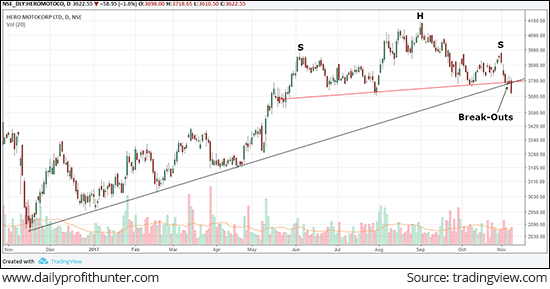
Hero Moto Corp has given multiple break-outs on the chart. Let's have a look.
The stock bottomed out at Rs 2,850 in November 2016 and traded in a strong uptrend tracking the rising trendline. It went on to hit a life high of 4,092 in September 2017. It corrected to 3,660 level before bouncing up. But the bulls couldn't hold the stock up and it reversed down from 3,880 level.
Today, the stock is down 1.6%. What's an interesting thing to watch for is that it has broken below the rising trendline connected from the November 2016 low.
It has also formed a head-and-shoulder pattern on the daily chart. This is a top reversal pattern. Today, the stock broke below the neckline line (red line) of the pattern.
So now will we see the bears taking the driving seat, or it is only a matter of time before the stock resumes its up move. Keep an eye out for it.
Hero Moto Gives Multiple Break-Outs
Comments
Log in or sign up to join the conversation.