

Indian share markets finished the trading day in red as the 25 bps repo rate cut announced by the RBI in its bi-monthly monetary policy statement failed to enthuse investor sentiment.
The RBI monetary policy committee (MPC) announced a 25 basis points cut in the policy rate citing a sharp fall in inflation. As per Livemint, RBI noted that there are several uncertainties to the inflation trajectory such as farm loan waiver impact on state finances and maintained the neutral stance of monetary policy. This is the first rate cut since October 2016 and the interest rate is now at a 6-year low.
At the closing bell, the BSE Sensex closed lower by 98 points and the NSE Nifty finished down 33 points. The S&P BSE Mid Cap finished down by 0.3% while & S&P BSE Small Cap finished down by 0.1%.
Losses were largely seen in software stocks, capital goods stocks and FMCG stocks. Consumer durables stocks and power stocks finished in green.
Asian stock markets finished mixed as of the most recent closing prices. The Nikkei 225 gained 0.47% and the Hang Seng rose 0.24%. The Shanghai Composite lost 0.23%. European markets are lower today with shares in London off the most. The FTSE 100 is down 0.33% while Germany's DAX is off 0.18% and France's CAC 40 is lower by 0.08%.
The rupee was trading at Rs 64.07 against the US$ in the afternoon session. Oil prices were trading at US$ 49.06 at the time of writing.
Bajaj Auto share price fell 0.8% in today's trade after the company registered a fall of 7% in total sales to 307,727 units in July 2017 against 329,833 units in July 2016. The company's total exports out of the above stood at 121,230 units, a fall of 8% as compared to 131,811 units sold in the corresponding month last year.
The sales of the motorcycles decreased by 7% and stood at 265,182 units in the month under review against 285,527 units in July 2016. The company has reported 4% fall in commercial vehicles sales, which stood at 42,545 units as compared to 44,306 units in month of July 2016.
Meanwhile, Hero Motocorp share price finished up by 2.1% after the company sold 623,269 units of two-wheelers in July 2017, registering a healthy growth of 17.1% over the corresponding month of the previous fiscal (July 2016) when the company sold 532,113 units.
This is the third consecutive month of six-lakh plus sales for the market leader in this fiscal, having clocked 624,185 units in June and 633,884 units in May.
Moving on to news from banking sector. As per a leading financial daily, in order to write down non-performing loans and to meet rising Basel III requirements, the public-sector banks (PSU) may need at least Rs 1.9 trillion additional capital over the next two years. Credit rating agency, S&P Global Ratings in its latest report has also noted that the lack of capital will put restriction on the lenders' ability while making haircuts on these loans.
The rating agency said that weak profitability along with rising capital demands from Basel III implementation will also continue to pressure the capitalisation of many of PSU banks and further suggested to look for alternate sources to increase their capitalisation. The report is also expecting that the government's commitment of support to PSU banks will remain in place.
Furthermore, S&P mentioned that weak PSU banks would continue to lose market share to the better-performing private sector banks & profitable PSU banks and non-bank finance institutions or domestic debt capital markets, adding that the banking sector may witness consolidation over time as public-sector banks with lower capitalisation and internal generation of capital could become takeover targets.
Window Dressing by PSBs
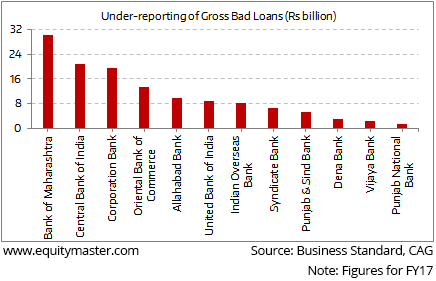
Meanwhile, Private banks have been accused of understating bad loans on their books. But public-sector banks are turning out to be the bigger defaulters. The Comptroller and Auditor General of India has pulled up the managements and statutory auditors of twelve public sector banks for under reporting bad loans and inflating their profits in 2016-17 by making lower provisions. The recognition and provision of bad loans by five of these banks also differed with RBI's audited numbers.
In news from pharma sector, Lupin's first quarter profit fell 59% to Rs 3.58 billion, well below analysts` estimates, as regulatory hurdles and pricing pressure in the United States, its biggest overseas market, weighed.
Revenue of the company fell 13.4% to Rs 38.69 billion from the same quarter last year. The results were below expectations as prices of some products such as Lupin`s generic diabetes drug fell and as domestic sales took a hit due to the implementation of a nationwide goods and services tax.
Lupin share price finished the trading day up by 1.6% on the BSE as the sentiments remained optimistic after the company received approval from US drug regulator for generic lidex ointment.
Pharma stocks finished in red with heavyweights like Sun pharma share price and Dr Reddy's Lab share price finishing down by 2% and 1.9% respectively.
In news from IPO sector, the initial share sale offer of Cochin Shipyard was subscribed 1.41 times till early afternoon trade on the second day of bidding.
The IPO received bids for 4,77,48,420 shares against the total issue size of 3,39,84,000, data available with the NSE till 1230 hours showed.
Cochin Shipyard aims to raise up to Rs 14.68 billion through its share sale offer.
However, we don't need thousands of IPOs to get rich. That's not how super investors make their fortunes. But a few good IPOs could certainly become the multibaggers in your portfolio in a few years.
We have reviewed each of them and have released their recommendation notes. You can check the same on their IPO page.
And here's a note from Profit Hunter:
The Bank Nifty traded a bit erratically as Reserve Bank of India (RBI) announced its monetary policy.
Until the policy was announced, the index was trading in a narrow range in a falling channel. But as the RBI rolled out its policy, the index experienced sharp volatility as you can see in the one-minute chart below. It broke the channel support and resistance lines a number of times.
Most of the stocks on the Bank Nifty Index traded on a negative note. IDFC Bank (-1.60%), Canara Bank (-1.40%), and SBI (-1.10%) were the top losers.
After the policy was announced, the index traded on a volatile note. It fell to a low of 25,032 but recovered immediately to a high of Rs 25,164. But it fell again to a day low of 24,996. After a bit of recovery, the index again hit a new day low of 24,926. Finally, the index ended the session with a loss of 68 points at 25,055.
Market participants were waiting for RBI policy to dictate the index's next trend. So will the policy bring a change to the index's trend or will the Bank Nifty continue it's up move? Let's keep track of it...
Bank Nifty Traded Volatile Post RBI policy


Comments
Log in or sign up to join the conversation.