


The U.S. Senate fell short of advancing the Digital Asset Market CLARITY Act, H.R. 3633, on September 15, 2026. The cloture vote was 49 in favor and 50 opposed, short of the 60 votes required to move it forward. The outcome was a significant setback for legislation intended to establish a federal framework for Bitcoin (BTC.X) and the wider crypto sector.
The bill’s failure leaves unresolved questions about how the United States would oversee digital-asset markets. Supporters presented the measure as a route to clearer rules, while opponents argued its approach did not provide sufficient safeguards. The vote also underscored that disagreements over regulation extend beyond how crypto assets should be valued.
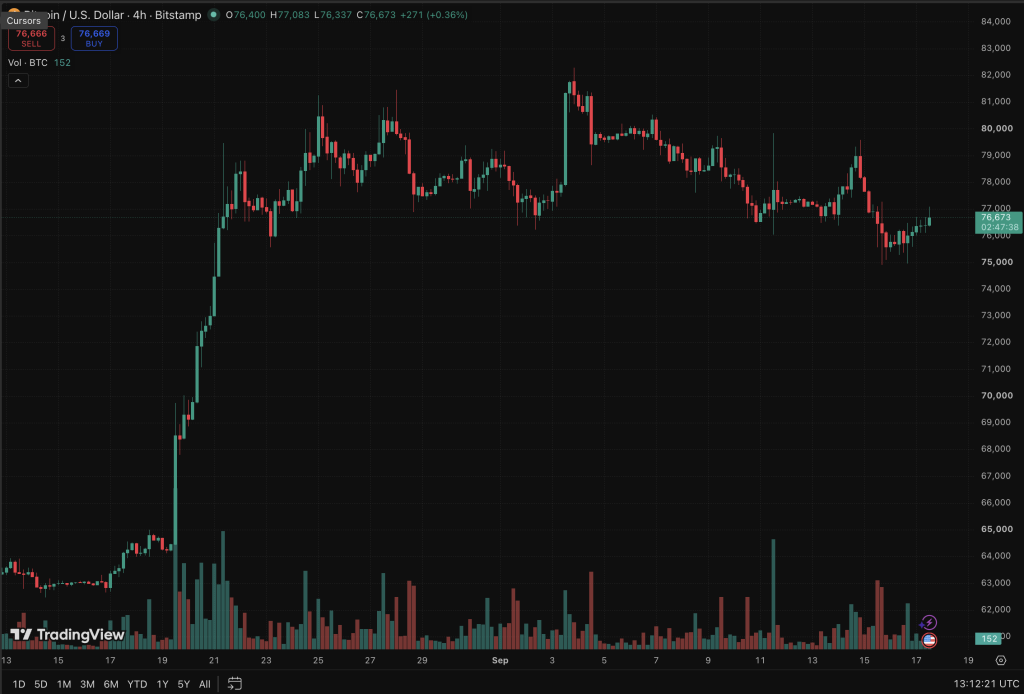
In response to the CLARITY Act vote falling short, the market responded by dropping -0.5%, with the total market cap currently sitting at $2.67 trillion. Daily trading volume is at just over $92Bn.
How the Cloture Vote Fell Apart and What Happens to Bitcoin and the Broader Crypto Market Now?
The Digital Asset Market CLARITY Act aims to create a regulatory framework for digital commodities, dividing oversight between the Securities and Exchange Commission and the Commodity Futures Trading Commission (CFTC).
The CFTC would play a larger role in regulating digital commodities transactions, which has sparked debate. Critics argue this could lead to a less stringent regulatory approach, while supporters contest that view.
The bill includes provisions for trade monitoring, recordkeeping, customer assets, anti-money-laundering obligations, and registration requirements. The House passed a version in 2025, but the Senate debated it for a long time.
During a procedural vote on September 15, all Democrats and four Republican senators voted against it. Senator Thom Tillis moved to reconsider the vote, indicating the measure is not finished and that the House and Senate still need to agree on a final version.
Value Versus Regulation: Coinbase (COIN) Vice Chair Calls for Regulatory Clarity
The Senate vote highlights two separate debates often combined in discussions of Bitcoin and the broader crypto market. One concerns whether digital assets have enduring value.
The other concerns the rules governing their issuance, trading, and oversight. The CLARITY Act was focused on the latter question: establishing a legislative framework for a sector that currently faces changing regulatory approaches across administrations.
Before the vote, Coinbase vice chair Ryan VanGrack argued that many Americans were investing in products without clear regulatory oversight and said regulation should matter regardless of a person’s view of Bitcoin and crypto in general.
His argument treated a workable regulatory structure as an urgent issue for the sector. The bill’s opponents, however, questioned whether its proposed safeguards and distribution of authority were adequate.
Who Bears the Regulatory and Market Consequences
Democratic concerns included an ethics clause to prevent elected officials from profiting from Bitcoin and the wider crypto industry while in office, though critics felt it was insufficient.
Republicans proposed stricter language barring federally elected officials and spouses from issuing cryptocurrencies and requiring divestment of major holdings, but disagreements remained.
Community bank leaders opposed parts of the bill related to stablecoins, arguing that allowing crypto companies to offer interest-like incentives could let them compete unfairly with traditional banks.
Crypto companies countered that these incentives were similar to credit card rewards. Bankers said losing local deposits would limit their ability to support small businesses and agriculture.
The legislation could be reconsidered, but with the November midterms approaching, its passage may be more challenging. A shift in control of Congress could further complicate matters, leaving the crypto sector uncertain about a market-structure framework that meets the needs of both supporters and critics.



Comments
Log in or sign up to join the conversation.