


Just a quick post to close out our conversation of distributions that return capital (ROC). At the end of yesterday's post, I said that if there wasn't already, there soon would be a way to build a portfolio that pays almost entirely ROC and that diffuses issuer risk for the few circumstances where a lot of ROC is preferable.
Derivative income funds are not insanely complex other than autocallable funds if you count those, but there are some moving parts, and while the odds of a malfunction seem extremely low, it's not the same thing as buying SPY or VOO. Looking closer, there are enough funds to diffuse issuer risk.
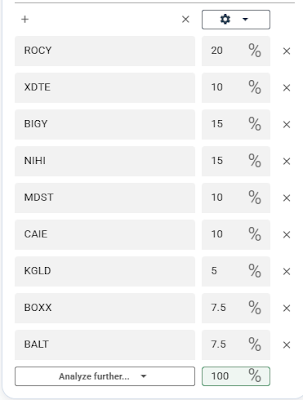
We've talked about ROCY; it is slightly less volatile than the other broad-based domestic ETFs listed. XDTE is borderline crazy high "yielding" at 20%, and its distributions have been 100% ROC. BIGY is a YieldMax product that sells call spreads against the 50 largest US stocks, and its distributions are almost always more than 95% ROC, but there have been several exceptions. NIHI is from Neos and gives some foreign exposure; Neos does a good job paying ROC. We've mentioned MDST a few times, it has been paying 100% ROC thus far. CAIE is an autocallable ETF that pays ROC. We mentioned ACSP as being a more volatile autocallable that says it will also pay ROC. MPIM is another new autocallable fund that says it intends to pay ROC; we'll see. KGLD yields 14%, references gold, and has been running 86% of its distributions as ROC. BOXX and BALT are fixed income proxies that don't pay anything, which is good in this context.
It's kind of a complete portfolio... kind of: domestic equities, foreign equities, some natural resource exposure, and fixed income (substitutes). To be clear about ROCY, XDTE, and BIGY, those funds diversify issuer risk; there's really no meaningful diversification looking through to the holdings. The large-cap domestic equity sleeve of this portfolio is 45%. If we just wanted that 45% in simple market-cap-weighted, then one fund would do. This is an aggressive strategy, so we are diversifying the issuer risk. It would probably be ok to put all 45% in ROCY, but that seems unnecessary in case there's something crazy that comes along, crazier than the craziest black swan.
The backtest is useless in terms of assessing growth rates; it's only six months. I think there could be some information in the volatility numbers, though.

The ROC Palooza portfolio also has a slightly lower standard deviation.
I asked Claude if it was reasonable to expect that the volatility characteristics could endure, and it said mostly yes, but it was worried about volatility shocks. I pushed back, asking about the Volmageddon event of early 2018. It told me to get the info from testfol.io, there it is below. They did a little better. Claude thought the fast decline at the end of 2018 could also be thought of as a volatility shock, and the fund's derivative income funds did a little better.
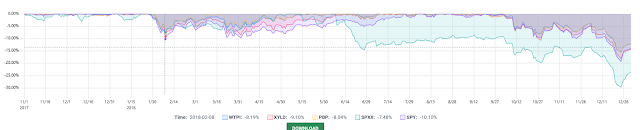
It's not the end of the world if ROC Palooza looks like VBAIX on a total return basis. KGLD could go up a little if stocks go down, I suppose, but to the extent gold tends to go up when stocks struggle, maybe KGLD could avoid going down. We'd need to add BTAL or managed futures if we wanted more reliable negative convexity in the portfolio.
This is an aggressive idea, as I have been saying, but it could be plausible, and although there aren't a lot of fund choices yet, we did cover a lot of bases in today's first iteration. Someone really wanting to add more defense could swap BTAL in for either BOXX or BALT.


Comments
Log in or sign up to join the conversation.