


The yield on the 30-year French government bond exceeded 4.7% on July 16, breaking a record that had stood since mid-October 2008 — at the height of the subprime crisis, one month after the collapse of Lehman Brothers. On July 22, the 10-year bond reached 4.06%, a level not seen since the end of the Great Financial Crisis.
We are certainly facing a new crisis, with the resumption of war in Iran and soaring oil prices, but the situation remains incomparable to the panic that reigned after the collapse of the major U.S. investment bank. At the time, markets feared a domino effect and a wave of bank failures comparable to that of the 1929 crisis.
Nevertheless, this is enough to put significant pressure on long-term interest rates: “UK 30y yields have climbed to 5.73%, US yields to 5.14%, Japan to 3.89% and Germany to 3.65%. Most striking: Japan now yields more than Germany after decades of near-zero rates.” (Holger Zschaepitz).
France, however, appears to be “particularly ill-positioned” amid this general rebound, according to Alexandre Baradez, head of market analysis at IG France, due in particular to political uncertainty. The spread between French and German 10-year bond yields has widened in recent weeks to reach 83 basis points. However, “This range of 80 to 90 basis points for the spread is the same level reached in the months following the dissolution of the National Assembly in 2024.”
Another, more structural problem is also resurfacing: France’s growing dependence on international investors. “Non-residents” hold an ever-larger share of the government debt. This proportion had fallen below 50% in 2022, but has since risen steadily to reach 57.5%, according to the latest figures from Agence France Trésor (AFT).
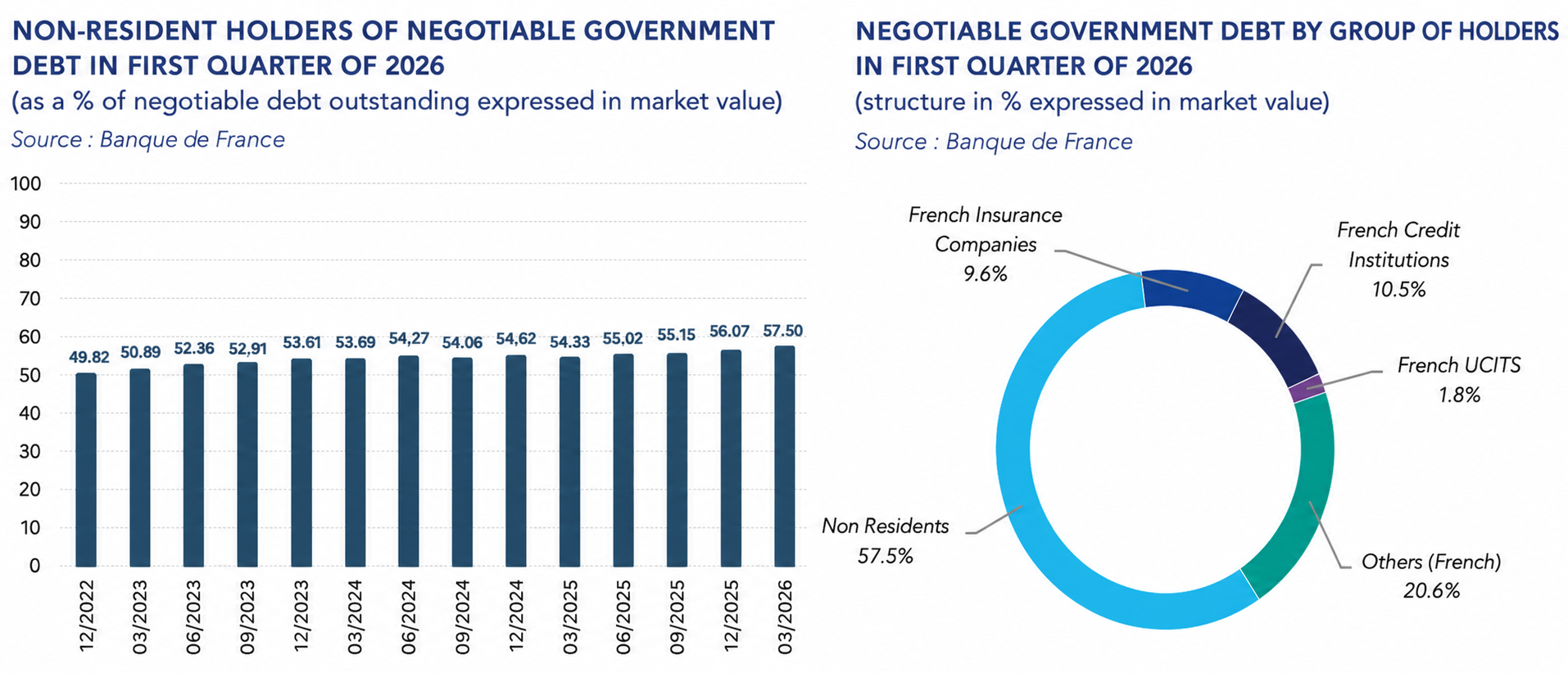
Source: Agence France Trésor
The other holders are French banks and insurance companies, and the Banque de France (20.6%, “others” category), as part of the public debt purchases initiated by the European Central Bank (ECB) but carried out in practice by the national central banks. This is commonly referred to as “printing money.” It operated at full capacity during the COVID crisis and helped drive interest rates down to near-zero levels. That is now over; real buyers must be found, and they are demanding increasingly higher interest rates.
The Bank of France recently warned, in fact, about the increasingly significant role played by so-called “alternative” funds or hedge funds in holding French sovereign debt. These are players drawn by the smell of blood, seeking to force market reversals and compel governments to capitulate so they can pocket the profits. The most iconic example remains that of George Soros, who helped drive the British pound out of the European Monetary System in 1992. The mere fact that these funds are now taking positions on French debt should be cause for concern.
Lacking the political will to rein in its budget deficit, France is becoming increasingly dependent on economic conditions, market tensions, and players willing to do anything to profit from the situation. A public debt crisis could erupt at any moment.



Comments
Log in or sign up to join the conversation.