

The headline, fictional, seasonally adjusted (SA) number of initial unemployment claims for last week came in at 264,000, beating the Wall Street conomist crowd consensus guess of 285,000. For the second time in 3 weeks the mainstream media headline writers crowed about the 15 year record low. In reality, on the basis of the actual data before seasonal maladjustment, the numbers have consistently been at, near, or below record lows since September 2013, suggesting an overstretched, bubble economy at full boil for 20 months.
The Department of Labor also reports actual, unmanipulated numbers. This week it said, “The advance number of actual initial claims under state programs, unadjusted, totaled 242,640 in the week ending May 9, an increase of 6,219 (or 2.6 percent) from the previous week. The seasonal factors had expected an increase of 7,430 (or 3.1 percent) from the previous week. There were 270,738 initial claims in the comparable week in 2014. ”
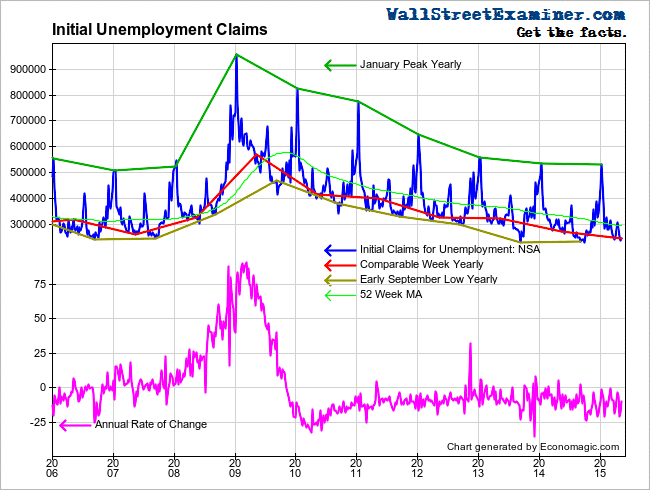
Initial Claims and Annual Rate of Change- Click to enlarge
In terms of the trend over the longer term, actual claims were 10.4% lower than the same week a year ago. Since 2010 the annual change rate has mostly fluctuated between -5% and -15%. This week’s data was in the middle of that range.
On the basis of the week to week change was near the average reading for this week of May. This week is a swing week with some up weeks but mostly down weeks in the prior 10 years. The actual decline of 6,000 (rounded) compared with the 10 year average decrease for that week of 5,600 (rounded). Claims decreased by 18,000 in the comparable week last year.
There were 1,715 claims per million of nonfarm payroll employees in the current week. This was a record low, well below the May 2007 level of 1,897 record low for that week of May. That occurred well after the peak of the housing bubble but before the carnage of mass layoffs that was to begin later that year.

Record Low Claims Per Million Workers- Click to enlarge
At the last bubble peak in 2006, claims began to increase late in that year. The housing bubble had already peaked a few months earlier but the stock market continued on its merry way for 9 more months, not finally ending its run until September 2007. A clear breakout in the number of claims toward the end of 2006 gave plenty of advance warning that all was not well, before stock investors got a clue. Conversely, at the 2000 top, claims had given little advance warning. They began to break out concurrently with the top in stock prices through midyear 2000. We cannot know in the current case whether claims will begin to weaken before stock prices turn down, but it should at least be concurrent with the turn in stock prices.

Initial Claims Inverted and Stock Prices- Click to enlarge
We have noted before in these updates that the oil price collapse may be analogous to the housing bubble peak in 2006. The impact of the oil price collapse started to show up in state claims data in the November-January period. While most states show the level of initial claims well below the levels of a year ago, in the oil producing states of Texas, North Dakota, and Louisiana, claims have been above year ago levels since the turn of the year. North Dakota and Louisiana claims first increased above the year ago level in November. Texas reversed in late January. Another oil producing state, Oklahoma, joined the wake subsequently.
With the rebound in the price of oil over the past several weeks, the increase in the number of unemployment claims in the oil states has moderated but they remain above year ago levels. In the most current state data, for the May 2 week, Texas was up 4% (vs. +13% in the previous week), Louisiana +10% (vs. +22%), and North Dakota +52% (vs. +72%). Oklahoma was up by 29% (vs. + 35%). There’s been wide variance in these numbers week to week. Therefore it is questionable whether the week to week improvement in the current data is an indication of an improvement in the trend. It does indicate that oil industry layoffs have slowed.
In the May 2 week, 9 states had more claims than in the same week in 2014. That was down from 14 the prior week. This number fluctuates widely week to week with many states near even. At the end of 2014, 8 were up year to year. At the end of the third quarter of 2014 there were just 5 but in early April the number had risen to 22. The impact of the wave of oil layoffs has subsided for now.
I track the daily real time Federal Withholding Tax data in the Wall Street Examiner Professional Edition. The year to year growth rate in withholding taxes in real time is now running +5.8% in nominal terms. This is down from a peak of over 8% in February, but up from +5.2% a month ago. It is a strong number that supports the likelihood of a gain in May payrolls similar to April’s. This week is the reference week for the May payrolls survey.
The claims data shows no sign of cooling in this financial engineering bubble economy, with even the oil patch layoffs being cut back. This will continue to encourage the Fed to engage in the charade of pretending to raise interest rates sooner rather than later. The real problems will start when the Fed finds that in order to get rates up, and keep them up, it will need to begin shrinking its balance sheet. Stay tuned the Professional Edition Fed Reports as I chronicle that soap opera there.



Comments
Log in or sign up to join the conversation.