

The anticipated economic recovery is now facing one of its most severe tests as real wages confront the recent surge in consumer prices. The real action, so to speak, will be just how consumers are going to react to these price increases, even if they prove to be transitory. The recovery process will hinge largely on whether consumption can be maintained as supply disruptions result in recent price increases in both immediate and consumer products.
We are constantly made aware of labor shortages in many industries, most notably the hospitality sector, as employers offer higher wages and even signing bonuses to entice workers. But we must not be swayed by specific issues facing that sector to conclude that workers are now enjoying significant increases in wages and salaries during this recovery period. Quite the contrary.
The most recent numbers from the US Bureau of Labour Statistics confirm that, after adjusting for inflation, 'real average hourly earnings' and 'real average weekly earnings' have declined over the past 12 months. Put differently, average income growth has failed to match the increase in consumer prices during this period of economic recovery. Real hourly earnings are less than $10 per hour and that has not changed for nearly two decades. In addition, there has been no increase in the average hours worked per week. The combination of these two factors results in a reduction in real average weekly earnings. On average, the US workers are not participating in this recovery process, but rather are struggling just to hold their own.
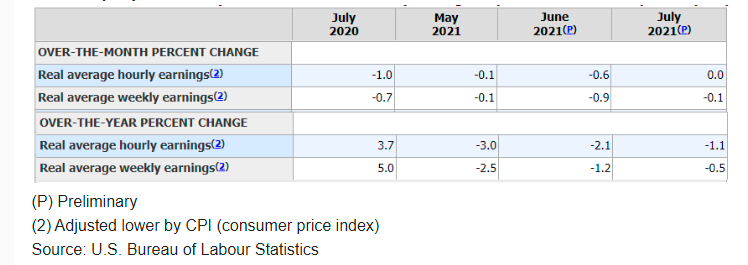
The challenge to the worker comes in those areas where product demand is inelastic, that is, where there is no immediate cheaper substitute. This is surely the case in the purchase of energy, basic foodstuffs, and rent. Where demand is inelastic, the consumer has no choice but to spend more income at the expense of reducing consumption of products/services that are purely discretionary. To the extent that discretionary purchases---eg travel, entertainment--- are curtailed, the cumulative effect is deflationary in the sense that economic growth slows. The recovery cannot be sustained if more income is devoted to the purchase of the necessities of living.
It could be argued that the consumers have amassed considerable savings during the lockdown periods. Many economists have argued that these enormous savings will push the economy over the finish line on its road to recovery. Given the growing uncertainty of new waves of virus infections, it is a huge stretch to expect the consumer to be insensitive to price increases driving down real wages and to call upon savings to satisfy discretionary spending. Today’s release of a CNBC survey confirms “ the rise of the delta variant.. is disrupting reopening plans across the country and introducing even more uncertainty on Main Street”(Uncertainty is back). To the extent that small business provides the vast majority of jobs, real wages will continue to be under pressure in a world dominated by such uncertainty.



Comments
Log in or sign up to join the conversation.