

Oil moves dominate rates direction at the start of the week, although US CPI looms large on Wednesday. In Europe, French budget risks and upcoming elections keep spreads vulnerable, but oil correlations make clean political relative value extraction difficult.

In the eurozone, 10y spreads over swaps have once again been driven by changes in oil prices.
Tricky relative value extraction amid geopolitics
One of the main drivers of rates market direction remains US economic data and its implications for Fed expectations. Here, the next key release in focus is Wednesday’s CPI report. The other driver is geopolitics and the dimming hopes of an imminent reopening of the Strait of Hormuz. This has seen oil prices rise again at the start of the week, dragging rates higher; 10y US Treasury yields reached 4.7% and the German Bund is closing in on 3.2%.
In Europe, a summer drawing to a close soon will also mean a resumption of regular government bond supply and a focus on budget negotiations into autumn. For obvious reasons, the main attention here falls on France. Budget consolidation efforts are hampered by the challenging macro backdrop as well as domestic political uncertainty. All eyes are on the presidential elections early next year, in particular after Le Pen announced her plans to enter the race.
At close to 80bp, the 10y benchmark spread of French government bonds versus German Bunds is already at the upper end of its range since summer 2024, when the call for snap legislative elections marked the beginning of French political turmoil. Looking ahead, negative headlines coming out of budget negotiations or around the upcoming French elections are still anticipated to bring about bouts of bond spread widening.
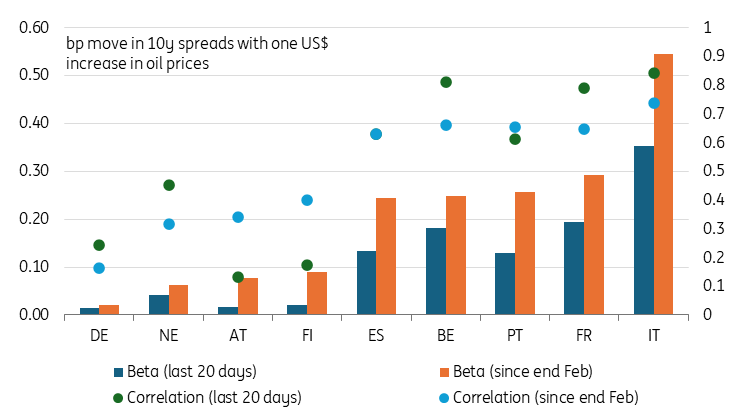
However, looking at 10y spreads over swaps for the semi-core and periphery countries, we also see that they have become very much driven by geopolitics again of late, specifically the price of oil. While the associated betas of the individual country spreads – i.e. the size of spread moves on given changes in oil prices have come down somewhat – the 20-day rolling correlations have risen back towards 0.6 to 0.8. For France, that correlation value stands at 0.79, with a value of one indicating perfect correlation.
This already shows the difficulty of isolating political relative value themes from the geopolitical noise. Even intra-country spreads are still highly correlated to oil. If we look at the 10y spreads of France over Italy – which, given the similar spread levels, would be an obvious choice to trade France deficit challenges – a quick regression analysis for data since the start of the year suggests that oil explains more than 80% of the variation. Using Belgium as a peer for France leaves one less exposed to geopolitics, with oil explaining less than 15% of the variation. However, that comes at the cost of higher negative carry given the roughly 20bp spread differential in the 10y area.
Spread correlations with oil remain high, although betas have come down
Tuesday’s events and market view
Geopolitics aside, calendars still hold little for markets to trade on, with all eyes on Wednesday’s US CPI. Tuesday sees the US release of the NFIB small business confidence indicator, existing home sales, and the weekly ADP employment change. The NY Fed also releases its quarterly household debt and credit report.
The government bond supply side sees more action, with Germany auctioning 5y bonds (€6bn) and Finland selling 10y and 17y bonds (€1-1.5bn). The US Treasury later auctions new 3y notes (US$58bn).



Comments
Log in or sign up to join the conversation.