

US strikes against Iran send oil prices higher again. However, it is real rates that are posing upward pressure on the entire curve, but divergences in real-term spreads between US, UK and eurozone markets should narrow at some point.
Divergences in real term spreads unlikely a stable equilibrium
The latest US strikes on Iran in reaction to the attacks on ships in the Strait of Hormuz have sent oil prices higher, with Brent topping US$76/bbl. The feed-through to rates via front-end pricing is clear, and markets, for instance, are back to more than fully pricing another hike from the ECB before the end of the year.
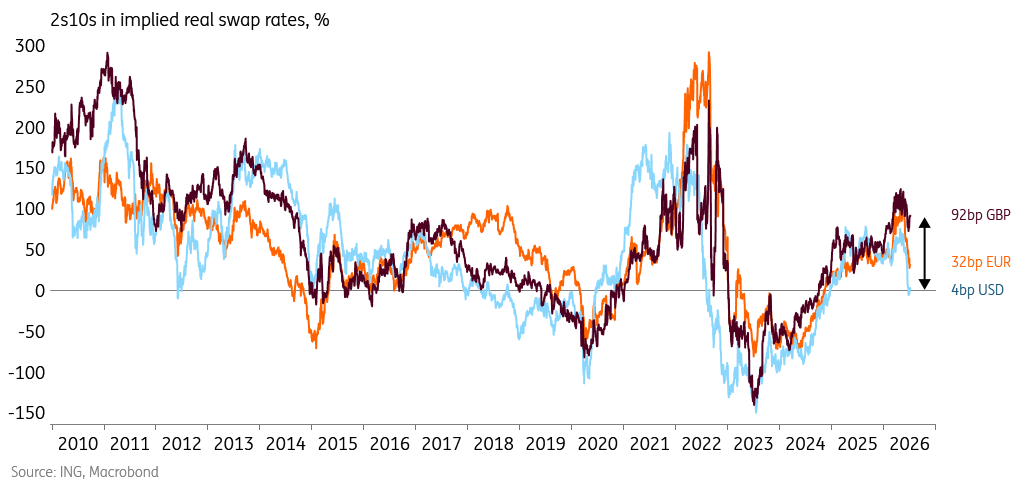
But real rates have been a driving force of global rates over the past weeks and are likely to keep volatility elevated going forward. Historically, we see that global 2s10s swap curves in real terms correlate tightly, but more recently we have observed significant divergences. Global risk premia tend to move in sync and the figure below highlights the strong co-integration of term spreads of developed markets. Over time, the 2s10s curves seem to converge to similar values, which is consistent with the idea of converging risk premia.
Before the start of the Iran conflict, the term spread seemed to be stabilising around 50bp for USD, EUR and GBP rates. But in recent weeks the USD 2s10s has almost fully flattened in real space, while the sterling curve is a steep 90bp. For both currencies, we think markets are positioned as too hawkish, and thus we see downside potential for 2y real rates. A front-end repricing lower would help steepen the USD 2s10s without the 10y having to do much. In contrast, the already steep GBP curve means that 10y sterling rates should have more room to follow lower in case of a front-end repricing.
Historically, real term spreads tend to converge over time
French presidential elections: Markets want to see fiscal improvements, regardless of who brings them
Markets have shown muted reaction to the headlines surrounding Le Pen, who has now decided to enter the presidential race. One reason is that with Jordan Bardella, the RN would have had someone to send into the race in her place who was even slightly ahead in the opinion polling.
The market’s main concern remains the country’s fiscal trajectory. Current economic headwinds make it more difficult to bring down the deficit, and political uncertainty also muddies the trajectory for coming years.
Spreads of 10y French government bonds over their German peers have widened back towards the 80bp mark over the past weeks, although the level overstates widening somewhat given a maturity mismatch between the current benchmark bonds. Expect it to even out by a couple of basis points when Germany launches its new 10y Bund benchmark. But looking at an interpolated 10y spread, we are more or less at the average spread going back to when snap elections were called in June 2024, setting off the more volatile environment for French bonds. As such, we still think that markets are lacking the clarity and confidence for material relief in spreads, and see it as more likely they will start testing the wider end of the range from here as we get closer to the next budget negotiations and the April 2027 elections.
Wednesday's events and market views
Central bank communications will remain in focus. In part, because there is little other data to observe. But with a busy slate of ECB speakers and the FOMC minutes of Kevin Warsh’s first Fed meeting, some interest seems assured. The events in the Strait of Hormuz sending oil prices higher again gives ECB speakers the backing for a more cautious and guarded approach, leaving a September hike well in play. Scheduled to speak are Nagel, Dolenc, Kocher and Moulin. On Thursday the ECB will publish the accounts of its last meeting.
In primary markets, Germany will auction a new 10y Bund benchmark for €6bn. Portugal sells 10y and 15y bonds for €1.5bn. The UK will hold tenders for gilts maturing in 2028 and 2030 for £0.75bn each. In the US, the Treasury sells US$39bn in 10y notes.
Comments
Log in or sign up to join the conversation.