

Key Takeaways
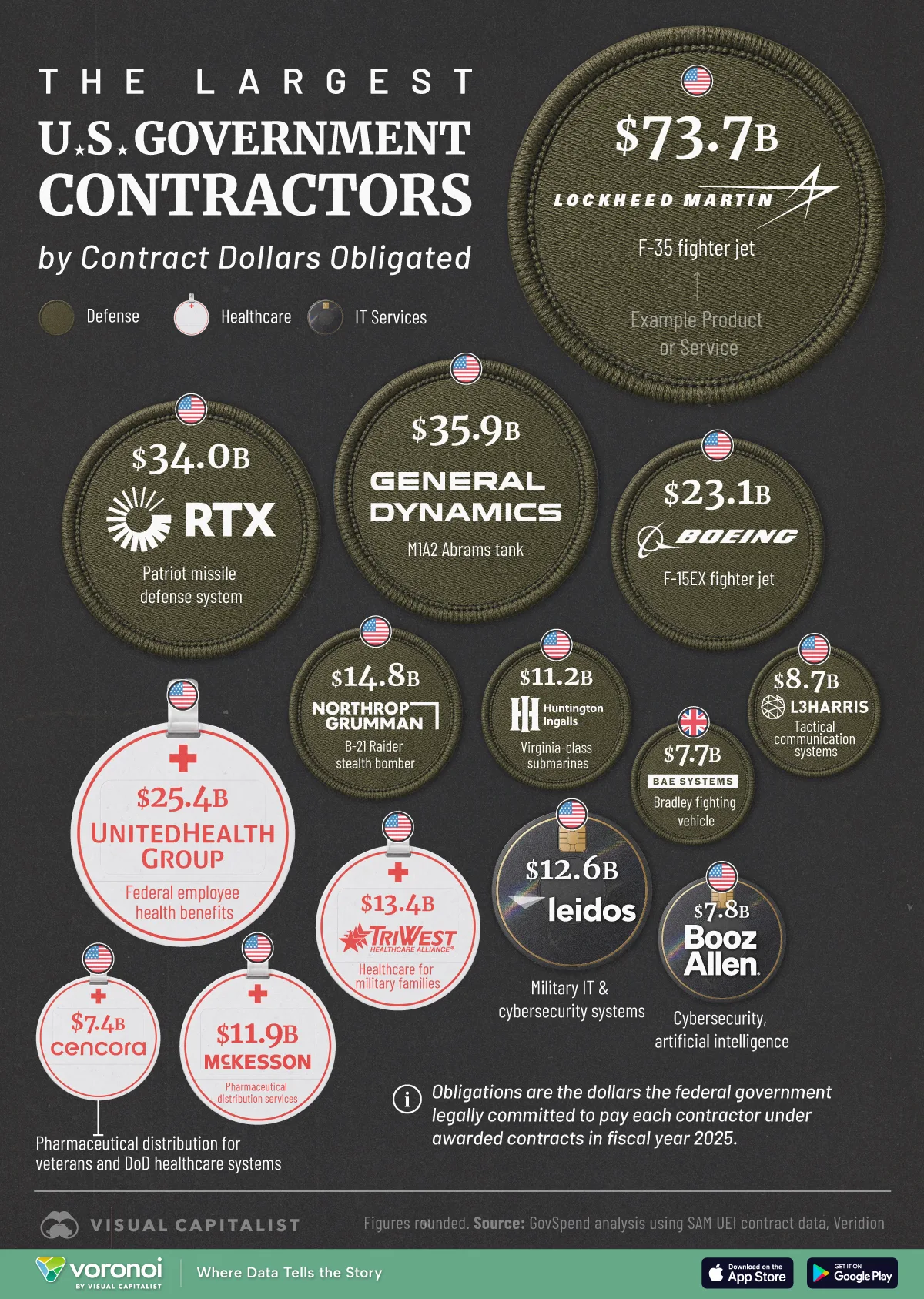
Lockheed Martin (LMT) received $73.7 billion in federal contract obligations in FY 2025, more than double the next-largest contractor.
Defense firms dominate the ranking, accounting for eight of the top 14 contractors.
Healthcare and IT companies also receive billions in federal spending through benefits administration, pharmaceutical distribution, and cybersecurity contracts.
The U.S. government spends hundreds of billions of dollars each year on private-sector contracts, but a relatively small group of companies receives a large share of that spending.
In fiscal year 2025, Lockheed Martin led all contractors with $73.7 billion in obligated spending, more than twice the amount awarded to the next-largest recipient.
This ranking shows the companies receiving the most federal contract obligations, spanning defense, healthcare, pharmaceutical distribution, and IT services.
The data for this visualization comes from GovSpend, using SAM UEI contract data and analysis from Veridion.
Defense Contractors Dominate Federal Spending
A handful of defense companies account for a significant share of federal contract spending.
Lockheed Martin alone received $73.7 billion in FY 2025, more than double the amount awarded to General Dynamics (GD), the second-largest contractor on the list. The scale of Lockheed’s lead reflects the government’s continued investment in major defense programs such as the F-35 fighter jet.
Company Name | Gov't Spending (2025) | Example Product / Service | Industry |
|---|---|---|---|
Lockheed Martin | $73.7B | F-35 fighter jet | Defense |
General Dynamics | $35.9B | M1A2 Abrams tank | Defense |
RTX (RTX) (Raytheon) | $34.0B | Patriot missile defense system | Defense |
UnitedHealth Group (UNH) | $25.4B | Federal employee health benefits | Healthcare |
Boeing (BA) | $23.1B | F-15EX fighter jet | Defense |
Northrop Grumman (NOC) | $14.8B | B-21 Raider stealth bomber | Defense |
TriWest Healthcare Alliance | $13.4B | Healthcare for military families | Healthcare |
Leidos (LDOS) | $12.6B | Military IT & cybersecurity systems | IT Services |
McKesson (MCK) | $11.9B | Pharmaceutical distribution services | Healthcare |
Huntington Ingalls Industries (HII) | $11.2B | Virginia-class submarines | Defense |
L3Harris Technologies (LHX) | $8.7B | Tactical communication systems | Defense |
Booz Allen Hamilton (BAH) | $7.8B | Cybersecurity, artificial intelligence | IT Services |
BAE Systems (BAESY) | $7.7B | Bradley Fighting Vehicle | Defense |
Cencora (COR) | $7.4B | Pharmaceutical distribution for veterans and | Healthcare |
General Dynamics follows Lockheed with $35.9 billion, while RTX ranks third at $34.0 billion. Together, these three companies account for a major share of spending among the top contractors.
Other large defense firms on the list include Boeing, Northrop Grumman, Huntington Ingalls Industries, L3Harris Technologies, and BAE Systems. Their contracts cover aircraft, missiles, submarines, combat vehicles, and military communications systems.
Healthcare Is Another Major Contracting Category
While defense dominates the ranking, healthcare is the second-largest category among top contractors. UnitedHealth Group ranks fourth overall with $25.4 billion in obligated spending, making it the largest non-defense contractor on the list.
Several other healthcare organizations also rank among the government’s biggest vendors. TriWest Healthcare Alliance supports military family healthcare programs, while McKesson and Cencora help distribute pharmaceuticals across federal healthcare systems.
Healthcare procurement includes veterans, service members, federal employees, and public health systems.
IT and Cybersecurity Firms Play a Growing Role
Federal spending increasingly extends beyond physical equipment and healthcare services. IT and cybersecurity contractors now play a critical role in supporting military operations, government agencies, and digital infrastructure.
Leidos received $12.6 billion in obligated spending in FY 2025, while Booz Allen Hamilton received $7.8 billion. Their work spans cybersecurity, artificial intelligence, data systems, and mission-critical technology platforms.
Comments
Log in or sign up to join the conversation.