


From Bloomberg:
The US is proposing new tariffs of at least 10% on imports from 60 trading partners, following an investigation into how trade partners handle goods allegedly produced by forced labor.
A 10% tariff rate would apply to imports from Canada, Mexico, the European Union, Taiwan and the UK, among other places, while products from other major economies, including China, India, Japan, South Korea, Brazil and Switzerland, would be subject to a 12.5% levy.
Regardless of one’s views regarding the degree of cynicism
embodied in such a proposal, my view is that this can only serve to further elevate trade and economic policy uncertainty.
While most commentary asserts that Section 301 tariffs are more legally defensible, the view is not unanimously held. Wolff at PIIE writes, regarding Section 301:
The language is clear: It addresses the “act, policies, and practices of a foreign country” using the singular. There is no indication that the Congress meant “one or more, or multiple foreign countries,” to be addressed all at once
…
For this reason, sweeping use of retaliatory authority to impose tariffs covering most US imports is unlikely to survive judicial review. This is true notwithstanding the considerable deference courts ordinarily give the president or the US Trade Representative in determining what constitutes “unreasonable” conduct in foreign economic relations. The Constitution assigns the broad tariff power to Congress, not the executive. That body stopped applying tariffs comprehensively after enacting the Smoot-Hawley tariff in 1930, and ever since has rejected doing so as bad policy.
To the extent that there will remain uncertainty regarding the implementation and durability of these Section 301 tariffs, the important point is that uncertainty will remain.
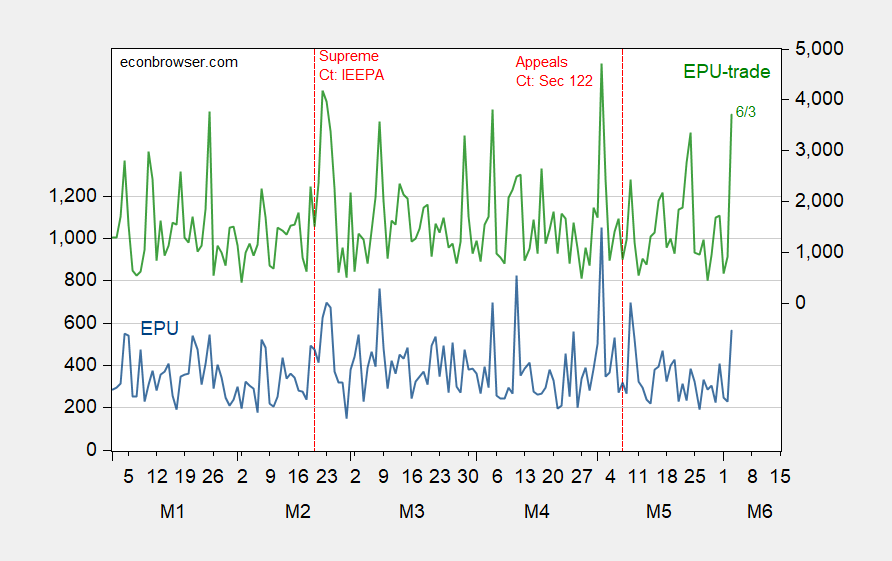
Figure 1: Economic Policy Uncertainty (blue, left scale), EPU-Trade Category (green, right scale). Source: policyuncertainty.com.
The above graph covers only 2026. I think we are becoming desensitized to the fact that uncertainty is at persistently high levels.
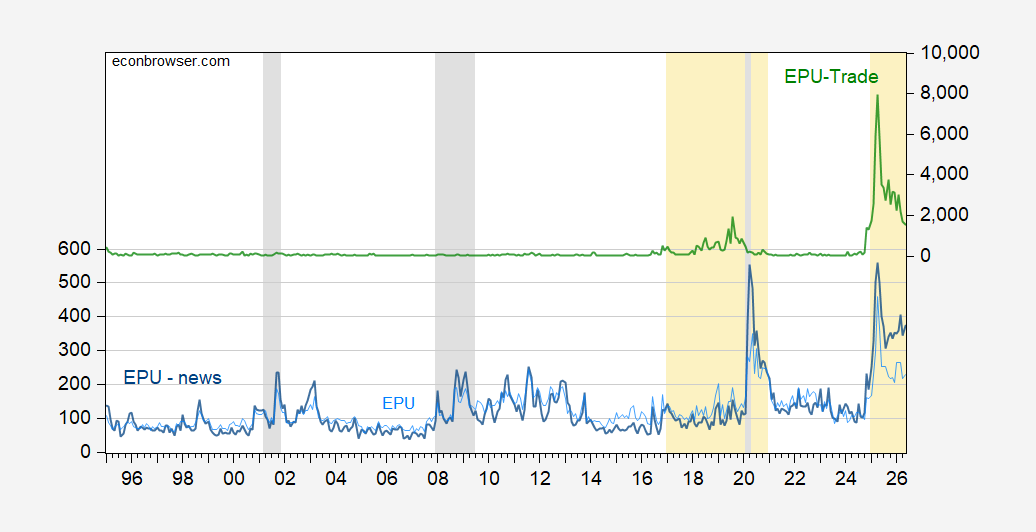
Figure 2: EPU-news (blue, left scale), EPU-baseline (light blue, left scale), EPU-Trade Category (green, right scale). NBER defined peak-to-trough recession dates shaded gray. Source: policyuncertainty.com, NBER.
Trump’s pursuit of the Section 301 avenue guarantees that there will not be a respite from economic uncertainty in the near future.

Comments
Log in or sign up to join the conversation.