


This is an update to my last article Projected Drop Of DJIA Underway.
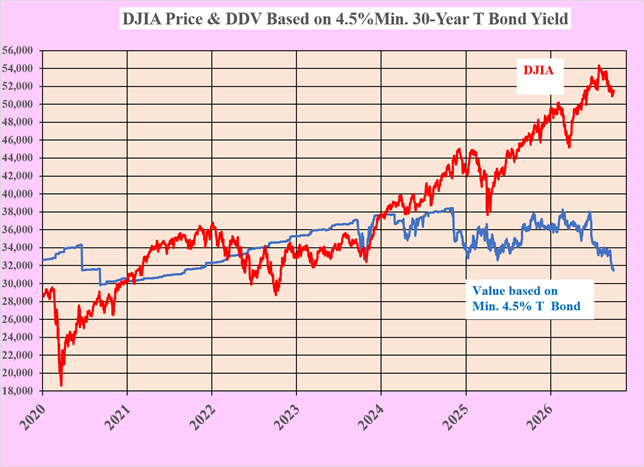
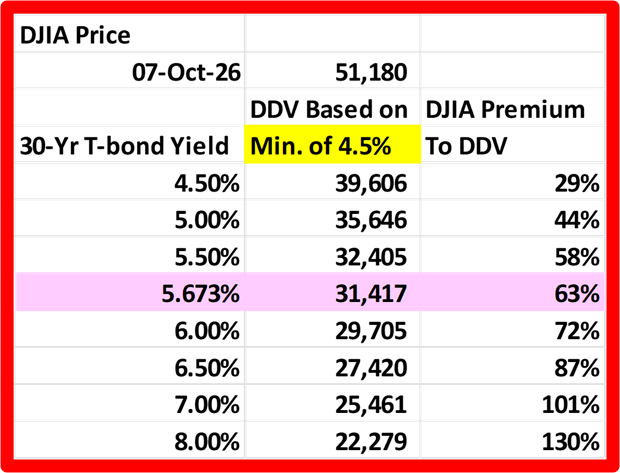
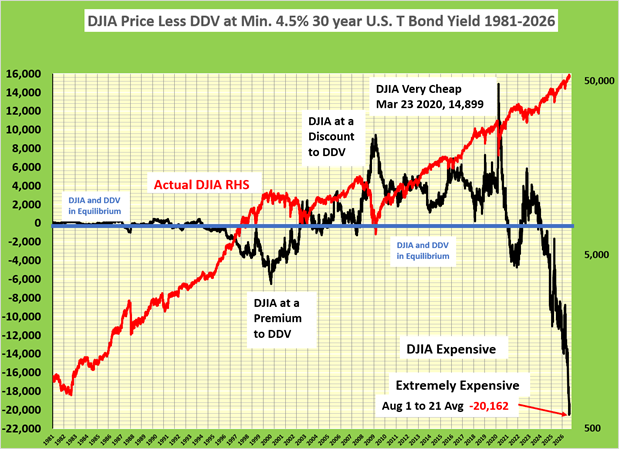
The DJIA peaked at 54,349 in early August and is now at 51,180. Its DDV is has also declined from a peak of 33,986 to 31,417 as the yield on the 30-year T-bond has risen from 5.25% to 5.67%. As a result of the 5.6% drop in the DJIA price and the 9% decline in its DDV the premium of the DJIA over its DDV has fallen only 4.8% to -19,673. A move in the right direction, but the market remains extremely expensive as it was during October 1987 and the Dot Bomb boom, shown on a percentage basis in the second chart.
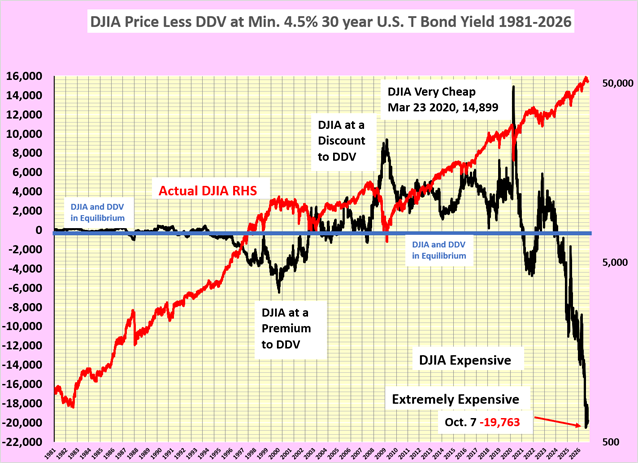
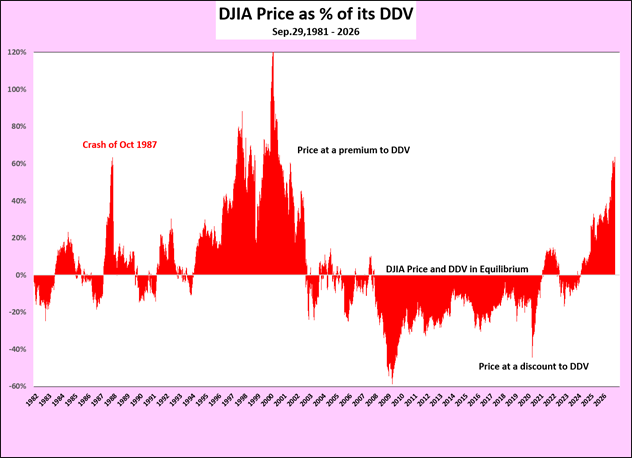
A further narrowing of the gap between price and value should be expected with the DJIA falling 39% to its DDV of 31,417, which may happen by year end.
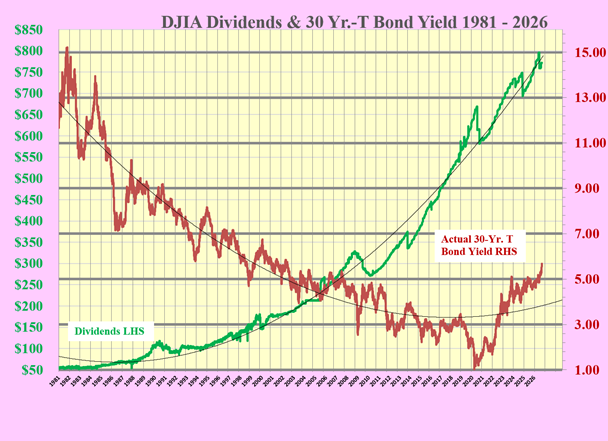
The yield of the 30-year T-bond being above 5.67% seems to confirm that the primary trend in long-term rates is up, as it has been since March 9, 2020.
Furthermore, as the 30-year T-bond yield is above 4.5%, it is pushing the DDV down much faster than the dividend of the DJIA can rise and push the DDV up.
The main driver in the projected rise in long bond yields is the overwhelming demand for financing from governments and the tech industries. AI demands may correct themselves as the dreams of soaring profitability meet the reality of overexpansion. Unfortunately. The same cannot be said for Sovereign Dept requirements as neither wing of the political spectrum seems willing to balance budgets and reduce debt by either cutting spending or, heaven forbid, raising taxes.
The next Chart shows the DDV of the DJIA at its lowest level since the start of Trump’s second term, Indeed, it is at the lowest level in over 5 years.
The following Table shows how the DDV changes based on different 30-year T-bond yields and the resulting premium of the DJIA to its value.
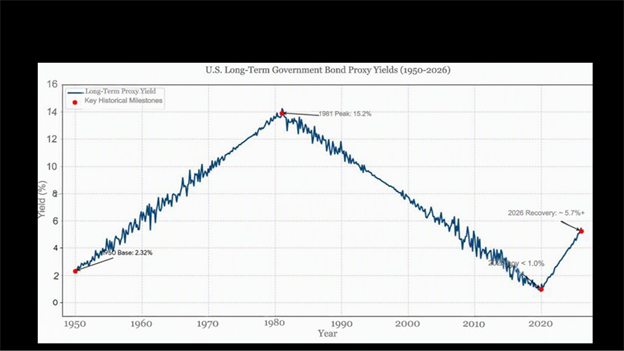
The turning point in the primary trend in long-term rates took place on March 9, 2020 when the intraday yield on the 30-year T-bond hit 0.5%. Since then, the long-term bond market has been in a bear market which could continue for the next couple of decades.
For those who lived through the Great Bond Bear Market of 1950 to 1981 you may recall that the DJIA hit 1,000 in 1966 and never went above it until 1982. It fluctuated between 600 and 1,000. There were good individual stocks, metals and oils come to mind, but the overall market went nowhere.
I recall my business school prof. in 1964 telling us that the BOE Lombard rate would never go above 5% because if it did, it would never come down below that level ever again. For the next forty years he was absolutely correct since it remained above 5% for that entire period.
The upward momentum of the DJIA over the past 44 years makes many believe that it will continue ad infinitum. Well, my argument is that it “ain’t necessarily so” and the next few decades may well be the reverse of what happened.


Comments
Log in or sign up to join the conversation.