

Productivity and costs for 2019Q4 were released yesterday.
(Click on image to enlarge)

Figure 1: Nonfarm business sector output per hour (blue), compensation deflated by CPI (brown), and compensation deflated by nonfarm business sector implicit price deflator (green). Source: BLS via FRED, author’s calculations.
Where NFB output per hour is QNFB/LNFB, real compensation is WNFB/P, and product wage is WNFB/PNFB.
Productivity has grown 34 percentage points more than the real wage, calculated using the CPI (urban all). Theory indicates that the marginal productivity of labor, ∂Q/∂L, (output per hour measures average productivity) should equal the product wage, not the real wage (which depends on the consumption basket). Still, the product wage (really compensation) has grown 10 percentage points less than productivity, since 1980Q1 (in log terms).
The CPI is a Laspeyres price index, so overstates inflation. Using a chain-weighted index (the personal consumption expenditure deflator, from the NIPA) reduces the gap between productivity and real wage, but does not eliminate it.
(Click on image to enlarge)
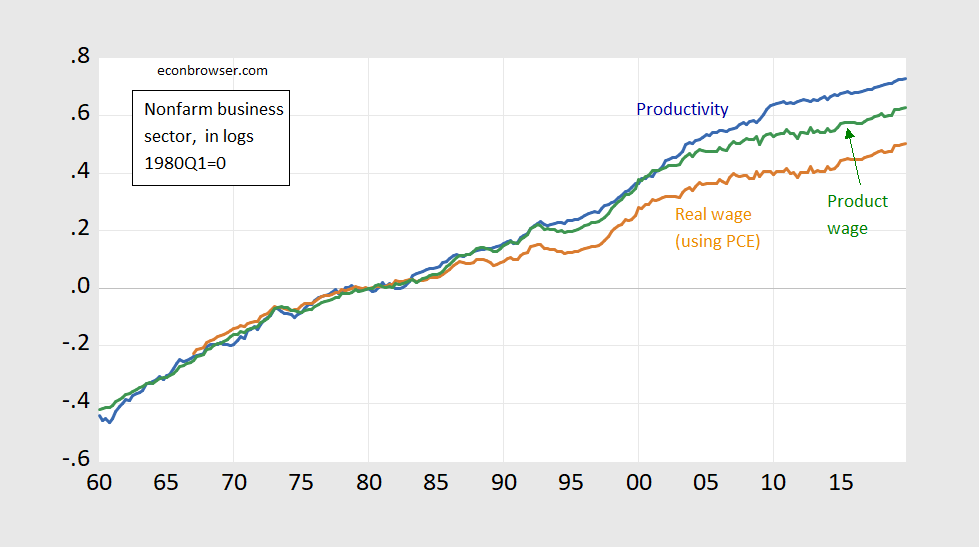
Figure 2: Nonfarm business sector output per hour (blue), compensation deflated by personal consumption expenditure deflator (brown), and compensation deflated by nonfarm business sector implicit price deflator (green). Source: BLS via FRED, BEA, author’s calculations.
The gap between productivity growth and real wage is then only 23 percentage points, since 1980Q1.


Comments
Log in or sign up to join the conversation.