


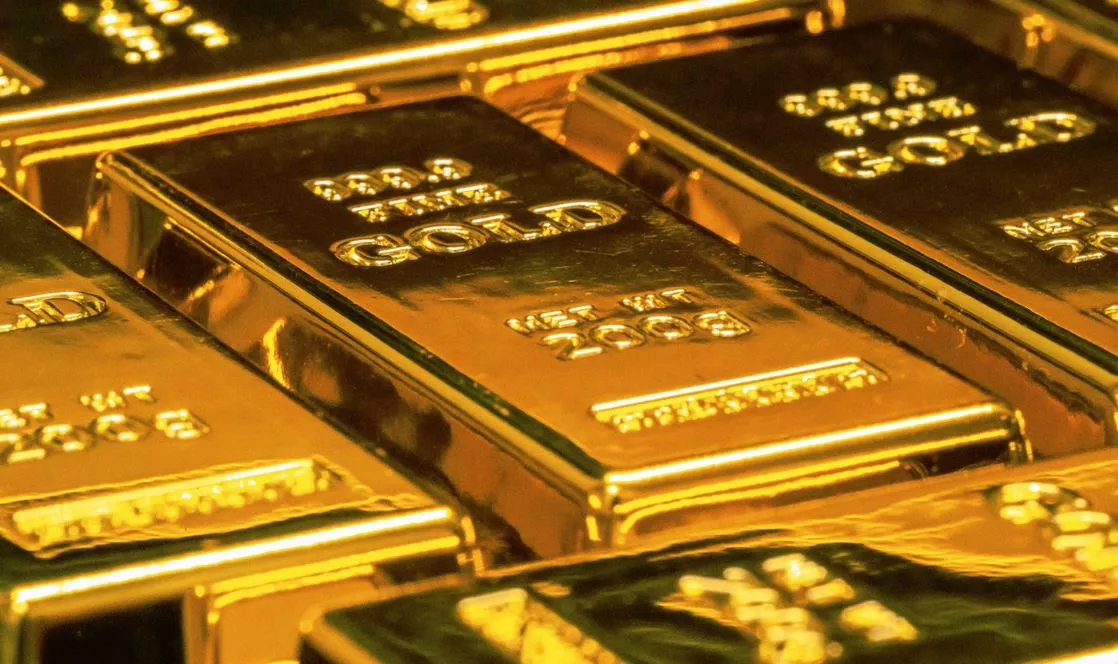
Photo by Jingming Pan on Unsplash
Precious metals have held up well against the Fed's tightening cycle. Gold gained 12.6 percent YTD, while silver traded relatively flatly from the beginning to the end of 2023, give or take a few wild swings in between.
With the probability of interest rate cuts on the horizon, investors wonder whether 2024 is finally the year for precious metals. The Fed's pivot to interest rate cuts this year is good news for commodities.
Lower interest rates result in a weaker dollar. As a result, commodity prices strengthen and rise. The positive real interest rates that used to favor bond investors are turning negative and creating an upside for gold and silver prices.
Here, we discuss the case for gold, silver, platinum, and palladium amid changes in central bank activity, US monetary policy, and geopolitical risk.
Furthermore, we select which metals are worth investing in as of Q2 2024 and beyond.
Which precious metals are worth buying in 2024?
The global economy will remain weak in 2024—about a half percentage weaker than in 2023. The delayed effects of rate increases are catching up with us. Margins are under pressure, and there are cracks in the labor market.
Although core inflation is reversing from the pandemic run-up, the lagged effects of monetary policy are challenging, overcoming inflation's last mile. Nonetheless, the Fed pivot is on the horizon.
As traders expect an easing Fed cycle amid a slowdown in global growth, gold and silver are back in vogue. PGMs (platinum-grade metals) could be under pressure in the short term.
Gold outlook: Moderately positive
The case for gold this year revolves around three determinants: unsustainably high debt driven by excessive government spending, dovish Fed monetary policy, and aggressive central bank buying of the asset.
As the dollar weakens and bond yields fall, gold and the US dollar are expected to move opposite each other.
Gold prices just reached a new peak on Wednesday, April 3, marking a fourth consecutive session of record highs due to a mix of factors, including sticky inflation, expectations of US interest rate cuts, and growing tensions in the Middle East.
Spot gold rose 0.1 percent to $2,283.07 an ounce from a previous peak of $2,288.09.
Moreover, US gold futures increased 0.9 percent to $2,303.50. The evolving economic and geopolitical factors have heightened bullion’s appeal.
Recent statements from US Fed policymakers conveyed it is "reasonable" to implement three interest rate cuts in 2024. Furthermore, recent data suggests that the growth of the US service industry is decelerating. Businesses are paying less for inputs—with prices dropping to a four-year low. These scenarios favor inflation.
Traditionally viewed as an inflation hedge and safe-haven asset in times of political uncertainty and economic stress, gold has increased in double digits since the start of the year—over 10 percent. As central banks continue to buy more gold and demand snowballs, gold prices rise further.
However, Fed Chair Jerome Powell has said more recently that the US central bank needs “more evidence of easing inflation" before it further lowers the cost of borrowing money. Investors awaiting more insights on the anticipated rate cuts may recalibrate expectations based on this new statement.
Atlanta Fed President Raphael Bostic expects only a single rate cut in 2024, which he believes will occur in Q4. Based on this and separate statements of Fed presidents from Cleveland and San Francisco, a near-term interest rate cut may not be implemented.
The market will move as traders project a 99 percent probability of rates staying unchanged at the Fed’s May policy meeting based on data from the CME Fed WatchTool.
In addition, traders expect a 62.5 percent chance of a cut by June—this expectation has dropped significantly from the 70.1 percent prediction the week before.
Silver forecast: Moderately optimistic
We’ve seen silver climbing in Q1 as well. However, the gains came in a far second to gold’s surge. Nonetheless, silver broke the psychological threshold of $26. It would be reasonable to anticipate another rejection at this technical ceiling.
In a breakout scenario, there could be a move upwards to $26.95—revisiting the high point in 2022. Continued strength will set $28.75 as the next target. $28.75 was the peak of May 2021.
In a bearish scenario wherein silver fails to sustain its momentum and gets knocked back down to its current position, the next support would be around $23.30 to $23.05. At this level, the 200-day moving average aligns with the Fibonacci retracement of 38.2 percent, mimicking the upward movement seen between 2020 and 2021.
If silver falls below this floor, we could see long-term trendline support at $22. The next target would be $20.85.
Palladium: Bearish sentiment prevails
Palladium’s current price—it traded at $1,021 as of April 8—is down 8 percent from its price at the start of 2024. Some analysts forecast palladium’s price to reach $1,048 midyear.
However, in a forecast survey with analysts as respondents, the average price prediction for palladium in 2024 is $1,060.10. This looks bearish compared to the 2023 average price, $1,337.39. It is also negative compared to the previous year's forecast, which averaged $1,809.81 in the same survey.
Platinum: Modest gains
This year, platinum's price predictions, which average $1015, are in sync with the average trajectory of silver and gold. This trend reflects an uptick versus its actual price average in early Q1 of 2024 at $952.88.
In 2023, platinum traded at $964.98 on average. Based on the previous year, analysts forecast a 5.2 percent increase in 2024. The price expectations, therefore, are modest.
However, some volatility may be ahead with the spread between the lowest low and highest high at $529.
Against a Backdrop of Global Uncertainty, Safe-Havens Prevail
The previous year, the world struggled with themes like deglobalization, messy disinflation, wars, a sudden regional banking crisis in the US, and China’s reopening reduced to a whimper.
In 2024, the US Fed is done with rate hikes. Most developed countries' central banks will likewise enter new easing cycles to boost demand. However, inflation is not falling to optimal targets, unemployment materializes, and the geopolitical backdrop remains fragile.
Amid this backdrop, safe-haven assets or safe diversifiers are attractive. Gold is closing in on a $16 trillion market cap as it sets new all-time highs. The outlook for gold is moderately bullish. Silver is generally aligned with the expectations for gold. Most analysts are bearish on palladium, while platinum is forecast to make modest gains versus 2023 with some volatility.


Comments
Log in or sign up to join the conversation.