

Industrial production outperformed consensus in May despite geopolitical disruptions and weak demand from the eurozone. While sectors linked to defence and infrastructure spending were buoyant, some manufacturing branches recorded deep declines; a K-shaped pattern is now becoming visible.
Polish industrial production rose by 4.1% year-on-year in May, above the consensus of 2.5% and our forecast of 1.8%. The acceleration from 3.1% in April occurred despite weak external demand, particularly from Germany, uncertainty and volatility linked to the conflict in the Middle East, as well as an unfavourable calendar effect (one fewer working day than in 2025). In seasonally adjusted terms, production increased by 1.4% month-on-month, after falling by 2.3% in April.
The strongest increases were recorded in the production of intermediate goods, energy-related goods and investment goods. Production of non-durable consumer goods grew slowly, while production of durable consumer goods fell significantly.
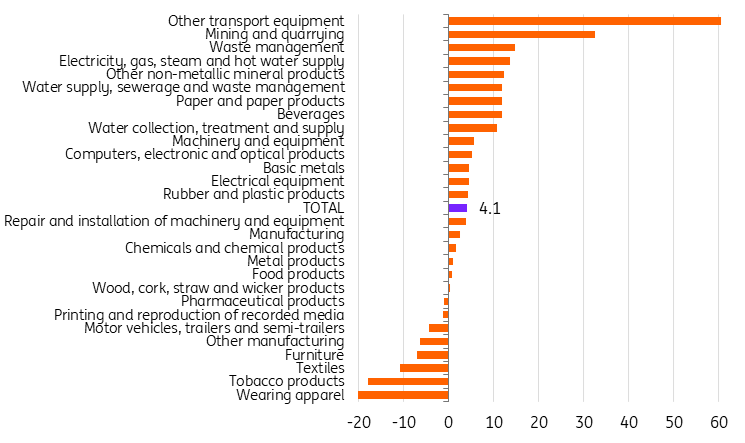
Within the structure of May industrial production, the largest increases were recorded in “other transport equipment” (up 60.5% YoY, with a 2.8% share of total production), mining and quarrying (up 32.6% YoY), waste management (14.8%), electricity, gas, steam and air conditioning supply (13.7%), and production of non-metallic mineral products (12.2%). The fastest-growing category includes ships, boats, rolling stock, aircraft, military fighting vehicles, motorcycles and wheelchairs. This suggests rising expenditure on defence equipment and infrastructure.
Nevertheless, several sectors recorded double-digit YoY declines, highlighting divergent trends across manufacturing branches – a K-shaped pattern. The deepest falls were seen in clothing production (-20.3% YoY), tobacco products (-17.8%) and textiles (-10.8%). Furniture production also declined significantly (-7.1%), as did the production of motor vehicles, trailers and semi-trailers. The latter category accounts for as much as 9.5% of total production and, like furniture, is under strong and growing competitive pressure from Chinese suppliers. Recent data from China points to solid YoY growth in industrial production alongside a decline in retail sales, indicating that Chinese firms remain primarily focused on export expansion.
Today’s better-than-expected industrial production data fits into the trend of moderate manufacturing activity observed in the second quarter of this year. A positive factor is the relative resilience of the domestic industry to the commodity shock (crude oil) associated with the blockade of the Strait of Hormuz, weak economic conditions in Germany, and rising competitive pressure from China. Poland is launching major public and defence investment programmes, which should provide an impulse for industrial recovery in the coming months and are already beginning to show in the data (high YoY growth in the “other transport equipment” category, which includes, among other things, military expenditure). As a result, we maintain our 2026 GDP growth forecast at 3.4%.
Today’s data opens the series of May readings for the economy. For the Monetary Policy Council, next week’s labour market data will be particularly important. Nevertheless, we expect National Bank of Poland interest rates to remain unchanged this year.
Growth of Poland's industrial production in May, by branch, in %, YoY

Comments
Log in or sign up to join the conversation.