
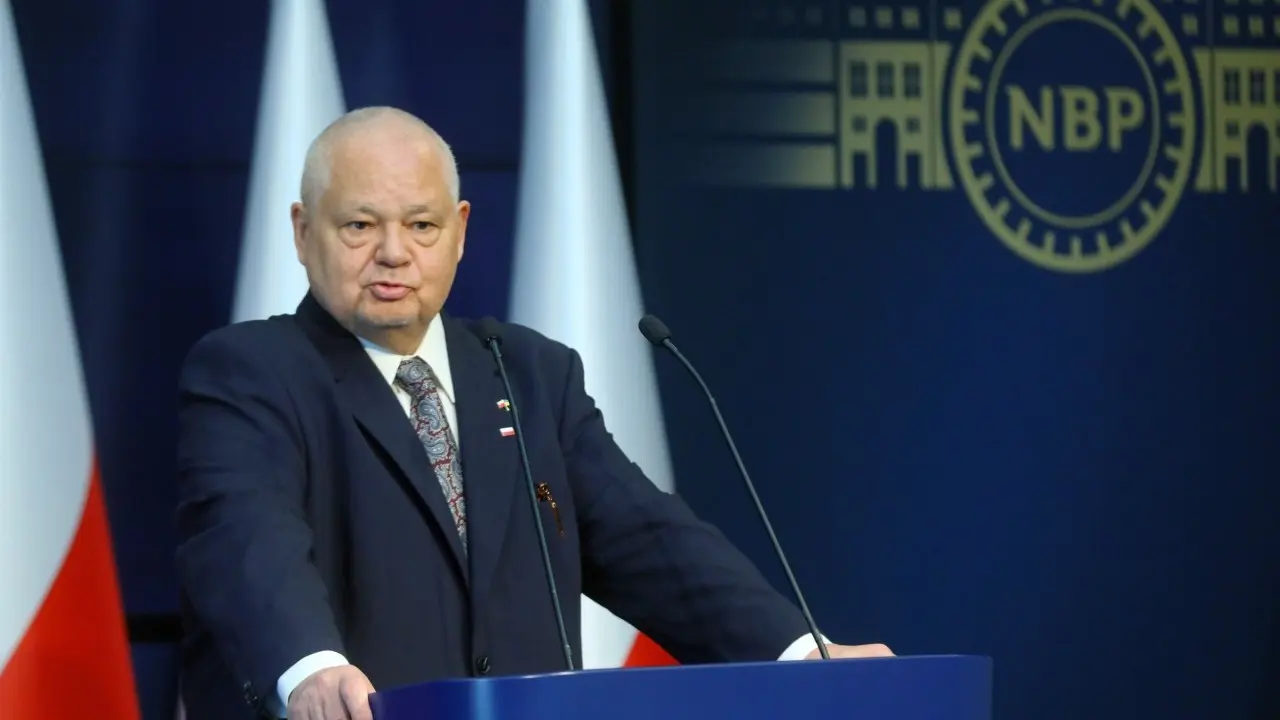
During the July press conference, the National Bank of Poland governor's rhetoric turned even more dovish than in June. Governor Glapiński did not even rule out putting forward a motion to cut rates by 25bp after the summer, but the rest of the Monetary Policy Council is more cautious. We see flat rates this year with risks tilted towards a potential cut
Rationale for July policy decision
In June, inflation fell to the National Bank of Poland's (NBP) target of 2.5% and has remained within the tolerance band (2.5%+/-1%) for a year. According to Governor Adam Glapiński, this means that the level of interest rates was and remains at an appropriate level. He stressed that inflation in Poland is lower than in the euro area and the United States.
Poland is not facing a renewed surge in inflation comparable to that seen during the 2022 energy crisis, while the scale of the supply shock related to the situation in the Middle East is smaller than previously expected. Medium-term prospects for both inflation and economic growth remain favourable. Therefore, keeping interest rates unchanged in July was justified.
Inflation
According to the NBP's projections, inflation may rise temporarily following the reinstatement of previous excise duty and VAT rates on fuels. However, over the medium term it should remain within the inflation target tolerance band and therefore should not exceed 3.5%.
Governor Glapiński identified four factors shaping inflation:
energy commodity prices (gas, oil and coal)
domestic economic activity
labour market conditions (wage growth)
fiscal policy
Regarding the first three factors, Governor Glapiński assessed them as potentially disinflationary. So far, higher commodity prices have not significantly fed through to the prices of other goods and services (except for tourism), while oil prices have declined in recent weeks. Economic activity remains favourable but is not robust enough to generate inflationary pressure. Wage growth has slowed and is now at its lowest pace in five years, suggesting that it should not become a source of inflationary pressure.
Mr. Glapiński identified fiscal policy as the main inflation risk. Elsewhere during the press conference, he also highlighted uncertainty related to the geopolitical situation, which is included in the first factor.
Monetary policy
The Chairman of the Monetary Policy Council (MPC) assessed that a cautiously dovish stance currently dominates within the Council, although he described his own position as more dovish and less cautious than that of the majority. In Adam Glapiński's view, a rate cut before the end of the year is likely. He also believes that by mid-2027 the overall stance of the MPC may become less cautious, increasing the Council's willingness to lower rates. The Chairman sees room for one 25bp rate cut by year-end and may submit such a proposal after the summer. However, he ruled out the possibility of two rate cuts.
Another dovish signal from the NBP Governor was his statement that restoring higher taxes on fuels would only lead to a temporary increase in inflation. This contrasts with 2025, when the Governor strongly emphasised inflation risks associated with the deregulation of energy prices. The Governor is not concerned about the recent weakening of the zloty.
Bottom line
Our baseline scenario assumes that NBP interest rates will remain unchanged through the end of 2026. However, we note that the central bank's rhetoric has become even more dovish than in June, and the balance of risks has now shifted towards the possibility of a rate cut before year-end. As recently as May, the balance of risks was skewed towards potential rate hikes.
The NBP Governor's dovish stance may prolong the weakness of the zloty, particularly against regional currencies. Moreover, the Governor explicitly stated that he is not concerned about the weaker currency, which contrasts with references in official communications to the possibility of foreign-exchange intervention. In yesterday’s comment we also said a combination of a dovish NBP stance and euro adoption aversion are zloty negative factors vs the Czech koruna and Hungarian forint.
Comments
Log in or sign up to join the conversation.