

Poland’s current account balance deteriorated sharply in April, reflecting worse terms of trade due to higher energy prices. However, Poland’s external position remains robust, and we expect the current account deficit to reach 1.6% of GDP in 2026
According to data from the National Bank of Poland, the current account deficit amounted to €1,558 million in April, three times worse than the consensus forecast (-€505 million; our forecast: -€342 million). This represented a marked deterioration compared with the March reading (-€234 million). We estimate that the 12-month current account deficit as a share of GDP worsened to 0.9% of GDP from 0.8% of GDP in March.
The April current account deficit in the balance of payments comprised:
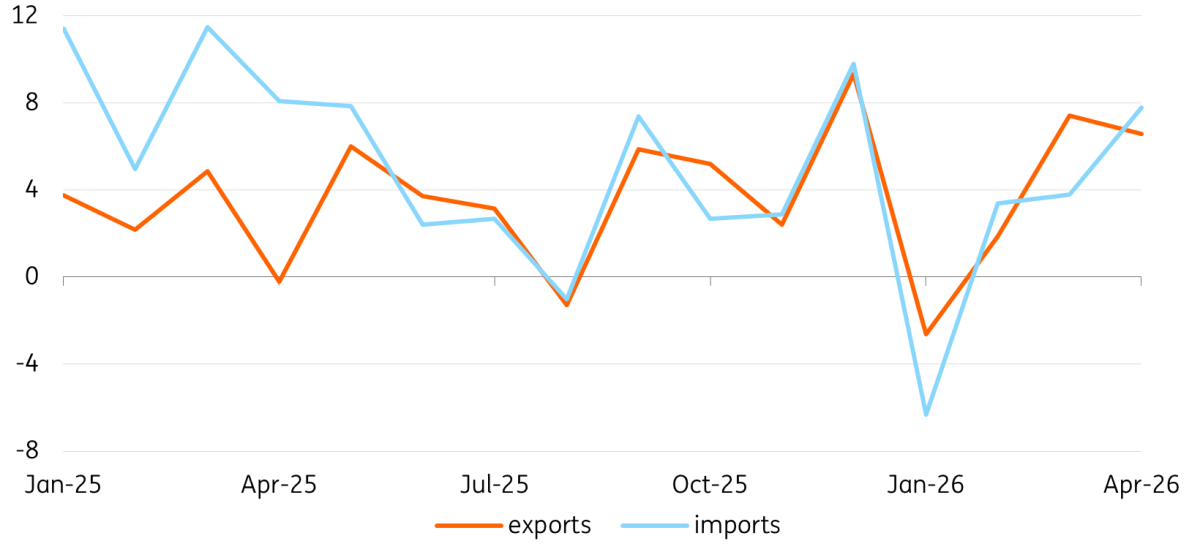
A merchandise trade balance of -€1,995 million from -€497 million in March. The sharply wider goods deficit occurred alongside high trade turnover: the value of exports in euro terms rose by 6.6% year-on-year in April, while imports increased by 7.8% YoY. Export growth slowed from 7.4% YoY in March, whereas import growth accelerated sharply from 3.8% YoY in March.
The traditionally positive balance in services trade of €3,466 million from €3,067 million in March;
Negative balances on the primary income account (-€2,951 million, after -€2,783 million a month earlier) and on secondary income (-€78 million, after -€21 million in March).
The NBP analyst commentary, referring to changes in the value of trade aggregates in PLN (the zloty appreciated by 0.3% YoY against the euro in April), points to a strong increase in exports of intermediate goods, including copper and raw silver. A solid increase was also recorded in exports of computers, which is rather a re-export category. Export dynamics, however, were being held back by declines in the automotive sector and in durable consumer goods, and this is a long-standing and concerning trend.
The strong increase in imports, by contrast, resulted from higher fuel prices, as well as increased import spending in categories such as computers, immunological products and vaccines. Imports of cars continued to rise, accompanied by a decline in deliveries of automotive parts.
We had expected that the value of crude oil and natural gas imports to rise significantly this year following the jump in energy prices since the start of the war in the Middle East, and this is reflected in the monthly data. The increase is incorporated into our forecasts for the current account balance this year (-1.6% of GDP in 2026, after -0.9% of GDP in 2025). Given weak demand from Poland’s main trading partners, net exports will not be a driver of Polish GDP growth this year. We currently forecast euro area GDP growth at just 0.3% in 2026, and 0.6% in Germany.
Nevertheless, despite the deterioration expected this year due to the oil shock, Poland’s level of external imbalance remains low and does not materially affect the PLN exchange rate. The zloty is influenced primarily by developments in core markets as well as by MPC decisions and communication.
Merchandise exports and imports growth, YoY, in %


Comments
Log in or sign up to join the conversation.