


PepsiCo Inc. (PEP) delivered strong fiscal Q3 results last month, though guidance was weaker than expected. Is that behind today's huge, unusual PEP put option volume? Maybe, but this deep out-of-the-money (OTM) play may be a bullish signal.
PEP is up over 1.3% in midday trading today at $139.20. Moreover, since bottoming out on Oct. 7 at $123.73 (right before the Oct. 8 earnings release), PEP is up 12.5%. Is this going to last?
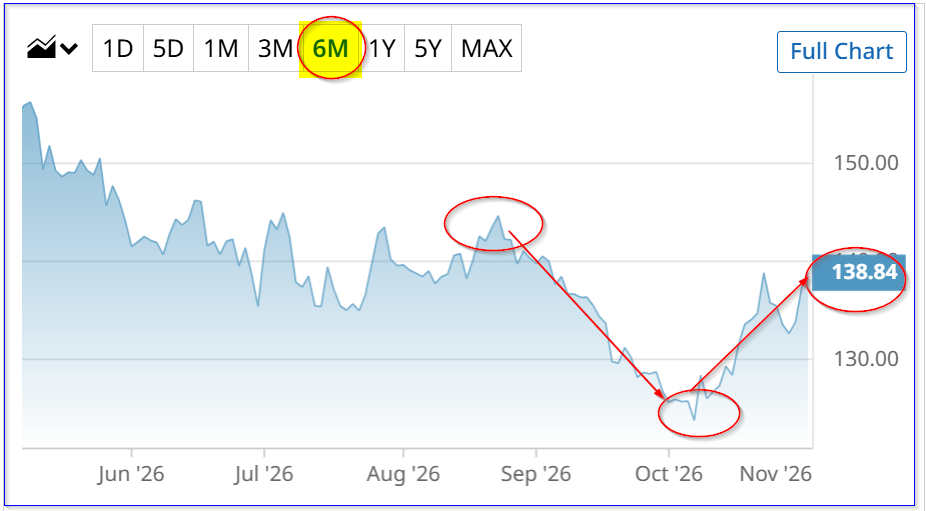
PEP stock - last 6 months - Barchart - Nov. 2, 2026
Maybe it will. After all, despite analysts' downgrades from lower-than-expected guidance (due to GLP-1 effects), PEP has generated strong free cash flow (FCF).
Is that why there is so much OTM put volume?
FCF Growth and Margins
For the quarter ending Sept. 5, PepsiCo generated $4.669 billion in FCF. That dwarfed the prior quarter's $1.505 billion and was over 34% higher than the prior year's Q3 ($3.48 billion).
This quarter's FCF also represented 18.5% of revenue, compared to 14.54% last year. In other words, even though revenue was up 5.5% YoY, its FCF as a percent of revenue increased 27%.
That shows that the company is squeezing out more cash, with lower expenses, as revenue rises.
This can also be seen in its trailing 12-month (TTM) FCF margins. In Q3, Stock Analysis shows that it generated $10.471 billion in FCF, or 10.66% of TTM revenue. That exceeded the prior quarter's TTM FCF margin of 9.58% and the prior year's 7.53%.
Notice, I didn't talk about earnings or earnings per share (EPS). That doesn't matter as much as FCF with a company like this.
The simple reason is that food and snacks are expected to generate lots of cash flow. A food company must constantly adjust prices and expenses to deal with various snack-eating trends.
Here is what this means for its valuation.
Price Targets for PEP
Next year, even despite all the lower guidance, analysts still project higher revenue. That average of 21 analysts is $101.77 billion for 2027, vs. $99.3 billion forecast for 2026.
As a result, if PepsiCo maintains at least an 11% FCF margin (lower than the 18.5%Q3 margin), it could generate over $11.19 billion in FCF:
$101.77b x 0.11 = $11.19 b FCF
Moreover, using a 5.5% FCF yield metric (based on its historical averages), PEP could end up with a $203.5 billion valuation:
$11.19b / 0.055 = $203.5 b value
That is over 7.1% above today's market cap of $189.9 billion. In other words, PEP could be worth 7% more:
$139.20 x 1.071 = $149 price target (PT)
Other analysts have slightly lower PTs. Yahoo! Finance says the average of 24 analysts is $141.29, and Barchart's is $141.14.
That could be why there is heavy out-of-the-money (OTM) put option volume today. The investors selling these puts collect the income immediately. They also have a very low chance of having to buy shares at low prices.
Unusually Heavy PEP OTM Put Option Volume
This is seen in today's Barchart Unusual Stock Options Activity report. It shows that over 1,500 puts have traded at the $100 strike price that expires on March 19, 2027. That's 137 days from now, about 4.5 months from now.
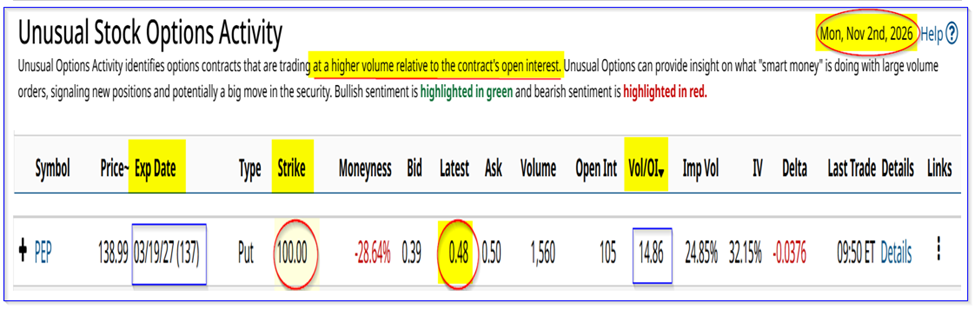
PEP puts expiring March 19, 2027 - Barchart Unusual Stock Options Activity Report - Nov. 2, 2026
This volume is almost 15x times the prior number of puts outstanding. Note also that the delta ratio is very low: -0.0376. That implies a 96%+ chance of success (that PEP won't drop to $100 by March 19).
In other words, the put buyers have almost no chance of success. That implies that the initiators of this put volume are mostly short-sellers. In other words, they collect $48 for $10,000 in collateral per put (i.e., a 0.48% yield).
Put Credit Spread
There could also be other multi-leg plays associated with this trade volume. For example, the “Details” link on the Unusual Stock Options Activity Report for this trade shows a large number of trades at the $120 put strike price with this expiry period.
That might imply, for example, that an investor could short the $120 PEP put for $218 and then buy the $100 put for $48. That gives the essentially bullish investor a net put credit spread of $170.
Moreover, the required collateral is only $2,000 per put credit spread play (i.e., ($120-$100) x 100), and the at-risk capital is $2,000 - $170, or $1,830.
As a result, the expected return is higher than a short-put play:
$170/$1,830 = 0.09289 = 9.29%
Given that the $120 put option expiring has a -0.1615 delta ratio, there is an 83.85% chance (1-0.1615) of success that PEP will not drop to $120 by March 19, 2027. So, this looks like a very attractive play for bullish PEP investors.
In effect, the annualized return is almost 25% (i.e., (365/137) x 9.29% = 24.75%).
The bottom line is that PepsiCo looks undervalued here, and a cheap way to play it is to sell short out-of-the-money puts, or to do an OTM put credit spread.


Comments
Log in or sign up to join the conversation.