

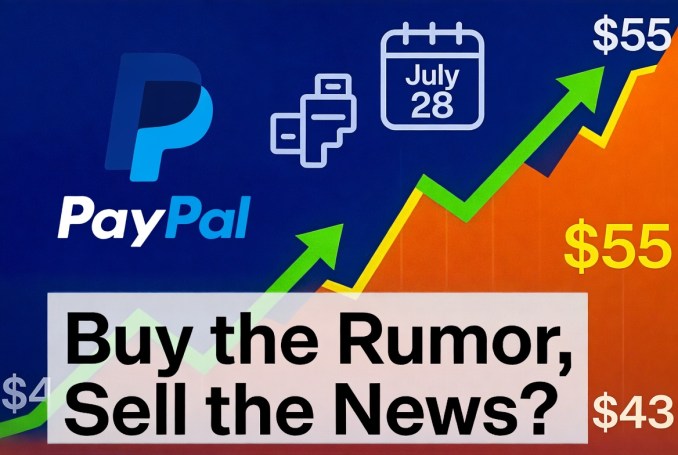
Good morning from David and me! We’re excited to share our latest thoughts on one of our holdings that has recently started moving nicely in our favour. We picked up shares of PayPal Holdings (Nasdaq: PYPL) in the mid-$40s (around $43) amid broader market caution and company-specific headwinds. Fast-forward, and with fresh takeover rumours swirling, the stock has climbed toward the mid-$50s. It’s always satisfying when a position you invest in starts validating the thesis through market action. In this post, we’ll break down the story so far, the catalyst behind the recent rally, what’s coming with earnings on July 28, 2026, and our thoughts on potential price action afterwards. As always, this is our perspective as long-term investors sharing ideas—not personalised financial advice. Markets move fast, and everyone should do their own due diligence.
PayPal’s Business and Recent Context
PayPal remains one of the most recognisable names in digital payments. Founded in the late 1990s, it pioneered online payments and built a massive two-sided network connecting hundreds of millions of consumers and merchants worldwide. Its ecosystem includes the core PayPal branded checkout, the popular Venmo peer-to-peer app (especially strong among younger users), Braintree for merchant processing, and growing initiatives in crypto, value-added services, and international expansion. Like many fintechs, PayPal faced post-pandemic normalisation. Transaction volumes slowed in some areas, competition intensified from embedded payments (Apple Pay, Google Pay, and bank offerings), and growth in core branded checkout proved tougher than hoped. The stock, which peaked near all-time highs years ago with a market cap well above $300 billion, had corrected sharply amid these pressures and a broader market rotation. In early 2026, the company underwent leadership changes, with Enrique Lores (formerly of HP (HPQ)) stepping in as CEO to accelerate a turnaround. Efforts include reorganising into clearer units (checkout, Venmo, and payments/crypto), aggressive cost discipline with AI-driven efficiencies targeting at least $1.5 billion in gross savings over 2–3 years, share buybacks, and reinvestment in higher-growth areas. Recent quarters have shown some stabilisation, with revenue growth returning (e.g., Q1 2026 saw solid beats on both top and bottom lines) and total payment volume (TPV) trends improving in spots like Venmo. Valuation had become compelling for many investors—trading at low single-digit multiples on forward earnings and generating strong free cash flow—setting the stage for opportunistic interest.
The Takeover Rumours Ignite the Rally
The big catalyst recently has been reports of a joint takeover approach. In mid-July 2026, news broke that Stripe (the private payments infrastructure giant) and Advent International (a major private equity firm) had submitted a joint offer to acquire PayPal at $60.50 per share. This values the company at more than $53 billion and represents roughly a 28% premium to the prevailing share price at the time of the report.
Key details from the reporting:
The bid was submitted earlier in July, following an initial approach in early April.
It is backed by approximately $50 billion in committed bank financing.
Stripe and Advent propose equal ownership stakes rather than breaking up the company.
Neither PayPal nor the bidders have commented publicly, and there is no certainty a deal will materialise—talks remain confidential and preliminary.
This follows earlier 2026 speculation about Stripe’s interest in parts or all of PayPal amid the stock’s decline.
The market reaction was swift and positive. Shares jumped significantly on the news, with reports noting gains pushing the price into the mid-$50s range at times—aligning with the move we’ve seen from our entry point in the mid-$40s.
Why does this make strategic sense on paper? PayPal brings enormous scale: a huge consumer user base, merchant relationships across ~90% of online retailers in some estimates, Venmo’s sticky engagement, and assets like Braintree. Stripe, while dominant in developer-friendly infrastructure, could benefit from deeper consumer-facing reach and branded experiences. Private equity involvement adds financial firepower and operational expertise. For shareholders, a deal at or above the rumoured level would deliver a meaningful premium after years of underperformance. Of course, nothing is guaranteed. PayPal’s board and new CEO are focused on an independent turnaround, and any deal would face regulatory scrutiny (antitrust considerations in payments are real). Earlier rumours in February 2026 had cooled without immediate action. Still, the bid puts PayPal “in play” and provides a floor of sorts while the company executes—or negotiates. It’s been rewarding to see our position move higher on this development. Buying in the mid-$40s during quieter periods and watching the stock respond to real corporate interest feels validating.
Earnings on July 28: The Next Big Catalyst
PayPal is scheduled to report Q2 2026 results before the market opens on Tuesday, July 28, 2026.
Consensus expectations (subject to updates) point to:
Revenue around $8.5 billion (modest year-over-year growth in the low-to-mid single digits on a currency-neutral basis).
Non-GAAP EPS around $1.28.
The company has a mixed but often resilient history of beating or meeting estimates in recent quarters, though guidance and forward commentary matter as much as the headline numbers. Key areas investors will scrutinise include:
Total Payment Volume (TPV) growth and mix (branded checkout vs Venmo vs other platforms).
Transaction take rates and margin trends (pressure from mix shifts or investments?).
Updates on cost savings, AI initiatives, and reinvestment plans.
Any commentary on the strategic review, capital allocation (buybacks remain active), or—crucially—the takeover approach.
Management has previously reiterated full-year guidance while noting tougher comps and near-term pressures on certain margins due to growth investments. A beat on revenue/TPV combined with confident guidance or even subtle positive signals around M&A could fuel further upside. A miss or overly cautious tone might trigger profit-taking, especially with the takeover overhang creating volatility. Earnings season is always a binary event for individual stocks, and with the added layer of takeover speculation, expect heightened swings in both directions around the release and conference call.
Where Could the Price Go Post-Earnings?
This is the million-dollar (or in this case, multi-billion-dollar) question. Here are the main scenarios we’re considering:
Bullish Path (Deal Momentum or Strong Standalone Results): A solid beat, upbeat guidance, and/or any indication that talks are progressing could push shares higher—potentially testing or exceeding the $60.50 rumour level in the short term as the market prices in a higher probability of a transaction. Even without a deal closing quickly, the bid provides psychological support and could attract more buyers. Our entry in the mid-$40s would look even better in this environment.
Base/Volatile Path: Mixed results with no major M&A update lead to choppy trading. The stock could pull back from recent highs on “sell the news” dynamics but find support from attractive valuation, ongoing buybacks, and FCF generation. The takeover rumour keeps a bid under the surface.
Bearish Path: Disappointing numbers, weak guidance, or confirmation that talks have stalled could lead to a sharper correction toward pre-rumour levels or below. Execution risks in the turnaround remain real amid competition.
Overall, we see the post-earnings period as potentially volatile, with the asymmetry tilted positively due to takeover interest. Many investors may prefer to wait for clarity rather than speculate aggressively beforehand. Our plan, as noted, is to take profits ahead of the earnings release and surrounding reaction—we’ve enjoyed the move from the mid-$40s and will reassess based on new information. Longer term, PayPal’s network effects, cash generation, and potential in AI/agentic commerce or expanded services give it staying power, whether standalone or under new ownership. The current valuation (still reasonable even after the rally) and activist/takeover interest underscore that the market sees optionality here.
Risks to Consider
No investment story is without risks. Key ones for PayPal include:
Intensifying competition eroding take rates or market share.
Slower-than-expected execution on the turnaround or cost initiatives.
Regulatory hurdles for any potential deal (or ongoing scrutiny of the payments industry).
Macro factors affecting consumer spending and transaction volumes.
Broader market sentiment toward growth/tech/fintech names.
The takeover process itself introduces uncertainty—deals can drag on, get revised, or fall through. Wrapping Up: We bought PayPal in the mid-$40s believing in its undervalued network and cash-flow profile during a tough patch. The recent takeover rumours from Stripe and Advent have provided a welcome catalyst, lifting the stock nicely into the mid-$50s. With earnings just days away on July 28, we’re positioned to take profits as planned while staying attentive to developments.



Comments
Log in or sign up to join the conversation.