

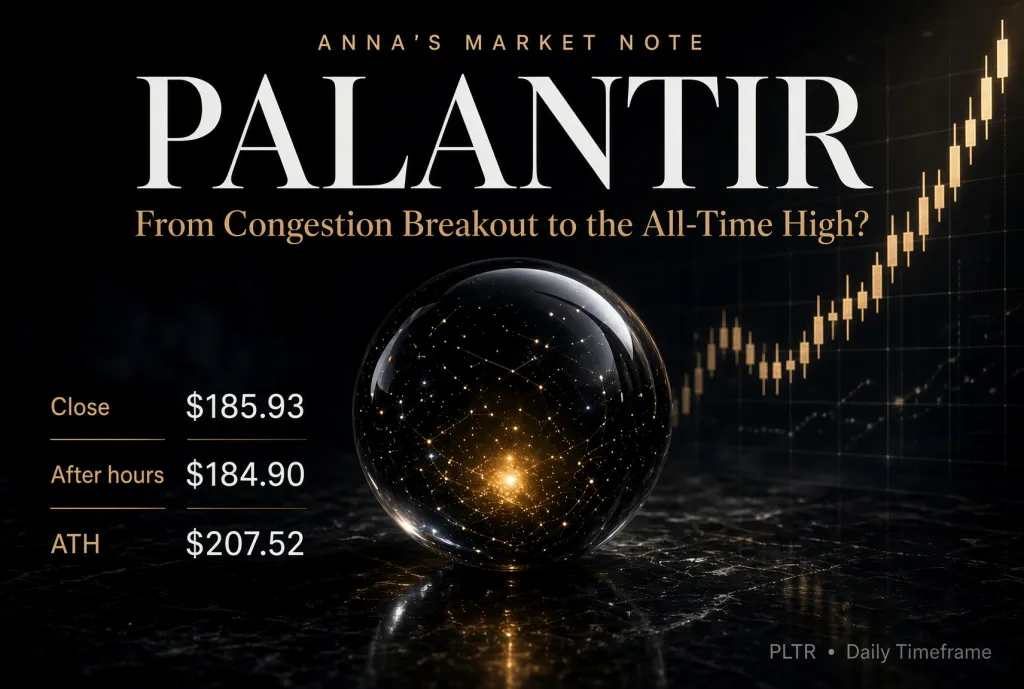
Background, the business, the Q2 reset — and why today’s close at $185.93 matters for a stock we hold and have traded multiple times on the way up.
Palantir (PLTR) has always divided a room. Some still see a shadowy government contractor. Others see one of the few software businesses that has turned the AI boom into accelerating revenue, fat margins and hard cash. For readers of this site, it is also a name we know well: we hold it, and we have traded it many times, from the double digits to the triple digits, on the way up. That is why today’s tape matters. Palantir closed at $185.93 after breaking out of congestion on the daily chart on good volume, and was last seen around $184.90 in the post-market. The all-time high of $207.52, set on 3 November 2025, is no longer a distant memory. It is about 11–12% away. The question is whether the business, the earnings reset and the technicals now give that high a realistic chance of being taken out in due course.
From seeing-stones to software for the West
Palantir Technologies was founded in 2003 by Peter Thiel, Alex Karp, Joe Lonsdale, Stephen Cohen and Nathan Gettings. The name comes from Tolkien’s palantíri — the seeing-stones that reveal what is happening across a vast and messy world. That is still a useful way to think about the company.
The founders’ starting point was post-9/11 intelligence work: how do you find patterns across fragmented databases without building a single, lawless surveillance warehouse? Early backing from In-Q-Tel, the CIA’s venture arm, helped Palantir into the US intelligence and defence world. Karp has been chief executive since the early years and remains the public face of the firm: combative on stage and unapologetic about serving Western institutions.
Key milestones:
2020 — Direct listing (not a conventional IPO); HQ moved from Silicon Valley to Denver
2023 — Launch of the Artificial Intelligence Platform (AIP)
2024 — Added to the S&P 500
2025–26 — Commercial AI demand, not just government work, becomes the growth engine
For years the stock was treated as a cult name: loved by a dedicated retail base, distrusted by parts of the institutional world, and often described as if it were a data broker. That caricature never quite fitted. Palantir does not hoover up the world’s personal data and resell it. It sits atop a customer’s existing systems, connects them, and turns that mess into something operators can actually use.
What Palantir actually sells
The product set is simpler than the mythology.
Gotham — The original government and intelligence platform. Built for defence, law enforcement and national security customers who need to fuse signals, reports, logistics and operational data, then act on it. This is the Palantir that shows up in debates about ICE, the Pentagon and allied militaries. Karp has never pretended the work is abstract.
Foundry — The commercial counterpart. Manufacturers, energy companies, hospitals, retailers and banks use it to integrate supply-chain, production, inventory and financial data without ripping out the underlying systems.
Ontology — The model of the enterprise’s objects and relationships; the map the rest of the software runs on.
Apollo — Deploys and updates software across classified, on-premise and cloud environments.
AIP — Lets customers put large language models and agents to work against their own data rather than handing that data to a frontier lab.
That last point has become the commercial argument of 2025–26. Karp calls it AI sovereignty: companies want the productivity of models without making their operations the training set for somebody else’s next model. Palantir claims to be one of the few firms that can turn tokens into operational value within a factory, hospital, or government agency. The customer mix still matters. The United States is the engine. In the latest quarter, US revenue was 81% of the group. The commercial side, once the junior partner to government work, is now the growth story. That shift is what the market is paying for.
The Q2 report that reset the tape
Palantir reported second-quarter 2026 results after the close on 3 August. This was not a mild beat. It was the sort of print a richly valued stock needs if it is going to keep climbing.
The numbers that matter:
Revenue: $1.935 billion, up 93% year on year (consensus near $1.81 billion)
US revenue: $1.573 billion, up 115%
US commercial revenue: $764 million, up 149%
US government revenue: $809 million, up about 90%
Adjusted operating margin: 62%
GAAP operating income: $912 million (47% margin)
GAAP net income: $1.062 billion (55% margin)
Adjusted free cash flow: $1.22 billion
Rule of 40: 155%
Net dollar retention: 157%
Remaining performance obligations: about $4.9 billion, up 103% year on year
US commercial TCV: $2.13 billion, up 153%
Deals of $1 million+: 220
Karp’s line captured the profitability shift: the company made more profit in one quarter than it generated in revenue in the same quarter a year earlier.
What they said about the future
Guidance was raised hard:
Q3 revenue: $2.160–$2.164 billion
FY 2026 revenue: $8.150–$8.158 billion (about 82% growth)
US commercial revenue: more than $3.424 billion (at least 134% growth)
Adjusted operating income: about $4.89 billion
Adjusted free cash flow: $4.5–$4.7 billion
GAAP operating income and net income still expected in every quarter of 2026
Karp said demand for AI sovereignty had been “unleashed,” called the quarter “otherworldly,” and told CNBC the growth “looks like this is going to go on for at least another 18 months.” Management also described the US commercial business as “on fire” — and still “nascent.”
How the market reacted
After-hours jump of roughly 15% on the print
Then a ~29% rip on 4 August, from a close of $125.65 on earnings day to $162.66 the following session
That was the moment the “AI trade is fading” narrative ran into a company that was still accelerating on both the commercial and government fronts.
The caveats
International revenue remains the weaker limb
Valuation after the rally is demanding — comments after the print put the stock in the high-30s to around 40 times the raised full-year sales figure
Any deceleration in US commercial growth, a stumble in government budgets, or a sense that AIP bootcamps are not converting into durable contracts would be punished quickly
Palantir remains a high-beta name; that has not changed
What the quarter still said about the future is constructive. Growth is no longer only government. Bookings and remaining deal value grew faster than revenue. Cash generation is no longer a promise; it is a feature. The strategic argument — keep the customer’s data inside the customer’s walls and put agents to work on an enterprise-controlled ontology — is landing at a moment when boards are nervous about handing operational data to model vendors.
The daily chart: congestion, then a break on rising volume
After the 4 August explosion, Palantir did what strong stocks often do: it went sideways and digested. From mid-August the daily range was messy rather than impulsive — highs into the low $180s, dips back through the $170s, a poke at $182.44 on 21 August that failed to stick, then another fade. That is congestion: buyers and sellers arguing about whether the $ 160s to $180s was the new home or just a rest stop. Volume cooled from the 175 million-share eruption on 4 August to more normal 25–40 million sessions.
Today’s session resolved that argument in favour of the bulls.
Opened near $179
High around $186.85
Closed at $185.93, up about 4.8%
Post-market around $184.90
That close sits above the mid-August supply zone. The daily chart has stopped chopping and has started trending again. A modest after-hours fade is a normal digest after a breakout day, not an immediate rejection. Levels that now matter:
Breakout / first support: the old congestion cap around $180
Failure tell: a close back in the $170s would turn today into another false start
Next reference: the November 2025 all-time high at $207.52
We have traded those swings before. The difference this time is the fundamental backdrop: profitability is no longer theoretical, and commercial growth is still accelerating.
Can Palantir take out $207.52?
From $185.93, the all-time high is not a moonshot. It is a measured move if the trend resumes.
Why it can happen in due course:
Full-year revenue guided near $8.15 billion, US commercial growth guided at 134% or better, cash flow guided at $4.5–$4.7 billion
The technicals have flipped from digestion to expansion
Net retention in the 150s and remaining deal value growing faster than revenue give the market a reason to keep giving the stock the benefit of the doubt
Why it is not a slam dunk:
Valuation leaves little room for a soft quarter
Getting back to the November 2025 high will require the broader AI complex not to roll over
Government work is both a feature and a risk; commercial momentum is cleaner, but still concentrated in the United States
The honest answer is yes — we could see the all-time high taken out in due course, as a base case if Q3 looks anything like the guide and if this daily breakout holds. It is not guaranteed tomorrow, and it is not the sort of level you chase blindly after a 50% bounce off the July lows. It is the sort of level a holder can plan around.
How David and I are treating it:
Palantir is a core holding and a trading vehicle. The long position is there because the software is embedded in customers who do not rip it out after one budget cycle, and because the financial model has begun to look more like that of a great software company than a story stock. The trading overlay is there because $PLTR still moves in violent ranges, and those ranges have paid us on the way up. Today’s close at $185.93, with the stock hanging near $184.90 after hours, is the first daily signal since the earnings spike that the range may be finished. If it is, $207.52 is no longer a memory. It is the next obvious reference on the chart.


Comments
Log in or sign up to join the conversation.