

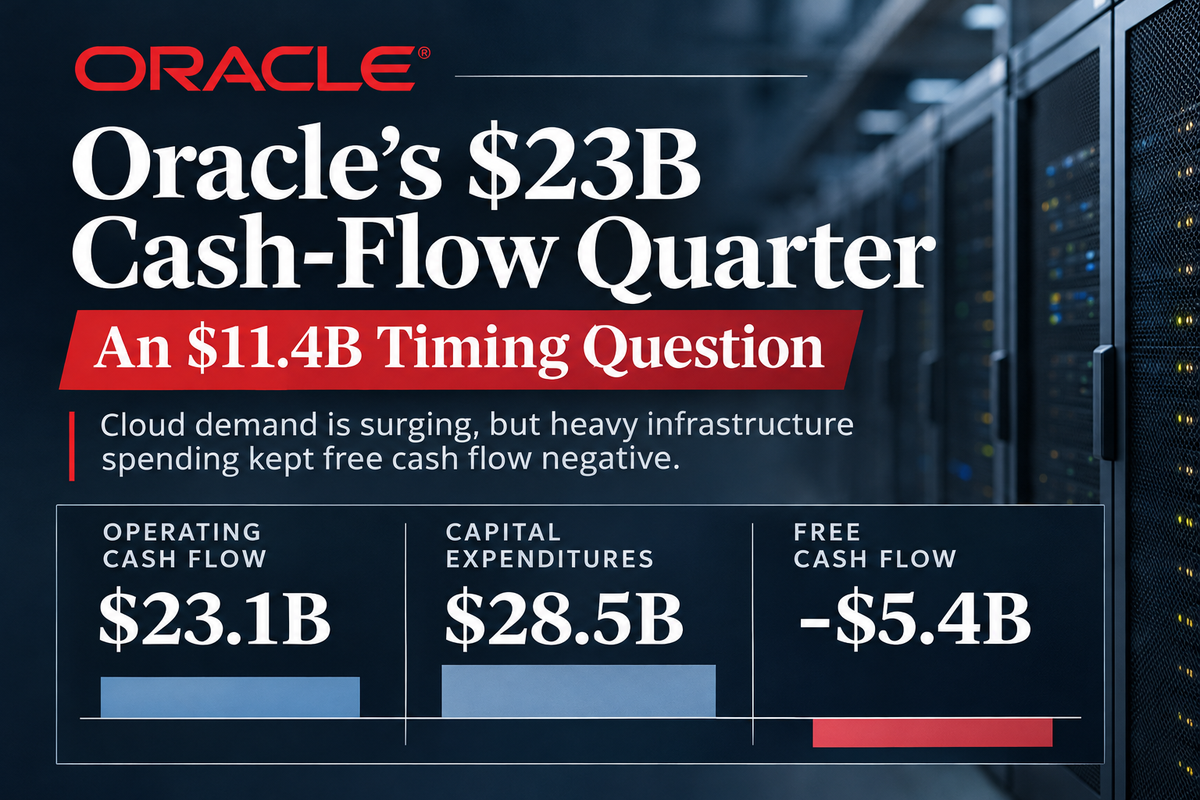
Cloud demand is surging, but large customer prepayments, infrastructure spending, and new shares make future free cash flow per share the more demanding test.
Oracle (ORCL) reported $23.1 billion in operating cash flow for its fiscal first quarter ended August 31, 2026, up from $8.1 billion a year earlier. That sounds like compelling evidence that its AI infrastructure expansion is beginning to fund itself. The cash-flow statement, however, asks for a more careful reading: $11.36 billion came from an increase in deferred revenue tied to customer prepayments carrying a significant financing component. At the same time, Oracle spent $28.50 billion on capital expenditures.
Those prepayments are genuine cash, not a fictitious accounting entry. They can also indicate customers are willing to commit capital before receiving the contracted services. But cash received upfront is not the same as cash generated after delivering those services, and it is not automatically available as distributable free cash flow.
This distinction matters because Oracle is no longer being evaluated solely as a mature software company. Its fiscal first quarter cloud infrastructure revenue grew 121% to $7.4 billion, while total revenue increased 30% to $19.3 billion. Remaining performance obligations, or RPO, reached $664 billion, versus $455 billion one year earlier. The demand signals are substantial. The question is how they translate into durable cash generation after capacity is built and operated.
A cash-flow surge with two different drivers
The comparison is striking. In the quarter ended August 31, 2025, Oracle generated $8.14 billion in operating cash flow and spent $8.50 billion in capital expenditures, producing negative free cash flow of $0.36 billion. One year later, operating cash flow had reached $23.10 billion, but capital expenditures rose to $28.50 billion. Free cash flow therefore fell to negative $5.40 billion under Oracle's own definition: operating cash flow minus capital expenditures.
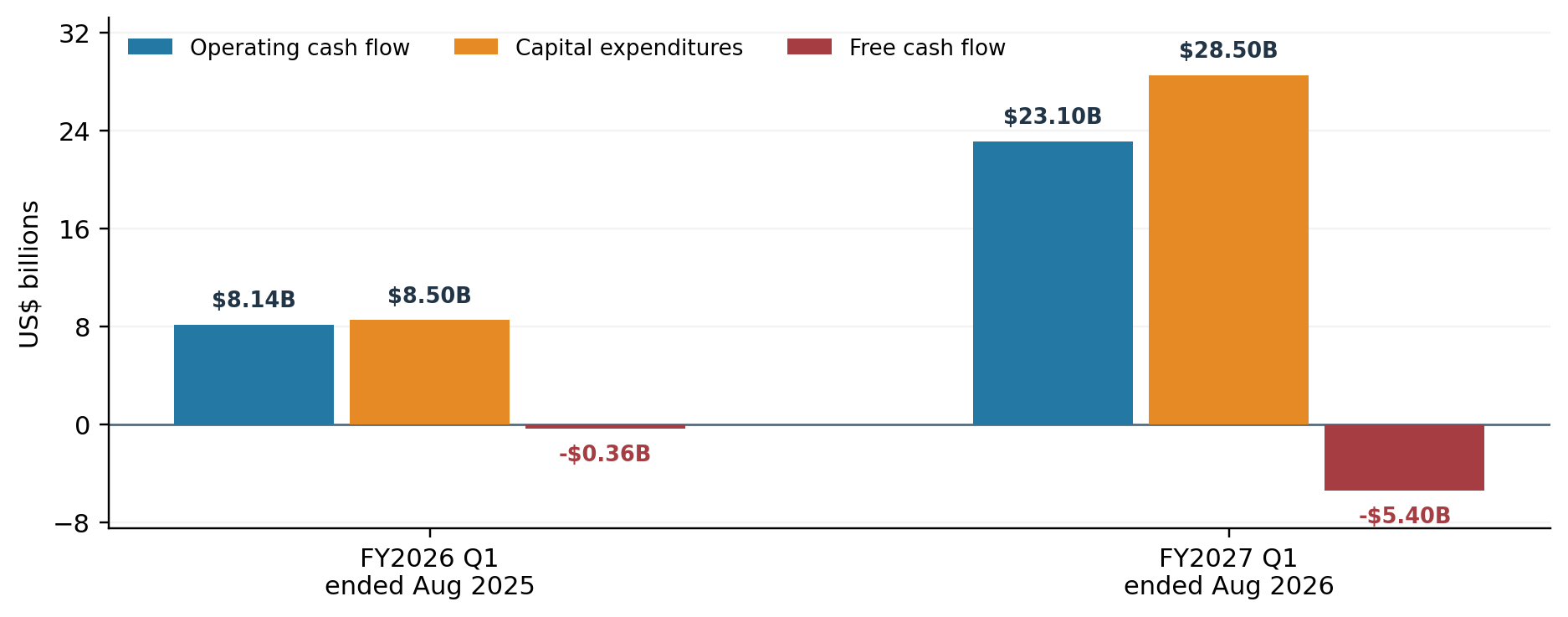
Figure 1. Fiscal first-quarter operating cash flow, capital expenditures and free cash flow (operating cash flow less capital expenditures), US$ billions. Source: Oracle Form 10-Q for the quarter ended August 31, 2026. Values rounded for display.
In other words, the company generated far more operating cash but spent even more building the infrastructure required to meet demand. That is not necessarily evidence of a bad investment. It is evidence that reported operating cash growth, by itself, cannot answer whether the buildout is becoming self-financing.
The financing component makes the comparison more nuanced. Oracle disclosed $11.363 billion of deferred-revenue growth from customer prepayments carrying a significant financing component in the current quarter, with no comparable amount in the year-earlier cash-flow statement. That represents about 49% of the $23.103 billion in operating cash flow reported this quarter. More strikingly, it equals approximately 76% of the $14.963 billion year-over-year increase in operating cash flow ($23.103 billion less $8.140 billion). Both percentages are arithmetic comparisons, not claims that the prepayments caused 49% of total cash generation or 76% of the change. Removing that single cash-flow line leaves $11.740 billion, but this is not a normalized operating cash-flow measure. Other working-capital movements matter, and the calculation says nothing about the profitability or eventual cash costs of delivering the prepaid contracts.
A $664 billion backlog has a long delivery schedule
Oracle estimates that only approximately 13% of its $664 billion RPO will be recognized as revenue in the next twelve months. It expects 37% in months 13 through 36, 34% in months 37 through 60, and the remaining 16% thereafter. These are management estimates of revenue recognition, not a timetable of profit realization or free-cash-flow collection.

Figure 2. Expected timing of revenue recognition from RPO as of August 31, 2026. Percentages are Oracle's estimates; the final 16% is the arithmetic remainder. Source: Form 10-Q.
This is both the opportunity and the risk. Multi-year commitments can increase demand visibility, making large capacity investments easier to justify. Yet the services still have to be delivered, the associated costs have to be incurred, and the expected margins must ultimately appear in reported results. Backlog should not be treated as cash already earned, or simply divided by a current-year revenue figure to infer a valuation multiple.
The commitments behind the capacity
There is another reason to separate contracted demand from realized cash economics. Oracle disclosed $288 billion in additional lease commitments, substantially all tied to data centers, that had not yet commenced and therefore were not reflected as liabilities on its August 31 balance sheet. These leases are generally expected to begin between the second quarter of fiscal 2027 and fiscal 2029, with terms of 15 to 19 years.
That $288 billion figure is not a bill due next quarter, nor is it directly comparable with RPO. Lease payments extend across many years, and the amounts represent different contractual relationships and timing conventions. It would be misleading to subtract $288 billion from the $664 billion backlog and present the result as an economic value. The relevant question is whether the cash earned from the underlying services over time will sufficiently cover data-center operating costs, lease commitments, and capital required to maintain the business.
Financing is already part of the picture. Oracle raised $19.9 billion in net proceeds by issuing approximately 141 million common shares through its at-the-market program during the quarter. Its reported common shares outstanding rose from 2.880 billion on May 31, 2026 to 3.024 billion on August 31, 2026, an increase of about 5%. Management also stated that it expected existing liquidity, operating cash generation, and available financing arrangements to cover obligations over at least the following twelve months. The capital raise supports liquidity and investment capacity, but it is not free cash generated by operating activities.
Oracle's cloud growth strengthens the demand case, but it does not by itself answer the per-share investment question. Investors therefore need to track whether contracted revenue eventually produces durable cash after the cost of building, operating and maintaining the required capacity, and how much of that cash accrues to each share as the share count changes. The larger share base is not, by itself, proof that the investment will destroy per-share value: financing could fund productive assets whose future economics more than compensate. A judgment about ORCL's valuation would also require a dated share price and explicit assumptions about future cash generation.
What would prove the thesis, or weaken it?
The constructive case is straightforward: AI-related cloud demand is growing rapidly; customers are committing to services years in advance; upfront payments reduce some near-term funding pressure; and large investments could eventually support attractive recurring economics. That argument deserves serious consideration.
The more skeptical case is also grounded in the filings: capital expenditures are running ahead of operating cash flow, customer financing materially affects the current cash-flow comparison, and very long-term infrastructure commitments introduce execution and utilization risks. Neither case can be settled using one quarter of data.
Over the next several reporting periods, I would follow four tests. First, how quickly does RPO become recognized cloud revenue? Second, do operating margins and cash collections improve after the associated capacity is delivered? Third, does free cash flow recover as capital spending moderates or utilization rises? Fourth, does free cash flow after investment improve on a per-share basis, taking account of any further share issuance, stock compensation and financing needs?
The most useful conclusion is not that Oracle's backlog is overstated or that its cash-flow improvement is illusory. It is that strong demand visibility and demonstrated cash profitability are different stages of the same investment thesis. Oracle has made the demand visible. The next test is how much lasting cash the contracts produce after the infrastructure is built, and how much of it ultimately belongs to each common share.

Comments
Log in or sign up to join the conversation.