

When Saudi Arabia, Russia, and other oil producing nations decided in November last year to limit oil production in order to stabilize the oil markets, many experts remained doubtful if the deal would hold through.
The OPEC nations known for under-reporting and non-compliance have had to set aside their differences in agreeing to the oil production cuts rather surprisingly. It was, however, obvious as Saudi Arabia started to feel the pinch of lower oil prices as well.
The oil markets cheered with enthusiasm as the deal was reached in November 2016, but so did the U.S. shale oil producers as well. In what seemed to be a strategic move by the Saudi's to deliberately let oil prices fall as a result of oversupply, the attempt to squeeze out the more expensive shale oil producers clearly failed.
Three months since the oil limits agreement took effect, the international crude oil markets continue to remain oversupplied with OPEC being forced into maintaining its strategy to keep production limited or risk another plunge in oil prices.
Surprisingly, OPEC nations have maintained a high level of compliance as the 11 nations adhered to their respective limits that were in effect since the start of this year. But at the same time, oil supply from the OECD nations also started to rise, pushing U.S. crude oil inventories to record highs and making the OPEC product cuts meaningless.
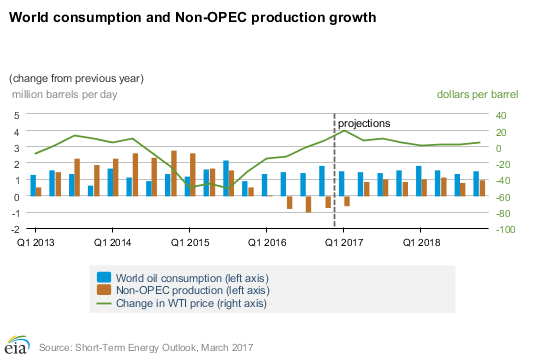
World consumption and non-OPEC production growth
With crude oil prices rising to nearly $55 a barrel in December last year, shale oil producers returned to the market, obviously a lot more leaner and effective and have since then, been pumping oil with a vengeance. Since OPEC decided to open the supply taps in June 2014, the U.S. shale oil industry has undergone a transformation.
Global upstream costs fell by 30% between the years 2014 through 2016 with cost deflation in the U.S. higher at 45%. The supply glut might have forced the U.S. shale oil producers out of business temporarily, but it allowed for the industry to become even more cost efficient.
The next OPEC meeting is due in Vienna in the month of May, and the OPEC/non-OPEC agreement is very likely to be extended for the remainder of the year.
The topic of Iran's exemption will no doubt resurface during the next OPEC meeting in May. Previously, the nation was exempted from supply cuts in order for the nation to rebuild its oil industry after the U.S. had imposed sanctions were lifted in January last year.
Iran is said to have increased production by over 800,000 barrels per day to 4 million bpd. Thus, it would have a hard time convincing OPEC members to continue to exempt the nation.
Going forward, Russia's contribution is likely to play a key role. The nation accounts for more than 50% of cuts from the non-OPEC nations. However, Russia has maintained that the oil production cuts will be gradual. It is estimated that Russia's production cuts have been around one-third of the agreed upon volume.
The nation has also sent out feelers that it is unwilling to participate in further production cuts as it views the current product limit deal having only a limited effect in the oil markets.
Both Russia and Iran are therefore likely to make things complicated for Saudi Arabia when the OPEC nations meet in just under a month’s time from now. The question will be whether Saudi Arabia will bear the brunt and take a massive product cut on itself or if the nation will manage to get both Russia and Iran on board to push forth with its agenda to push oil prices higher.

Comments
Log in or sign up to join the conversation.