

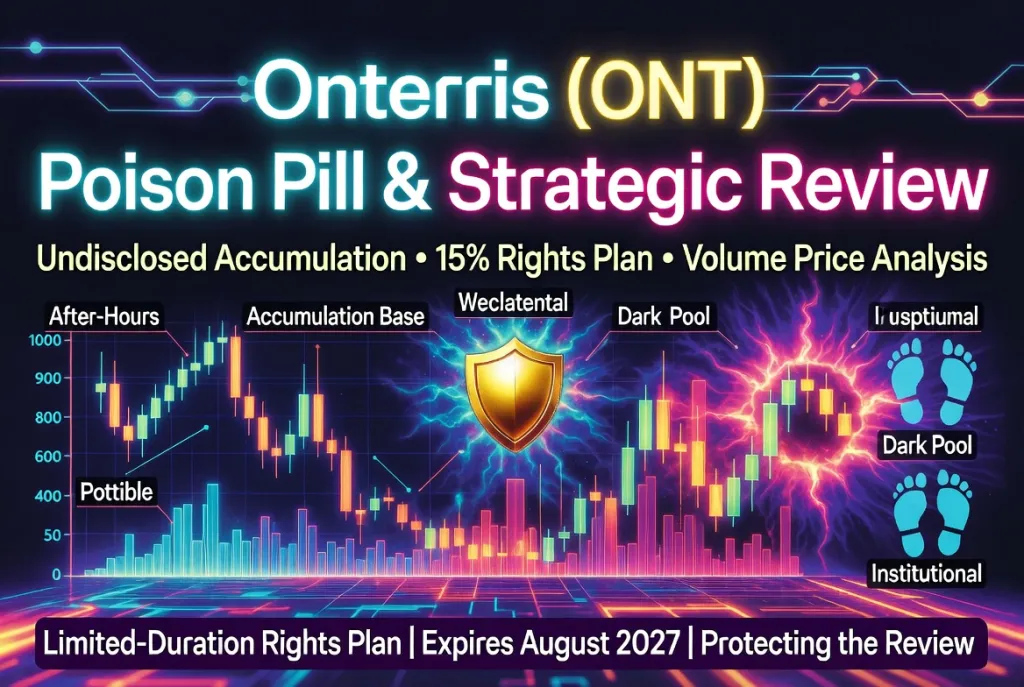
On 5 August 2026, Onterris, Inc. (ONT) delivered a textbook example of how corporate defence, operational headwinds and quiet accumulation can collide in a single trading session. The environmental services company reported weaker-than-expected second-quarter results, cut its full-year guidance, announced a comprehensive Board-led strategic review, and adopted a limited-duration stockholder rights plan (the classic “poison pill”). The share price, which had closed the regular session around $22.60–$22.80, plunged sharply in after-hours trading toward the mid-to-high teens.For traders who focus on Volume Price Analysis, corporate actions and the footprints of larger players, this combination is relatively rare and therefore instructive. It raises clear questions about background, motivation, immediate implications for shareholders, and the range of possible medium-term outcomes.
Company Background
Onterris is the rebranded form of Montrose Environmental Group. The name change and ticker switch from MEG to ONT took effect on 4 May 2026. The company provides environmental consulting, laboratory testing, treatment and related services across the United States, Canada and Australia. Its work often involves complex regulatory, air, water and soil challenges, including areas such as PFAS treatment and emergency response. Like many specialised service businesses, revenue can be lumpy. A meaningful portion has historically come from environmental emergency response and recovery work, which is inherently unpredictable. The company has grown through organic expansion and bolt-on acquisitions, maintains a share-repurchase programme, and had been targeting margin improvement even as it navigated variable top-line conditions.
What Triggered the Announcements
In the second quarter of 2026, revenue fell to $186.7 million from $234.5 million a year earlier. Management attributed the decline primarily to historically low environmental emergency response activity, lower pass-through revenue, and some temporary regulatory effects on certain testing work. Adjusted EBITDA came in at $31.9 million (17.1 % margin). While adjusted earnings per share beat some expectations, the top-line miss was clear. Full-year 2026 guidance was lowered: revenue to $740–$790 million (from $840–$900 million) and Consolidated Adjusted EBITDA to $117–$120 million (from $125–$130 million). Management still pointed to expected margin expansion and solid second-half cash-flow generation, but the reduction was material.Alongside the numbers, the Board announced a comprehensive strategic review covering the business, portfolio, capital allocation, long-range plan and strategic alternatives—including the possibility of evaluating acquisition interest. No timetable or preferred outcome was given.To protect that process, the Board adopted a one-year limited-duration stockholder rights plan, effective immediately and expiring on 4 August 2027. The stated reason was “significant and undisclosed accumulation of Onterris shares and derivative securities.”
How the Poison Pill Works
The rights plan is a classic defensive mechanism. The company declared a dividend of one preferred share purchase right for each common share outstanding, payable to stockholders of record on 17 August 2026. Each right entitles the holder to purchase one one-thousandth of a Series B Preferred Share at an exercise price of $105 (subject to adjustment). These rights initially trade with the common shares. They become exercisable and trade separately only if a person or group acquires beneficial ownership of 15 % or more of the outstanding common shares (or launches a tender/exchange offer that would result in such ownership). At that point the rights of the acquiring person become void, while other holders can exercise at a substantial discount, creating heavy dilution for the unwanted buyer. The Board can redeem the rights for a nominal $0.001 each or exchange them under certain conditions. The plan is deliberately short-dated (one year) so that it does not become a permanent entrenchment device.
Why the Company Took This Step
The Board’s explicit rationale is straightforward: protect the integrity of the strategic review and ensure that any party seeking control must do so on terms that appropriately compensate all stockholders. An undisclosed accumulation—especially one involving derivatives as well as shares—creates the risk of a “creeping” position that could later be used to influence or disrupt the review process without paying a control premium. By installing a 15 % trigger and a time-limited poison pill, the Board buys itself breathing room. It forces any large buyer either to negotiate or to stay below the threshold while the review runs its course. This is a standard defensive response when management detects unusual activity that has not yet triggered public 13D or 13G filings.
What It Means for Ordinary Shareholders
For most retail and institutional holders the immediate practical impact is limited. The rights are distributed automatically; no action or payment is required. In normal circumstances the rights expire unused or are redeemed for a negligible amount. There can be temporary accounting or display quirks in brokerage accounts when the rights are declared, because the theoretical value of the rights is conceptually stripped from the common stock. This can produce large-looking unrealised losses that do not reflect the actual market price movement of the shares themselves. Those distortions typically resolve once the corporate action is fully processed. The short-term price reaction has been negative, which is common when guidance is cut and a defensive rights plan is announced simultaneously. Markets often interpret the combination as a signal of uncertainty or as management protecting itself. Liquidity can thin and volatility rise while participants digest the news.
The Medium-Term Angle: Undisclosed Accumulation
This is where the situation becomes more interesting for traders. The Board would not adopt a poison pill lightly. The reference to “significant and undisclosed accumulation” of both shares and derivative securities implies that someone has been building a position quietly—most likely through dark pools, block trades, or synthetic instruments that avoid lighting up the public tape and public ownership filings. In many historical cases, such quiet accumulation has preceded either an activist campaign or a strategic approach. When a company simultaneously opens a formal strategic review, the probability that the accumulation is related to a potential transaction rises. A successful sale or other value-unlocking outcome would typically occur at a premium to the pre-announcement price, which is the medium-term positive scenario many long-term holders hope for. Of course, accumulation alone does not guarantee a favourable outcome. The buyer could be opportunistic, the review could conclude that the standalone plan is preferable, or market conditions could deteriorate further. The weak emergency-response revenue and guidance cut remain real near-term headwinds. Possible Paths ForwardSeveral scenarios are plausible:
The strategic review identifies a buyer or partner and a transaction is announced at a premium. The rights plan would then typically be redeemed or amended to facilitate the deal.
No credible transaction emerges and the company continues as a standalone entity, focusing on margin recovery, bolt-on acquisitions and capital returns. The rights simply expire in August 2027.
The accumulating party discloses a stake (via 13D or 13G) and engages constructively or confrontationally with the Board.
Further operational softness or broader market weakness keeps pressure on the share price, testing support levels established in prior months.
From a Volume Price Analysis perspective, the key will be the character of volume on any further declines versus any subsequent recovery attempts. Low-volume drifts lower after the initial reaction would be consistent with a temporary shake-out; high-volume selling that fails to produce new lows could signal absorption by stronger hands.
Conclusion for Traders
The Onterris episode is a compact case study in modern corporate defence. A company facing operational softness and an undisclosed buyer has chosen a short-duration poison pill to protect a newly launched strategic review. The immediate market reaction has been punitive, which is typical. Yet the very existence of significant undisclosed accumulation—especially alongside a formal review—keeps open the possibility of a medium-term catalyst that many investors would view as constructive. For traders the setup is rare enough to be worth watching closely: guidance cut + strategic review + 15 % rights plan + evidence of quiet buying. The next material developments are likely to be either a formal ownership filing, further commentary from the company on the review, or a shift in the volume profile that reveals whether the larger player is still active. Until then, the stock remains a volatile instrument whose price is being driven as much by corporate-action mechanics and positioning as by the day-to-day fundamentals of environmental services. Patience, attention to volume, and awareness of the rights-plan calendar (record date 17 August) will be useful companions for anyone following the story.



Comments
Log in or sign up to join the conversation.