

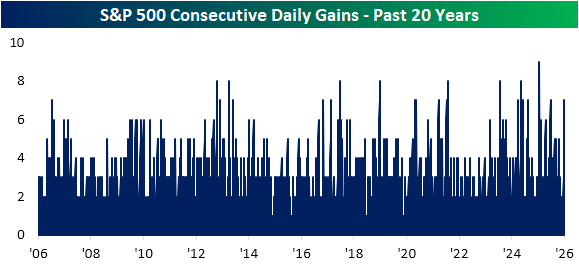
Over the weekend, ceasefire talks fell apart, and the Strait of Hormuz started facing a blockade this morning. Despite these negative catalysts leading to a negative tone at Monday's open, equities rallied throughout the session with the S&P 500 finishing up over 1%. That return to green candles also meant the S&P 500 has now rallied in eight of the last nine sessions. In fact, Friday was the only down day recently, and that snapped a seven-day winning streak. As shown below, that was the longest streak of consecutive up days since another seven days last October. Going back to 2000, that was the 29th example of a winning streak of 7 days or more, with the longest going for nine days last May.
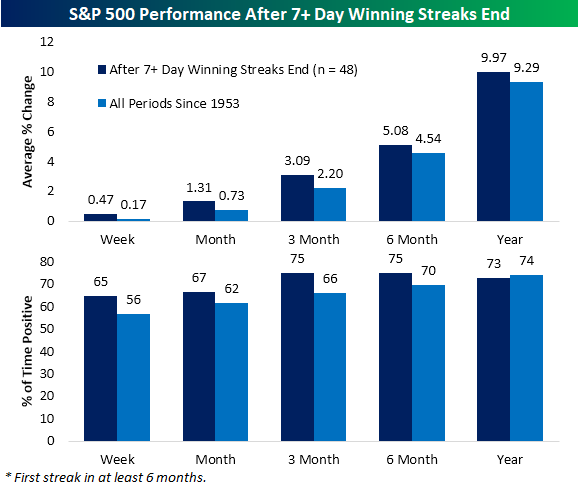
Again, winning streaks lasting at least 7 days have been somewhat uncommon. Filtering out those streaks to only look at those without another one in the prior six months, as was the case recently, there have been 48 instances since the start of the five-day trading week in 1953. As shown below, from the close of the first down day that ended those winning streaks, the S&P 500's average performance has been modestly stronger than the norm and consistently positive in the weeks and months ahead.
The broad index isn't alone in stringing together a number of up days in a row. Of all S&P 500 members, seven are currently on even longer winning streaks of at least nine trading days, with one stock, State Street (STT), now on a ten-day winning streak. In the charts below, we show how those streaks stack up versus their respective histories. None of these winning streaks has gone on long enough to be records, although STT and Microchip (MCHP) are each only one day away. We would note that most of these stocks, other than STT, are in the Tech sector or adjacent to it. Regarding Intel (INTC), its winning streak is one of many that have lasted 9 days throughout its history, but as we discussed in an earlier post, there hasn't been a time since 1984 that it has risen by more in such a span.


Comments
Log in or sign up to join the conversation.