On Holding Chooses Margins Over Volume

On Holding is prioritizing gross margins over volume by throttling wholesale shipments to protect its premium brand.

High growth sportswear brands usually face a harsh choice when consumer demand normalizes. They can push more inventory into wholesale channels to protect near term revenue, or they can slow shipments to protect full price selling. On Holding (ONON) is choosing the second path, but only after some of its everyday running shoes sold more slowly than management wanted at U.S. retailers. The Swiss sportswear company moved its full year constant currency growth outlook from at least 23% to the low 20% range while raising its gross margin forecast. This moves the debate from how fast the company can grow to whether strong direct to consumer demand and better margins can offset a real slowdown inside part of the wholesale business.

Main Note

The Premium Pivot at On Holding

On Holdings (ONON) Quote

Verdict: Management is sacrificing some near term wholesale revenue to protect full price selling and retailer inventory health, but the slowdown is not purely optical. Sales of some everyday running shoes at U.S. retailers fell below management’s expectations. The bullish case is that direct to consumer growth and a higher mix can protect margins. The bearish case is that the wholesale weakness is an early sign that demand for the brand is cooling.

What happened

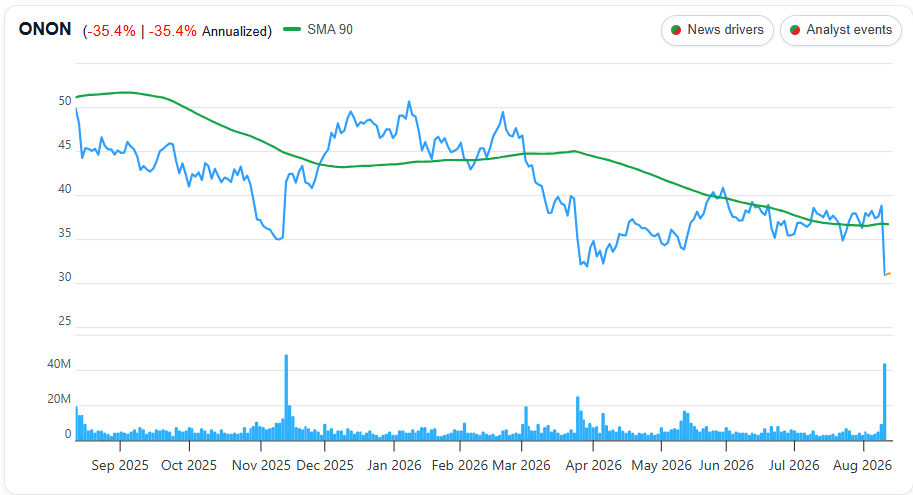
On Holding reported second quarter net sales of 850.3 million Swiss francs, up 13.5% as reported and 21.6% at constant currency, but below the roughly 878 million francs analysts expected. Direct to consumer sales grew 34.3% at constant currency, while wholesale grew 12.7%. Growth in the Americas slowed to 13% from 17% in the first quarter, and the shares closed down roughly 20%.

Management lowered its full year constant currency growth outlook from at least 23% to the low 20% range. At current exchange rates, the company now expects 3.47 billion to 3.56 billion Swiss francs in sales, compared with its prior forecast of at least 3.51 billion. That means the lower end came down, but the midpoint of the new range is close to the old floor. Management said it held back wholesale shipments after sales of some everyday running shoes at retailers fell below expectations, particularly in the Americas. The goal is to keep retailer inventory clean and protect full price selling ahead of new products, not to abandon wholesale or force shoppers into On stores.

On Holdings (ONON) 1 Year Chart

On Holdings (ONON) 1 Year Chart

Why it matters

Wholesale partnerships are excellent for volume but terrible for pricing control. When retail partners panic about inventory, they slash prices, which trains consumers to wait for sales. By pulling back from wholesale, On Holding is trying to stop that cycle before it permanently damages the brand equity that allows it to charge up to $290 for a pair of running shoes.

What changed in the thesis

Investors previously modeled On Holding as an unstoppable hyper growth story where wholesale and direct channels would expand simultaneously. The new setup requires investors to accept a slower, more deliberate growth trajectory where margin expansion matters more than unit volume. The math now depends on direct to consumer sales accelerating enough to plug the hole left by the wholesale retreat.

What the market may be missing

The market is not simply confusing a strategic choice with a demand problem. There is a real demand issue inside part of the U.S. wholesale business because management said sales of some everyday running shoes at retailers were below its ambitions. The counterweight is that direct to consumer sales still grew 34.3% at constant currency, gross margin reached 65.4%, and management raised its full year gross margin outlook to at least 65%. The key question is whether those strong direct results are a better signal of brand health than the softer wholesale performance.

Valuation and expectations

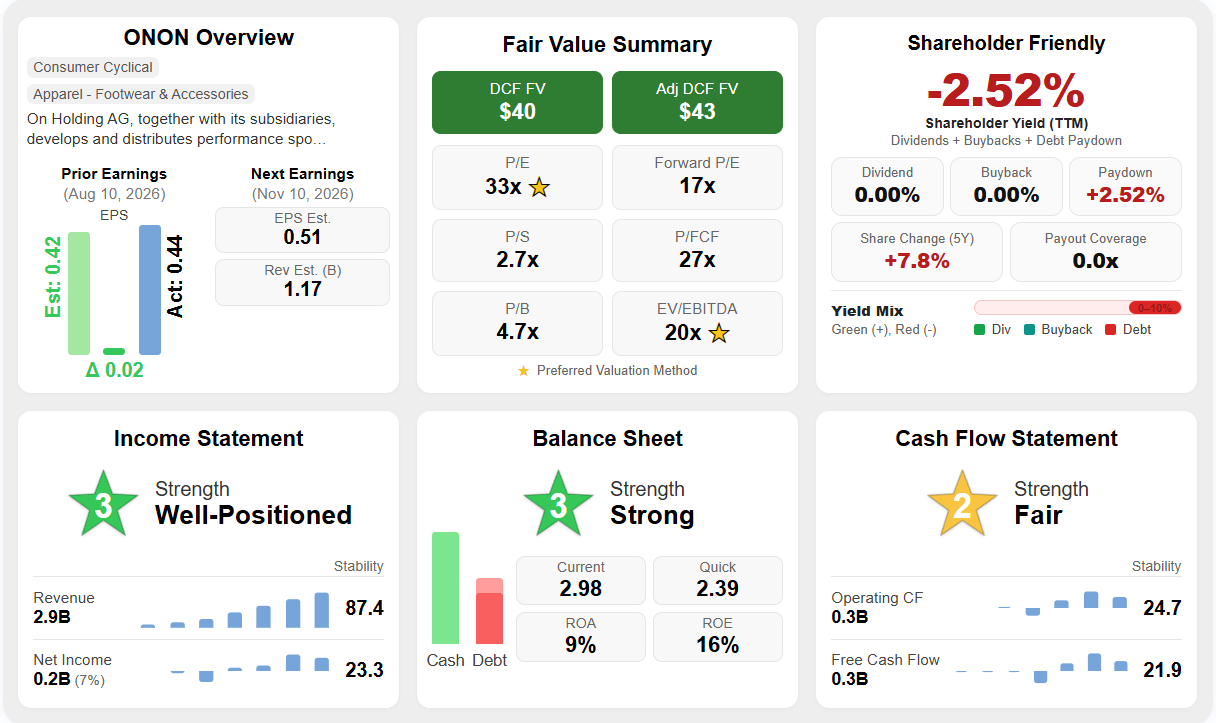
The valuation multiple for On Holding requires pristine execution. With the revenue growth estimate coming down, the stock must find support through expanding gross margins. If the direct to consumer shift fails to lift gross margins over the next two quarters, the market will likely compress the multiple further.

On Holdings (ONON) Summary Scores

On Holdings (ONON) Summary Scores

Bottom line

On is not shrinking wholesale into irrelevance. Wholesale still represented more than half of second quarter sales and grew 12.7% at constant currency. The company is temporarily moderating shipments, mainly in the United States, to keep retail inventory clean ahead of new products. The next two quarters need to show three things at once: healthier wholesale sales to shoppers, continued direct to consumer growth, and gross margin strength without relying on a permanent retreat from wholesale.

Pre Market Pulse

  • The July consumer price index report is scheduled for release at 8:30 AM ET today. Economists expect headline inflation to rise 0.1% from June and 3.4% from a year ago, while core inflation is expected to rise 0.2% for the month and 2.5% from a year ago.

  • Investors are watching the report to judge whether the Federal Reserve holds rates steady or raises them in September. Markets are roughly split between those two outcomes, so the current debate is not about an interest rate cut.

  • U.S. stock futures were modestly higher before the report, with Nasdaq futures leading after upbeat results from several artificial intelligence infrastructure companies. Higher energy prices tied to the Middle East conflict remain an important inflation risk.

Why it matters this morning

Today’s consumer price report is a test of inflation and the Federal Reserve’s next move, not a direct reading on consumer spending. A hotter report would strengthen the case for a September rate increase and could pressure expensive discretionary stocks. A cooler report could reduce those odds. The more direct test of consumer demand comes Friday, when July retail sales are released.

Peer Read Through

Nike (NKE)

The undisputed giant of athletic footwear has struggled with its own direct to consumer strategy, recently relying more on wholesale partners again to clear inventory. The On Holding news shows how difficult balancing these two channels remains.

Deckers Outdoor (DECK)

The parent company of Hoka is the most direct competitor to On Holding in the premium running space. If On Holding is pulling back from wholesale shelves, Hoka might capture that abandoned physical retail space.

Lululemon Athletica (LULU)

The apparel maker represents the gold standard of a mostly direct to consumer premium athletic brand. Its historical ability to avoid discounting is exactly the model On Holding is trying to replicate.

Group takeaway

The entire athletic apparel sector is currently bifurcated. Brands with strong direct relationships and pricing power are surviving, while those dependent on wholesale partners are suffering margin compression from industry wide promotions.

What to Watch

  • Third quarter revenue growth, which management expects to be slower than fourth quarter growth because most of the remaining wholesale reductions will happen in the third quarter.

  • Sales of everyday running shoes at U.S. wholesale partners to see whether the weakest part of the quarter begins to stabilize.

  • Direct to consumer growth and gross margin performance to confirm that the higher direct mix is producing durable profits.

  • Inventory levels to make sure slower wholesale shipments do not leave On carrying too much product on its own balance sheet.

  • The September 21 and 22 investor day in Zurich for the company’s updated long term strategy.

  • The October specialty store rollout of the Cloudsurfer 3 with the new SURREAL superfoam, followed by a broader rollout in January, along with the continued expansion of LightSpray into additional products.

Bottom line

The thesis does not rest entirely on the direct channel. It rests on whether On can keep direct sales strong while restoring healthier U.S. wholesale demand, avoiding excess inventory, and launching new products without discounting. If direct sales weaken at the same time wholesale remains soft, the bear case strengthens quickly.

STOCKS IN THIS ARTICLE

Also Mentions:

Comments