

Here’s a picture of Brent (monthly average of daily data) through October, and futures.
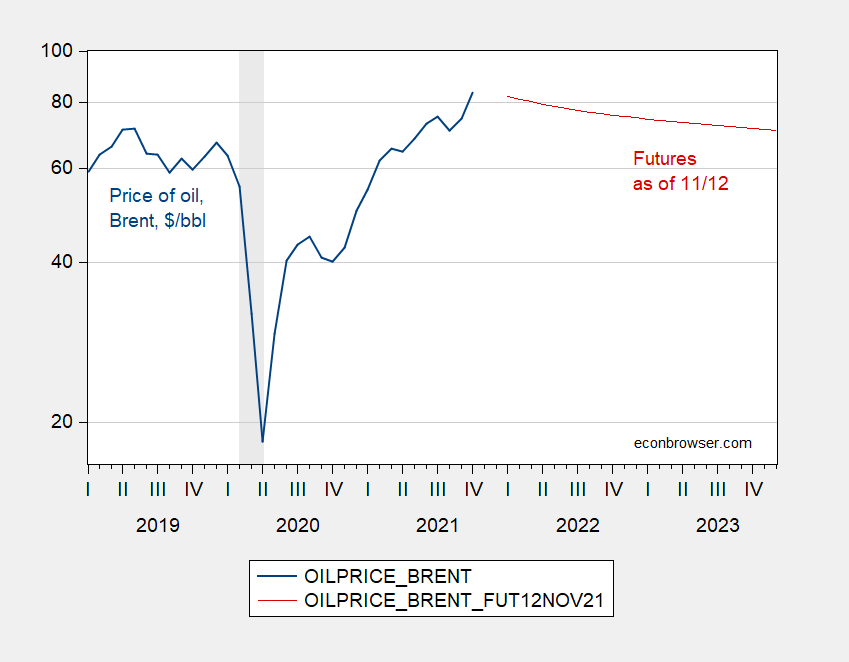
Figure 1: Price per barrel of oil (Brent) (blue), and futures contract prices as of 12 November 2021 (red), both $/bbl. NBER recession dates (peak to trough) shaded gray. Source: EIA via FRED, barchart.com, NBER.
Chinn and Coibion (2014) and subsequent analyses find futures do a fairly good job at prediction. Chinn and Coibion examined data up to 2012, for WTI, while Kwas and Rubszek (Forecasting, 2021) examined both WTI and Brent for 2000-March 2021. As noted in this post, futures improve upon a random walk for both RMSFE and direction of change at horizons up to a year.
The DOE’s Energy Information Administration model as reported in the Short Term Energy Outlook reports the following forecast for WTI (as of November 9th):
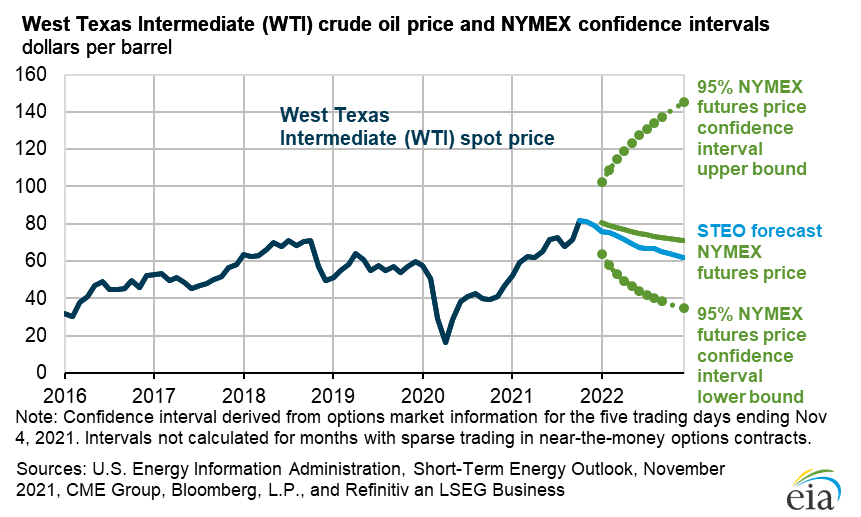
Source: DOE IEA STEO (November 9, 2021).
So both WTI and Brent are forecasted to decline. How much credence to put in either futures or the STEO forecast (described here)? Miao et al. (Energy Economics, 2017) conducts a horse race of LASSO factor models against various benchmarks, including futures and STEO’s forecasts. Futures and the STEO model do not do altogether badly in terms of the RMSPE’s.


Comments
Log in or sign up to join the conversation.