


Government measures helped to absorb price shocks partly
South Korea’s consumer price inflation rose 2.2% year-on-year in March (vs 2.0% in February, 2.3% market consensus). On a monthly basis, prices rose 0.3%, below the market consensus of 0.6%. Rising global oil prices explained most of the increase, though the impact was smaller than expected. Government measures such as the fuel price cap and food vouchers helped to reduce the impact on consumers. Transportation prices rose the most, by 5% YoY, compared to the previous month’s 1.1%. But food prices declined to 0.5% from the previous month’s 2.1%. The March figures indicate that the uptick in commodity prices has not yet broadened to other products or services. Excluding food and energy, core inflation edged down to 2.2% (vs 2.3% in February, 2.1% market consensus).
Although today’s inflation increase came in below expectations, we expect the recent rise in energy prices to exert a stronger influence in the months ahead. Fuel costs continued to rise despite the price cap. We also expect currency impacts to feed through to domestic prices in the coming months.
Fuel price cap measures helped to limit the gasoline price hike
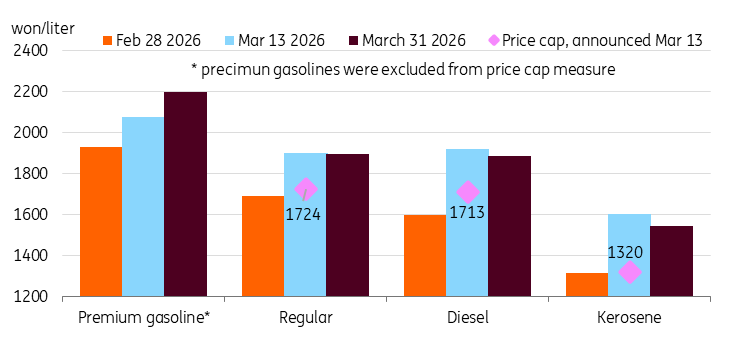
Source: CEIC, Opinet
BoK watch
Price pressures remain relatively contained due to government support, even as domestic demand is poised to weaken. Thus, the Bank of Korea is expected to keep its policy rate at 2.5% at the April meeting. The BoK will likely take a wait-and-see approach as it evaluates whether external shocks are contained or intensify. It will also consider the impact on growth and financial stability.
BoK will take a wait and see stance at its April meeting
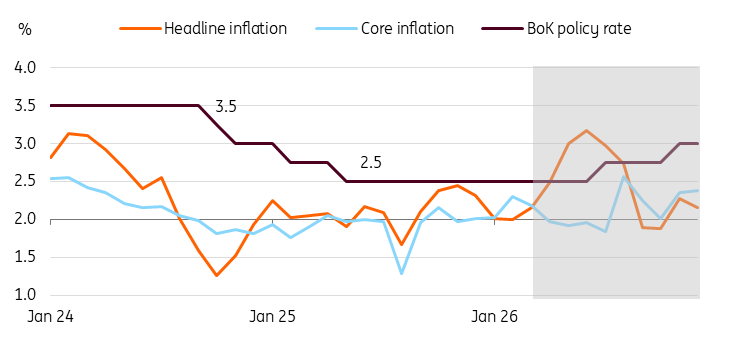
Source: CEIC, ING estimates



Comments
Log in or sign up to join the conversation.