

US equity index futures managed a small bounce overnight but were struggling to shake off the growing list of macro concerns. Rising oil prices and higher government bond yields reinforce a difficult backdrop for risk assets right now. Unless something fundamentally changes, it is difficult to see how investors will justify increasing their risk exposures. Among the major indices, the Nasdaq 100 is particularly exposed to the shift in market conditions, given the index’s heavy concentration in long-duration technology and growth stocks. Granted, stocks such as Meta (META) were sharply higher premarket (after the company introduced Muse, a personal AI agent), but company-specific news is happening in a challenging macro environment.
Key inflation data ahead
The recent struggles for stocks come ahead of an important run of economic and policy events, including the ECB’s interest-rate decision, US inflation data and further developments in the Middle East.
For now, investor sentiment remains cautious, with the combination of higher energy prices and elevated borrowing costs threatening to at least extend the recent period of consolidation for major indices, if not trigger a correction of some sort.
Oil remains at the centre of the market debate
Yesterday saw Brent crude climb above $100 a barrel for the first time since July, and today we are looking at even higher oil prices, as the conflict has intensified with no signs of the two sides getting back to the negotiating table. This is raising fresh concerns over energy supplies, at a time when China is reportedly replenishing its stockpiles - something the US must do too, with crude inventories here at their lowest levels since the early 1980s.
Iran, meanwhile, has warned that it is prepared for a more intense conflict and could escalate its counterstrikes if attacks on its territory and infrastructure continue. Tehran has also reorganised its military command structure around what it describes as a more offensive posture.
The risks are not confined to Iran. Saudi Arabia has taken several energy facilities in the south offline after Iran-backed Houthi militants in Yemen claimed further attacks on the kingdom.
For financial markets, the key concern is the prospects of a prolonged energy shock. Nasdaq 100 futures could reflect this changing macro environment soon.
A sustained move above $100 in crude would put renewed upward pressure on inflation. Meanwhile, tanker rates are surging higher, providing additional inflationary pressures. Central banks cannot ease monetary policy in that environment, while higher energy costs squeeze households and corporate margins.
Treasury yields add another headwind
Oil is not the only source of pressure. US Treasury yields have also moved sharply higher this week, with the 10-year yield rising to its highest level since 2023, as it closes in on the key 5.00% level.
The move came despite the US government announcing that it would TRIPLE the size of its next buyback of longer-dated government debt. The measure was intended to support demand in the Treasury market, to help lower yields and reduce the cost of servicing the debt. But it appears to have backfired, with investors growing worried about the increasing levels of debt - now above $40 trillion- and rising interest payments.
Treasury Secretary Scott Bessent has argued that while the administration cannot determine the equilibrium price of government bonds, it can attempt to slow disorderly moves and prevent a damaging narrative from taking hold in the world’s largest bond market.
For technology stocks, the significance is straightforward: higher Treasury yields raise the opportunity cost of owning equities and reduce the present value assigned to future corporate earnings. That relationship bodes ill for equity markets.
CPI could determine the next move
Attention now turns to US inflation data. Producer prices for August are due first, due shortly, with economists expecting monthly PPI to have risen 0.4% after being unchanged in July.
Friday’s CPI report is likely to carry greater weight. Headline inflation is expected to have increased 0.4% month on month in August, leaving the annual rate at 3.4%. Core CPI is forecast at 2.4%, down from 2.5% previously.
A benign reading could give markets some breathing room. But an upside surprise, particularly against the backdrop of $100-plus oil and rising Treasury yields, would be more problematic. It could reinforce expectations of tighter monetary policy and put more pressure on already expensive growth stocks.
Nasdaq 100 technical analysis
Technically, the Nasdaq 100 futures remain trapped in a lengthy consolidation phase. The key question is whether that sideways pattern ultimately resolves higher or develops into a deeper correction.
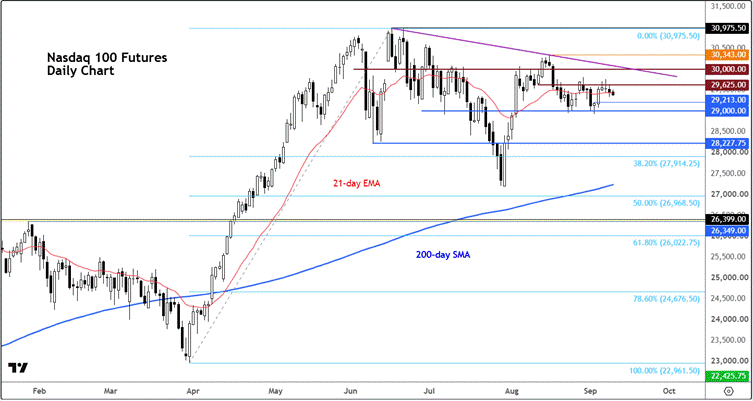
Support is currently concentrated around 29,000-29,200 on Nasdaq 100 futures. A decisive break below this region would be a clear bearish development. In that case, some follow-up technical selling could be the outcome, potentially towards the next support around 28,230ish.
On the upside, resistance is evident near 29,625. Beyond there, the psychologically important 30,000 level becomes the next major test. It also coincides with the descending trend line that has capped the market during the recent consolidation.
A sustained break above 30,000 would therefore represent a meaningful improvement in the technical picture and could signal that the broader uptrend is ready to reassert itself.
For now, however, the risks remain skewed towards caution. If Brent crude remains above $100 and Treasury yields continue to climb, the Nasdaq 100 may continue to struggle. With inflation data approaching, this could prove to be a pivotal week for US stock markets.

Comments
Log in or sign up to join the conversation.