

Global market ended the week on a positive note. Japan's index spiked above the 22,000 level for the first time since 1996. The benchmark index posted gains of 2.4% during the week. Robust corporate earnings coupled with broad economic improvements have led to the surge in the index.
Coming to the European markets, benchmark index in Germany and Britain too touched record highs during the week. Benchmark index in Germany posted gains of 2% during the week. Depreciation of Euro and Pound against the dollar have helped bolster shares of exporters in the European market.
Further, prices of crude oil surged to levels above 60 dollars during the week. From the lows of 30 dollars in 2016, the crude prices have now doubled. With, Organization of Petroleum Exporting Countries (OPEC) cutting production, global oil markets seem to be broadly balanced now after years of oversupply.
This sharp rise could be negative for corporates for whom crude and its derivatives is the main raw material. Paints, FMCG, aviation, oil and cosmetics industry are the industries which rely heavily on crude and its derivatives for its raw material requirement.
Key World Markets During the Week
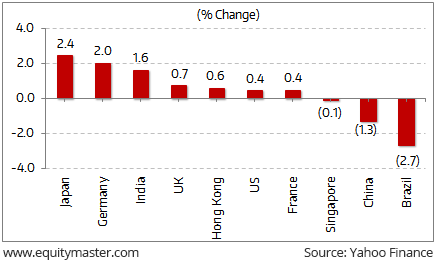
Back home, benchmark indices in India too logged record highs as BSE Sensex closed at 33,686. Strong capital inflows and services PMI data coupled with decent corporate earnings led to the index surging by 1.6% during the week.
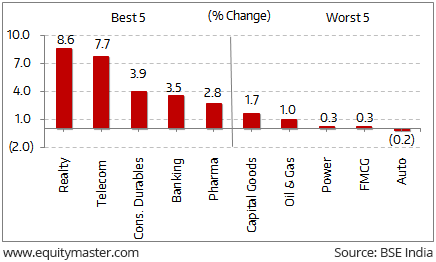
Majority of the sectoral indices ended the week on a positive note with stocks from realty and telecom sector gaining the most.
BSE Indices During the Week
Now let us discuss some key economic and industry developments during the week gone by
The Trend of Subdued Volume Growth Reversing for FMCG Companies
The volume growth as reported by top FMCG players in their second quarter results is nothing but encouraging. Heavyweights such as Hindustan Unilever India, Emami and Bajaj Corp reported decent volume growth of 4%, 10% and 5.1% respectively. The growth comes after back to back quarters of de-growth or sluggish growth.
A spurt in the volume growth essentially means that the FMCG players would now be in a better position to take price hikes. Henceforth, realizations could improve, leading to better margins.
However, it needs to be seen whether the spurt in the volumes is mainly on account of an increase in the demand from the end users. The reason why we say this, is because a lot of destocking had happened at the end of distributors in the first quarter. Restocking of goods in the second quarter may have contributed to the volume growth.
Provided, the volume growth has come in from the end user and that too from the rural territory, it would be good news for the FMCG companies.
India Broke into the Top 100 in the Ease of Doing Business Ranking
In the recent rankings as published by World Bank, India climbed almost 42 positions in the preceding two-three years, to make it to the 100th rank. From 142 in 2014, we are at 100 now.
The sharp jump was seen on the back of structural reforms like GST, RERA and the bankruptcy law.
However, the current ranking is still far off from the government's desire to make it to the top 50. Amitabh Kant, CEO of Niti Aayog, states one way of getting close to the top 50 is to ease the granting of construction permits. He further goes on to state that permits should be available online, with no human intervention involved.
Further, he states that the judiciary process should be expedited by establishing commercial courts at district level. He also emphasizes to not give more than three adjournments which is what the civil procedure court entails. We give adjournments ad nauseam. So we need to bring it down to just three and you will see India making a big jump.
Movers and shakers during the week
| Top Gainers During the Week (BSE Group A) | ||||
|---|---|---|---|---|
| Company | 27-Oct-17 | 03-Nov-17 | Change | 52-wk High/Low |
| Hindustan Copper | 69.85 | 87 | 24.4% | 88/50 |
| Divis Laboratories | 871 | 1,052 | 20.8% | 1,319/533 |
| Jet Airways | 524 | 623 | 18.8% | 645/332 |
| DLF Ltd | 184 | 213 | 15.8% | 216/101 |
| OPTO Circuits | 7.04 | 8.09 | 14.9% | 12/7 |
| Top Losers During the Week (BSE Group A) | ||||
| Bhushan Steel | 77 | 67 | -13.2% | 103/38 |
| UPL Limited | 830 | 777 | -6.4% | 902/584 |
| J&K Bank | 86 | 81 | -5.7% | 96/55 |
| JSW Energy | 86 | 82 | -5.3% | 88/54 |
| Multi Commodity | 1,067.9 | 1,012.1 | -5.2% | 1,411/932 |
Source: Equitymaster
Some of the key corporate developments in the week gone by
Divis Lab share price rallied 20.8% during the week on the reports that USFDA will be lifting the Import Alert 66-40 and moving to close out the Warning letter issued to the company's Unit-II at Visakhapatnam.
Coal India reported production and off take numbers for October 2017. The state-owned miner achieved 93% of the targeted coal production at 46 million tonnes in October 2017. For the period April- October 2017, actual coal production was 95% of the targeted at 278 million tonnes.
Offtake figures were 100% for the month of October, while those for the period between April-October 2017 stood at 97%.
Meanwhile, the Odisha government slapped a penalty of Rs 201.7 billion on Coal India's subsidiary, Mahanadi Coalfields Ltd. (MCL) for flouting environment and mining plant norms.
The Odisha government issued a show cause notice on why the penalty should not be imposed on the company and has given 30 days for the miner to respond.
The Odisha government is also assessing forest norms violation in the state and the amount of penalty for it. Another penalty could likely be levied for it on the company.
As per an article in the Economic Times, five Indian companies are named in a new lawsuit over alleged price cartelisation in the US.
As per the news, Sun Pharma, Dr Reddy's Labs, Emcure Pharma, Zydus Cadila and Glenmark Pharmaceuticals are among 12 generic drug manufacturers sued jointly by 45 US states over charges of colliding with each other to fix prices of nearly 15 drugs.
The lawsuit has also named global pharma majors such as Teva, Sandoz, and Activis among other drug companies in the above probe, which is an extension of a 2014 investigation where six companies were under the scanner.
As per article in a leading financial daily, Zydus Cadila received approval from the US health regulator to market Clobetasol Propionate ointment. The ointment is used to treat a range of skin conditions.
The company has received final approval from the US Food and Drug Administration (USFDA) to market its product in the American market.
The ointment will be manufactured at the company's Ahmedabad-based facility. Notably, the Zydus group has now more than 165 product approvals.
Torrent Pharmaceuticals Ltd is likely in advanced discussions to acquire the domestic formulations business of Unichem Laboratories Ltd for Rs 32-33 billion.
As per the reports, Torrent Pharma has been looking to expand its presence in the domestic market and Unichem has a good portfolio, particularly its Losar brand of drugs in the cardiovascular space. In 2016-17, Torrent Pharma's domestic business revenue was Rs 19.77 billion, up 8% YoY. Concerns over valuations have kept foreign buyers away from the pure generic drugs business in India.
Until September 2017, there have been 27 mergers and acquisition (M&A) deals in the pharma and healthcare sector, valued at US$719 million, which is much lower than the 54 deals, valued at US$4.7 billion, in calendar year 2016.
As per an article in The Economic Times, IDFC Bank and Shriram Capital are set to call off merger talks as both sides have failed to arrive at an acceptable valuation after four months of negotiations and regulatory misgivings.
As per the reports, the complex structure proposed by the managements involving at least four big entities engaged in transport and consumer financing and infrastructure funding. This stuttered various stakeholders who seemed to be pulling in different directions.
Reportedly, IDFC Bank was trying to find its feet in the fast-evolving, technologically driven banking industry after it got a licence in 2014. Shriram was keen on entering banking to reduce the risk of market volatility.
Some of the key corporate results in the week gone by
Power Grid Corporation of India Limited reported a 14.4% rise in net profit during the second quarter of financial year 2017-2018 compared to the corresponding quarter of the last financial year.
The net profit for the quarter under consideration stood at Rs 21.4 billion for the country's Central Transmission Utility. Comparably, PGCIL reported a net profit of Rs 18.7 billion in the same quarter of the last financial year.
Revenue from transmission business rose to Rs 70.6 billion during the second quarter of the current financial year. This is 13.6% higher than the Rs 61 billion revenue this business earned in the same quarter of the financial year 2016-2017.
Further, total income for the quarter stood at Rs 74.9 billion, 15.6% higher than the Rs 64.8 billion topline reported for the corresponding quarter of the last fiscal.
Bharti Airtel reported a 76% fall in consolidated net profit at Rs 3.4 billion for the second quarter. It had posted Rs 14.6 billion in the year-ago period.
Consolidated revenue also declined by around 12% to Rs 217.8 billion (Rs 246.5 billion).
Revenues from India stood at Rs 167.3 billion, a fall of 13% year-on-year (YoY), led by a mobile drop of 17% YoY, the company stated.
However, mobile data traffic grew four-fold in the quarter to 784 billion megabytes (MBs), against (178 billion MBs) in the year-ago quarter. Mobile broadband customers rose 34% to 55.2 million (41.3 million).
Reportedly, the financial stress in the industry continues due to double-digit revenue decline and will be further accentuated by the reduction in interconnection charge (IUC) rates in the next quarter. This will eventually force operator consolidation and exits as we have witnessed in the recent past.
Notably, the telecom regulator's call to cut interconnect usage charge (IUC) by as much as 57% and scrap it altogether from January 2020, is likely to trigger a sharp jump in Reliance Jio Infocomm's operating margins over the next one year.
This is another blow for industry players, as India has one of the lowest IUC rates in the world. Globally, the IUC rates continue to be gradually phased out.
Going forward, whether these companies will be able to enjoy additional revenues from having a large subscriber base or their profitability and debt servicing capability gets impacted will be the key thing to watch out for.
Tata Steel too reported its quarterly results. The consolidated net profit stood at Rs 10.2 billion for the quarter ended 30 September 2017 as compared to a consolidated net loss of Rs 494 million in the year ago quarter.
Total income during the second quarter increased to Rs 327.2 billion as against Rs 272.3 billion in the year-ago period.
During July-September 2017, total expenses of the company were also higher at Rs 305.7 billion as compared to Rs 268.7 billion a year ago.
Further, deliveries from India operations grew 17% year-on-year to 3.1 million tonnes in the quarter despite subdued market conditions. Wider product range enabled entry into new segments.
Consolidated quarterly total steel deliveries were up 15% to 6.5 million tonnes, with Indian deliveries contributing about 48% of the total.
During the quarter finished steel demand grew by just 4% QoQ. This was primarily due to subdued demand driven by the GST related issues, slower economic activity, the reports noted.
Reportedly, Tata Steel, which has reportedly shown an interest in the distressed assets of Essar Steel and Electrosteels Steel, is banking on the Thyssenkrupp arrangement in Europe to deliver its balance sheet.
Meanwhile, the company remains positive on the outlook for India as government reforms are expected to facilitate domestic investment and growth. The thrust on tax reforms and transparency will facilitate the formalisation of economy and serve as tailwind to players like Tata Steel.
Indian oil corporation reported its quarterly results. The company reported an 18.4% jump in September quarter net profit to Rs3,696.29 crore from a year ago on account of higher volumes despite increased costs. Indian Oil's revenue jumped about 10% to Rs 1.1 trillion in the second quarter from a year earlier as the company stepped up sale of refinery products in domestic and export markets.
Maruti Suzuki share price is expected to see some momentum as the company posted a marginal increase in September quarter net profit but still beat Street expectations. Maruti Suzuki India Ltd posted more than a 3% rise in its quarterly profit, beating analysts' estimates. The company reported a profit of Rs 24.84 billion (US$381.86 million) for the second quarter of FY18, versus Rs 24.02 billion a year ago.
ITC too reported its results. The company reported a 5.6% rise in net profit for the second quarter ended September 30, driven mainly by its paper and new FMCG businesses. Net profit stood at Rs 26.39 billion for the quarter and Rs 52 billion for the first half of 2017-18 compared with Rs 48.84 billion a year earlier. The company said that its performance was subdued as the legal cigarette industry volumes were under severe pressure due to the sharp increase in tax incidence under the GST regime.
And here's a note from Profit Hunter:
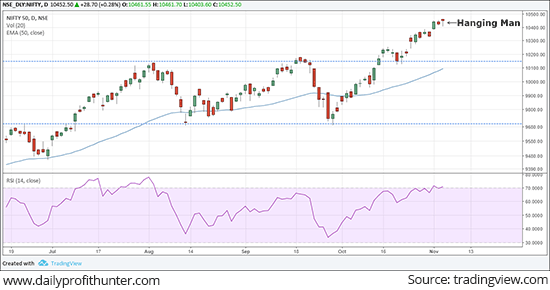
The Nifty 50 Index traded another week on a strong note. On Monday, it opened the session higher and continued to trade up to close positive. The index witnessed some selling pressure the next day, but the bears couldn't hold it down. On Wednesday, the index gapped up 55 points to hit a new lifetime high after India received a boost from World Bank for ease of doing business. Finally, on Friday, the index continued to trade positive and ended the weekly session at its life high - up 1.30%.
The index formed a hanging man candlestick pattern on the daily chart, which is a short term reversal pattern. A negative open and close in the next trading session will validate the pattern. This could mean a short term correction on cards.
From the low of 9,688 to today's close 10,452, the index has rallied one-sided in the past one month - up 7.90%.
Will the hanging man pattern bring in correction for the Indian markets or will the index continue with its steady momentum? Let's wait and watch... You can read the detailed market update here.
Nifty 50 Index Ends at Life High



Comments
Log in or sign up to join the conversation.