

No longer can President Trump act like a bully when it comes to trade relations with the U.S.'s two largest trading partners. Previously, the U.S. government used the “emergency“ powers under IEEPA (International Emergency Economic Powers Act) to lay on tariffs as a lever to pry concessions from Canada and Mexico regarding non-trade issues, such as border security and energy policy. The Supreme Court (SCOTUS) ruled that the use of tariffs is illegal under IEEPA. Canadian and Mexican trade officials now have a lot more bargaining power, even as Trump shifts to alternative legislation to continue his trade war.
Given the fact that Mexico and Canada now are the two most important trade partners, the SCOTUS ruling is all the more important, as the U.S. pursues its goal of reducing its trade imbalances. The two nations combined have a $243 billion trade surplus with the U.S., an increase of 5.3%.
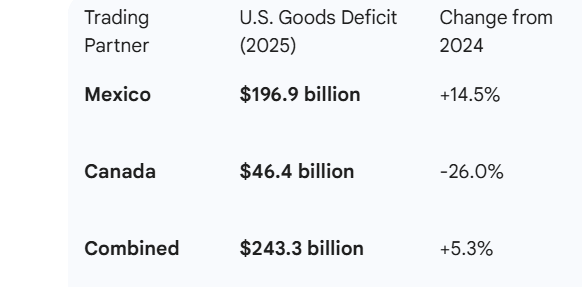
What is changed by the SCOTUS ruling? No longer can Trump use the bogus issue that Canadian immigration is too porous and he must impose the so-called “fentanyl” tariffs. What has not changed, however, are the tariffs that apply to steel and aluminum, since they fall under a different legislation, the Trade Expansion Act of 1974, used largely as pure protection against foreign competition. Overall, the Court ruling encourages Trump to work towards a deal without the use of a sledgehammer to make it quick. That technique has been used in many countries around the world, but has not been used in the case of Canada or Mexico. Neither government's head of state went running to the White House in search of trade. Although Canada was hit harder than Mexico on the initial round of tariffs, Prime Minister Carney played his cards well enough and bought the time needed prior to negotiations on Canada -US - Mexico Agreement (CUSMA). Now,the U.S. has lost a lot of the trade leverage it once had.
So, Trump is desperate for some form of tariff policy, and is pivoting to use other legislation to deal with U.S. trade deficits. However, these new sets of tariffs, by law, are short-lived to a maximum of 150 days. Then what? Midterm elections will dominate the political landscape in less than 5 months. Already, the House of Representatives voted to eliminate tariffs affecting Canadian exports. Pressures are building up with the U.S.business circles that tariffs are harmful. Studies by leading authorities conclude that the tariffs are exclusively borne by U.S. businesses and ultimately their customers.
For Canada and Mexico the real issue is how the Supreme Court ruling affects the negotiations for a renewal of CUSMA (USMCA, as it's known in the US), the free-trade agreement with its origins going back to the late 1980s (and replacing NAFTA in mid-2020) . At one end of the spectrum, the U.S. could walk away from the agreement upon its expiry (it is up for review mid-2026). However, with the enormous amount of trade crossing over the borders of Canada and Mexico, especially in autos and parts and in agricultural goods, it is not likely that Trump will act against the interests of some “red” states which are deeply entwined in two-way trade with Canada. We can expect that the negotiations on CUSMA will be protracted and from Canada’s viewpoint there is no urgency to begin talking. The dynamics involved in these negotiations have fundamentally changed with Trump having lost the indiscriminate use of tariffs. As for the sectoral tariffs, especially steel and aluminum, there are pressures on Washington to cut them back sufficiently, since many U.S. manufacturers are suffering from rising prices of basic materials and backlashes from U.S. customers who ultimately are paying for this misguided policy.
What started out as a grand plan to reduce U.S. trade deficits and, at the same time, revitalize U.S industries through reshoring of investment, is now coming apart. Trump will not let go of tariffs, but the two largest trading partners are now in a much stronger position to deal with the “tariff man”.



Comments
Log in or sign up to join the conversation.