


All eyes will be on Netflix Inc. (NFLX) and its free cash flow (FCF) generation when it releases earnings on Oct. 20 after the market closes. Last quarter, FCF dipped, along with operating cash flow. Will this repeat?
NFLX closed at $70.61 on Monday, Oct. 12, up slightly. NFLX has recovered from a recent trough at $67.06 on Oct. 2, but it's still down from a three-month peak of $82.73 on Sept. 2.
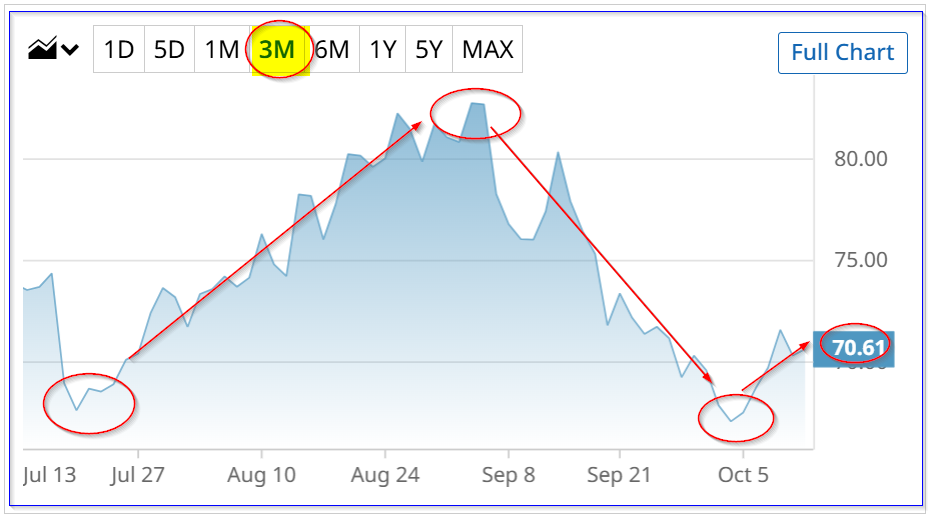
NFLX stock - last 3 months - Barchart - Oct. 12, 2026
But management expects to generate $12.5 billion in FCF, despite the Q2 dip. Higher taxes from the Warner Bros. (WBD) termination fee payout lowered Q2 FCF. That should not occur in Q3.
As a result, analysts expect higher Q3 FCF, and many expect it could rise over the $12.5 billion forecast in 2026.
Forecasting Netflix FCF
Analysts now forecast revenue will reach $51.22 billion this year. That's 13.36% over the $45.18 billion in revenue last year. Next year, they forecast $56.945 billion, another 11.1% increase.
So, if management's $12.5 billion for FCF comes to pass, the FCF margin will be 24.4%.
In the last 12 months (LTM) ending June 30, FCF was $11.15 billion, according to Stock Analysis. That includes the $2.8 billion termination fee collected in Q1. Without this fee, the $8.35 billion in LTM FCF represents 17.3% of its LTM revenue ($48.371) in Q2.
For the first half, FCF was $6.619 billion, including this fee, so the second half is expected to generate at least $5.881 billion in FCF (i.e., $12.5b - $6.619b). This would represent 18.3% of the expected $32.135 billion in revenue in H2 (i.e., $51.22 b est - $24.81 b H1 revenue).
In other words, management expects its FCF margin to rise. In fact, if it makes 18.3% next year, FCF could rise to $10.42 billion.
Projecting a Fair Market Value (FMV) for Netflix
Using a 3% FCF yield metric (i.e., dividing estimated FCF by 3.0%), the fair market value (FMV) for Netflix could be $347.3 billion:
$10.42b / 0.03 = $347.3 billion FMV
That is 18.1% higher than its existing market cap of $294.0 billion, according to Yahoo! Finance today. In other words, the price target (PT) is 18.1% above today's price:
$70.61 x 1.181 = $83.39 PT
Moreover, Wall Street analysts have significantly higher projections and PTs. Yahoo! Finance's survey of 51 analysts shows an average PT of $92.55. That is 30.5% higher than Monday's close. Similarly, Barchart's mean survey PT is $94.09, or 33.3% higher.
The bottom line is that analysts expect strong revenue and FCF, and they have been raising their forecasts and PTs.
As a result, one way to play NFLX is to short out-of-the-money (OTM) puts. That way, an investor can collect income while waiting for the stock to drop a bit for a lower buy-in.
Shorting OTM NFLX Puts
For example, the Nov. 13 expiry $66 put strike price has a midpoint premium of $1.69. This strike price is 6.5% below Monday's close (i.e., it is out-of-the-money).
It also has a low delta ratio of -0.2691. That implies a 73% chance of success for a short seller of this put.
Moreover, the expected yield for a short seller of this put contract is $1.69/$66.00, or 2.56% over the next month. The premium is collected upfront, so the short-seller already has a potential winning bet.
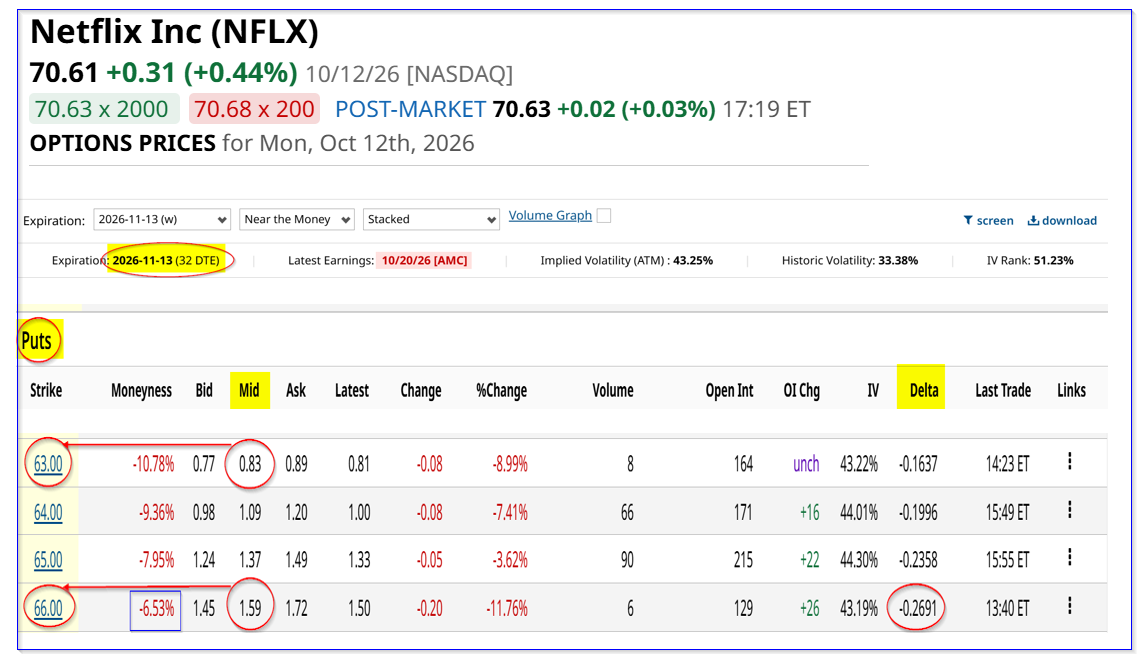
NFLX puts expiring Nov. 13 - Barchart - As of Oct. 12, 2026
That is very attractive to value investors, especially since the breakeven point is $64.41, or 8.9% lower than Monday's close.
However, note that to do this play, an investor must post collateral of $6,600 to collect $159 (i.e., a 2.56% income yield). The collateral would be assigned to buy 100 NFLX shares if the stock drops to $66.00 on or before Nov. 13 and the account is assigned to buy shares.
Note that the worst that happens here is that the investor could end up with an unrealized loss, if NFLX drops below $64.41, the breakeven point.
However, not every investor wants to tie up $6,600 to make just $159 over 1 month. Another play, with more risk, is to a put credit spread.
NFLX Put Credit Spread Play
Here, the investor would also buy 1 put to cover downside risk. But, as a result, the brokerage firm would require much less capital. The investor collects the difference in premiums.
So, for example, if the investor buys 1 put at the $63.00 strike price for $0.83 (i.e., $83 per contract), the next put credit collected is:
$159 - $83.00 = $76
Why do that? Because the collateral required is now only $300 (i.e., $66 short - $63 long x 100). So, the expected return (ER), if NFLX stays over $66.00, is very high:
$76 / $300 = 25.33%
Moreover, the “at risk” amount is even lower (i.e., $300 - $76, or $224) since the $76 is collected upfront. So, the net true ER is:
$76 / $224 = 33.93%
That is very attractive to value investors, especially if they expect NFLX to keep rising after its upcoming results.
The downside risk is high, though. For example, if NFLX drops to $63.00, the whole $300 is forfeited. The net loss is $224.
However, an investor could repeat the play, or get out of the trade and roll it over to the next month, if this happens. Moreover, consider this.
An investor could do 2 put credit spreads and collect $152 after posting $600 in collateral. That is more than a short-put investor would collect ($159) after posting $6,600.
The bottom line is that if NFLX stock keeps rising, this is an attractive way to play its rebound.


Comments
Log in or sign up to join the conversation.