


Netflix on tv with remote by freestocks via Unsplash
Netflix, Inc. generated $5.1 billion in free cash flow (FCF) in Q1, including a $2.8 billion deal termination fee. Adjusted FCF margins are still high, implying the stock is worth $119, +22%. One attractive play could be shorting OTM puts.
Netflix closed at $97.31 on Friday, April 17, down 9.7% after releasing its Q1 results after the market close on April 16. This is still above a recent low of $75.86 on Feb. 12, right before the company walked away on Feb. 26 from its attempt to buy Warner Bros. Discovery.
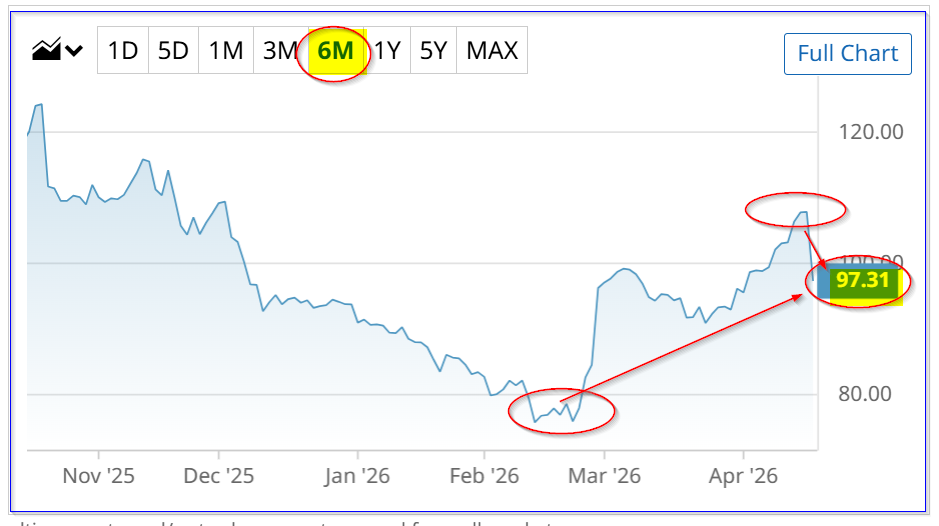
Image Source: Barchart - Netflix stock over the last six months as of April 17, 2026
Strong FCF and FCF Margin Results
Even after deducting the $2.8 billion cash termination fee, Netflix still generated $2.25 billion in operational free cash flow in Q1. That represented 18.4% of its revenue and was higher than the prior quarter's FCF of $2.11 billion (17.5% FCF margin).
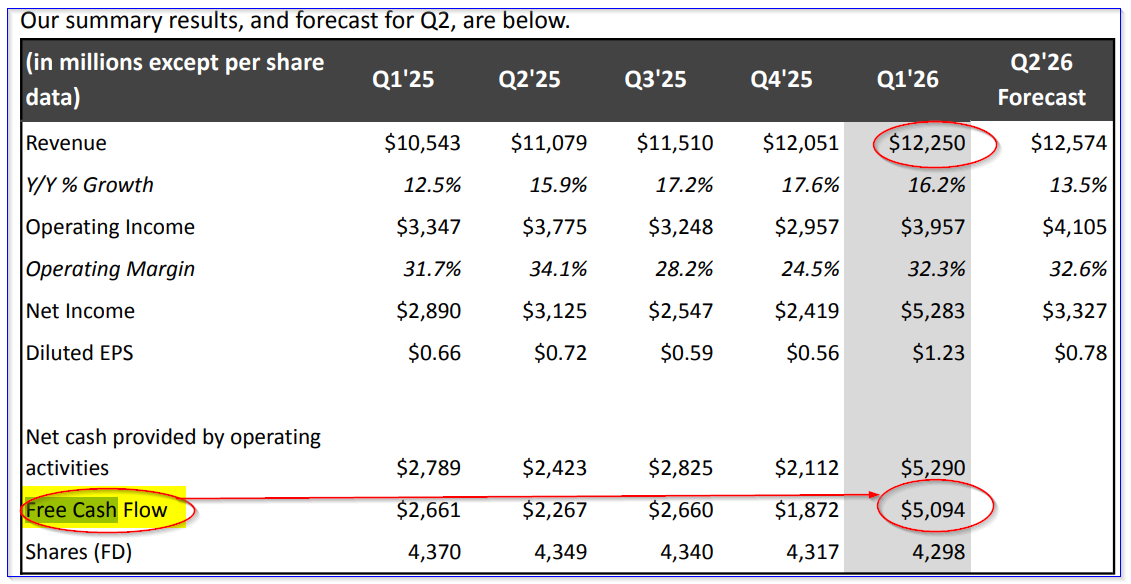
Image Source: Netflix Shareholder Letter - free cash flow (FCF) as of April 16, 2026
Moreover, over the trailing 12 months (TTM), its adjusted FCF was over 19.4%. This can be seen from Stock Analysis data, which shows that its TTM revenue was $46.8 billion, and its TTM FCF was $1.894 billion:
$11.894 billion - $2.8 billion fee = $9.094 billion adj. TTM FCF
$9.094 billion / $46.8 billion revenue = .1943 = 19.43%
That was only slightly down from its 20.94% FCF margin last quarter for all of 2025, as shown in Stock Analysis data.
Projecting Strong FCF
Moreover, management has guided that it expects to hit $12.5 billion in FCF for 2026, which equals $9.7 billion on an adjusted basis. It also forecasted revenue between $50.7 billion and $51.7 billion for 2026. That works out to a projected adj. FCF margin for 2026 of 18.95% (i.e., $9.7 / $51.2 billion average revenue).
However, if Netflix can generate an average 20% margin over the next 12 months (NTM), and using analysts' revenue estimates, Netflix could generate much higher FCF:
0.20 x $52.41 billion (Stock Analysis revenue forecast) = $10.48 billion adj. FCF in 2026
0.20 x $58.56 billion = $11.71 billion adj. FCF 2027
Therefore, the NTM FCF forecast is $11.1 billion. That would be $1.64 billion more than the $9.46 billion Netflix generated in 2025. In other words, adj. FCF is set to rise +17.3% over the next year. This could push Netflix stock's valuation much higher. Here's why.
Higher Price Targets for Netflix Stock
I previously discussed Netflix's valuation in a March 27 article. Over the last 12 months, Netflix's $9.09 billion adj. FCF works out to 2.21% of its present market cap of $410.9 billion, taken from Yahoo! Finance calculations:
$9.09 / $410.9 billion = 0.0221 = 2.21%
That is the same as multiplying its adj. FCF by about 45x (i.e., 1 / 0.021 = 45.3x) . Therefore, using our NTM FCF multiple, Netflix could be worth over $500 billion, or +22% more:
$11.1 NTM FCF x 45 = $502.86 billion market cap
$502.86 billion / $410.86 = 1.224 -1 = +22.4% upside
That implies the Netflix price target (PT) is worth over 22% more per share:
1.224 x $97.31 = $119.10 PT
That's higher than my prior $114.79 price target last month. Moreover, analysts have raised their price targets.
For example, Yahoo! Finance's survey PT is now $114.53, up from $113.21 three weeks ago, as I reported in my prior article. In addition, Barchart's mean analyst survey PT is now $115.63, up from $114.67, and AnaChart's average analyst price target is now $120.16, vs. $110.53 three weeks ago.
The bottom line is that Netflix is set to generate strong FCF over the next two years with higher revenue forecasts. That means the stock is still deeply undervalued.
However, it could take a while to rise. One way to play Netflix to set a lower buy-in price while also generating yield income is to sell-short out-of-the-money (OTM) puts.
Shorting OTM Netflix Puts
I discussed this in my prior article at the end of March. I suggested shorting the $88.00 and $89.00 strike price puts expiring May 1, 35 days away. At the time, the premiums were $2.59 and $2.90, yielding 2.94% and 3.26%, respectively (and 5% to 6% lower than the Netflix price, i.e., “out-of-the-money”).
Today, those premiums have shrunk to just 18 cents and 23 cents, respectively, so this play has been very profitable. It makes sense to repeat one-month away puts at OTM prices.
For example, the May 22 expiry period (34 days to expiry) has attractive short-put premiums at strike prices 3.4% to 5.4% lower than Friday's close.
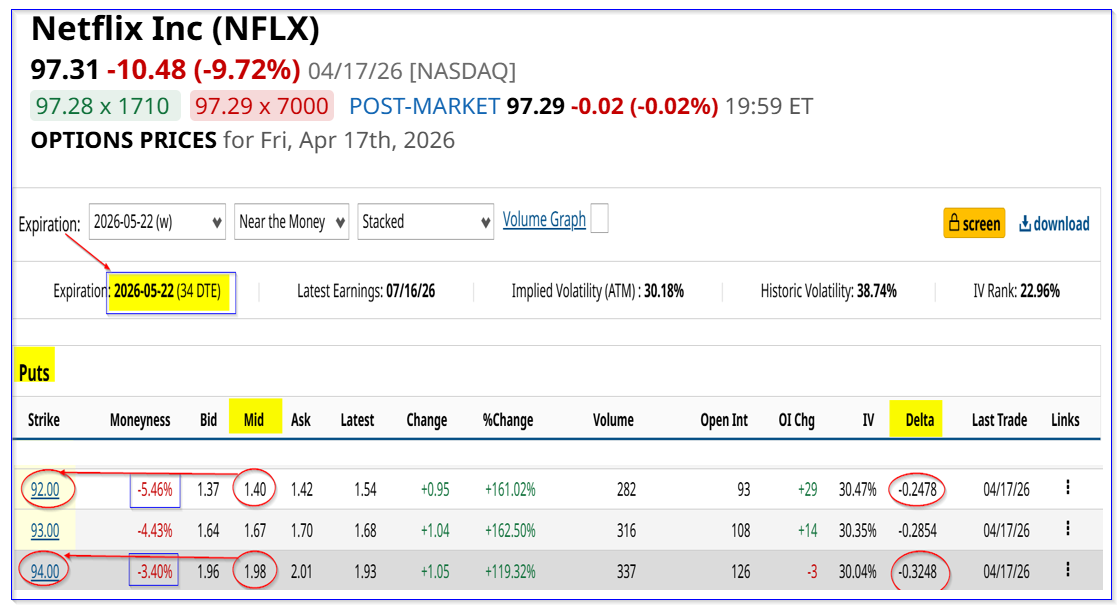
Image Source: Barchart - Netflix puts expiring May 22 as of April 17, 2026
For example, the $94.00 strike price (3.4% lower) has a midpoint premium of $1.98 for a 2.106% one-month yield (i.e., $1.98 / $94.00), and the $92 strike price, 5.4% lower, has a 1.52% yield (i.e., $1.40 / $92.00).
The bottom line is that investors can make an attractive income waiting to buy Netflix if it falls to these lower put option strike prices.



Comments
Log in or sign up to join the conversation.