

The writing was on the wall, and the National Bank of Hungary did not disappoint. On the contrary, the revised ultra-low inflation outlook encouraged the Monetary Council to commit to two more rate cuts after today’s reduction during the summer. We envisage at least one additional rate cut to the projected official path
ING's policy view: We agree that there is scope for further cuts
The National Bank of Hungary cut the base rate to 6.00% on 23 June, matching the expectations in our preview. When the Monetary Council last decided to ease monetary conditions in February, it clearly avoided the term 'rate cut cycle'. Times are changing quickly, however, and we now find ourselves in a 'mini cycle'. Nevertheless, the significant improvement in the inflation outlook would justify at least a 'midi' cycle, if not a 'maxi' one, if you like fashion metaphors.
The price pressure has eased to such an extent that we are forecasting an average inflation rate of 2.3% in 2026. Before the central bank revealed its new forecast, this figure seemed impressive. Perhaps it is time for us to take a summer retreat and regroup. To be fair, we have already factored in expected fluctuations in fuel prices and the gradual removal of other price protection measures. Unless the forint depreciates significantly, the outlook for structural developments under this scenario remains favourable. We predict that inflation will peak at around 3.0-3.5% year-on-year. However, due to base effects and stronger repricing driven by domestic demand, price pressure will continue to creep higher, and the pinnacle of the inflation cycle could reach 3.5-4.0% in mid-2027.
Looking ahead, if the external environment remains supportive and local politics deliver on previous commitments to the euro adoption plan, EU funding developments and long-term fiscal adjustments, the risk premium for Hungarian assets could remain persistently low. In this case, we forecast a 'midi' cycle involving three or four further rate cuts sequentially following today's move. Our terminal rate for this year is 5.00-5.25%. However, if the situation remains favourable as winter approaches, we wouldn’t rule out switching to a 'maxi'.
ING’s market views
The NBH press conference brought a dovish outcome to the market, particularly due to the very low inflation forecast for this year and next, heading well below our expectations and market consensus – making the NBH the most dovish forecaster on the market. Also, the commitment to two rate cuts during the summer and calling for a “mini rate cut cycle” may be a reason for the market to see this meeting as clearly dovish.
The press conference sent EUR/HUF above 356, but it eventually stabilised somewhere in the 355-356 range. These are levels where we would expect some resistance and attractiveness for new forint buyers. However, together with the NBH meeting, we also see a switch in global sentiment to be more risk-off with an equity sell-off and a stronger US dollar, which gives the forint additional risk of a sell-off in the near-term.
On the other hand, from a rates perspective, the market has basically priced in the rate cuts that the NBH mentioned today. The front-end of the curve does have reasons to rally, and we see further steepening as we discussed in the NBH preview. Still, this should not be a game-changer for FX.
In rates, the market is pushing the NBH rate terminal lower to the 4.50-4.75% range after the press conference, and we are likely to see a further rally in the coming days. This is still higher than we saw pricing in 2024 of around 4.25-4.50% under less favourable conditions for the central bank. Therefore, we believe the front-end has more room to go lower, and the bull-steepening of the curve will continue.
Updated GDP and CPI forecasts of the NBH (% YoY)
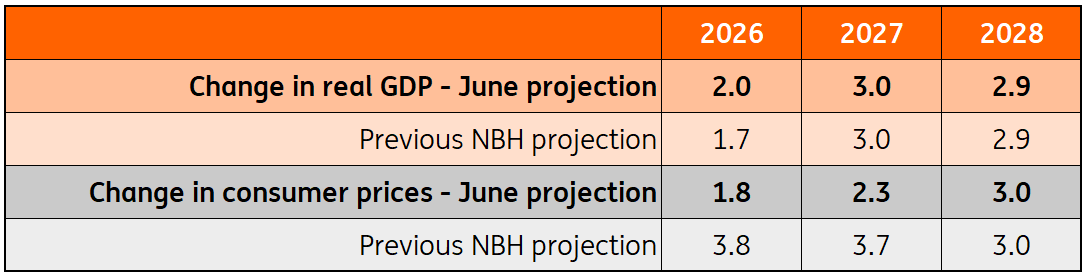
The updated GDP & CPI forecasts
The full macroeconomic assessment and outlook will be published alongside the June Inflation Report on 25 June. Based on the latest GDP and inflation forecasts, the NBH's outlook has become much brighter.
The favourable GDP figures for the first quarter, combined with a sharp rise in consumer confidence and a strong improvement in households’ real disposable income, resulted in an upward revision of GDP growth in 2026. On inflation, significant downward revisions have been made across the entire forecast period, with shockingly low projections for both 2026 and 2027. However, these take into account the continued use of price shield measures and price caps, as the decree-turned-law has scrapped the phase-out date. To provide a more realistic picture, the NBH conducted an alternative calculation, the results of which will be published in the detailed Inflation Report.
Regarding alternative scenarios, the Monetary Council highlighted six, four of which were labelled as the most relevant. From an economic activity point of view, the risks are tilted to the upside, while inflation-related scenarios show balanced risks.


Comments
Log in or sign up to join the conversation.