

US futures
Dow futures 0.54%, S&P futures 0.6% & Nasdaq futures 0.9%
In Europe
FTSE 1.75% & DAX 2.7%
US stocks extend the rebound on ceasefire hopes
The Strait of Hormuz could remain closed
ADP payrrolls fall to 64k from 66k (vs 40k expected)
Oil falls as the risk premium fades
US stocks extend rebound on ceasefire hopes
US equities are set for another strong open after posting solid gains yesterday, as investors continue to respond positively to comments from President Trump suggesting that an end to the Middle East conflict could be drawing closer.
Trump, who is due to speak again later today, and Secretary of State Marco Rubio both indicated that the Iran conflict could potentially end within the next couple of weeks. Iranian leadership has also signalled that it may be willing to consider ending the war under certain conditions.
Notably, Trump has suggested that the conflict could end without the full reopening of the Strait of Hormuz. Even so, oil prices are falling sharply, with crude down around 3% on Wednesday as markets respond to the possibility of de-escalation.
That said, while the geopolitical risk premium is beginning to fade, the normalisation of physical oil flows is likely to take longer. Shipping bottlenecks, infrastructure damage, elevated insurance costs, and disrupted export routes mean that energy prices could remain structurally higher for longer even if military tensions ease.
Still, the near-term market reaction is clearly risk-positive. Treasury yields are also moving lower, which is helping to support equities after the S&P 500 and Nasdaq posted their steepest monthly declines in years during March.
This matters especially for growth stocks, where lower yields reduce the discount rate applied to future earnings and make valuations more attractive.
US data
On the data front, ADP payrolls came in slightly stronger than expected at 62,000 in March, following a revised 66,000 increase in February and above market expectations for 40,000.
The release follows yesterday’s JOLTS job openings data, which showed hiring activity and vacancies falling to their weakest levels since 2020, and comes ahead of Friday’s more closely watched nonfarm payrolls report.
Taken together, the data continues to suggest that the US labour market is gradually softening.
That creates a more complicated backdrop for the Federal Reserve. A cooling jobs market would normally argue for easier policy, but rising inflation risks driven by higher energy prices point in the opposite direction.
The Fed could be increasingly caught between slowing growth and renewed inflation pressure.
Corporate news
Nike is falling more than 10% premarket despite beating quarterly earnings and revenue expectations. The negative reaction reflects continued weakness in the key Greater China region, while management also cut revenue guidance for the current quarter — reinforcing concerns that the turnaround remains fragile.
Meanwhile, Big Tech is extending yesterday’s rebound. After suffering one of its worst weeks in nearly a year last week, the sector is benefiting from falling Treasury yields and improving market sentiment even as Iran threatens the likes of Apple, Google Microsoft in the region. Lower yields are particularly supportive for large-cap growth stocks because they increase the present value of future earnings.
Nasdaq – technical analysis
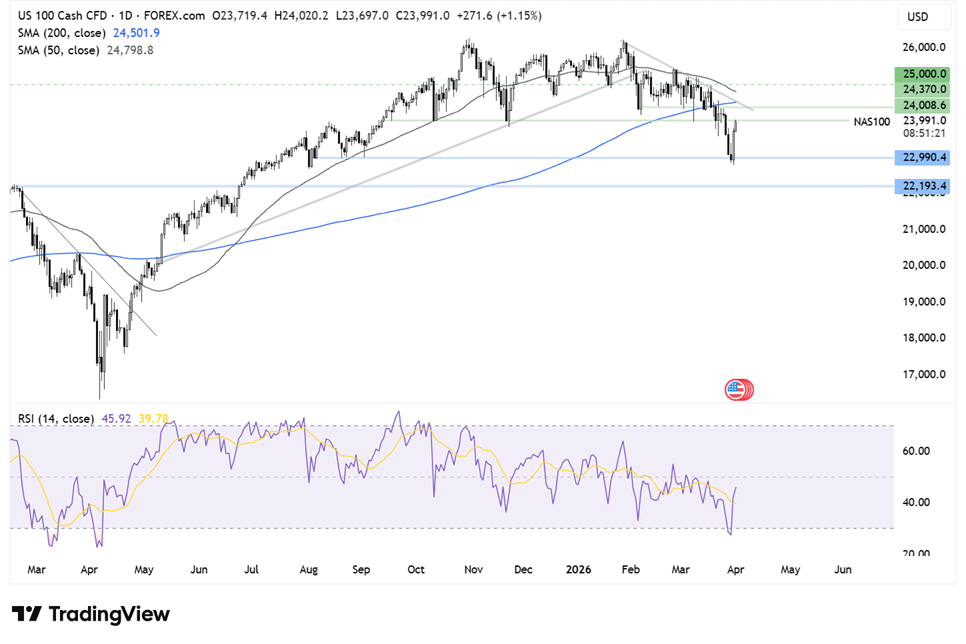
After breaking below the 200-day SMA, the Nasdaq found support around 22,800 and has rebounded, now testing resistance near 24,000, which marks the October and November lows.
If buyers can push above 24,000, the next key area comes in around 24,500, where the 200-day SMA and falling trendline resistance converge.
A sustained move above that zone would improve the near-term outlook and bring 25,000 back into focus.
On the downside, sellers would need to break below 22,800 to create a fresh lower low and reopen the door towards 22,200, the February 2025 high.
FX markets – USD eases, GBP/USD rises
The US dollar is weakening as safe-haven demand continues to unwind amid improving sentiment and growing hopes of a ceasefire in the Middle East. The dollar posted its strongest monthly gain since July last year in March, driven by geopolitical uncertainty and the view that the Fed would remain on hold for longer. But as market mood improves and de-escalation hopes rise, some of that support is fading.
EUR/USD is moving higher, helped by both a softer dollar and still-elevated expectations for ECB tightening. That said, the market pricing surrounding ECB rate hikes could be too aggressive. Higher oil prices can lift headline inflation, but monetary tightening alone cannot offset an externally driven energy shock. Policymakers are likely to want to see more convincing evidence that inflation is spreading into core prices, wages, and services before responding more forcefully.
That remains questionable for now, particularly after yesterday’s eurozone data showed core inflation easing to 2.3%.
GBP/USD is also rising for a second consecutive day as the dollar softens, despite warnings from the Bank of England that the global economy is facing a significant negative supply shock linked to the Middle East conflict. Sterling may also be drawing some support from reports that Prime Minister Keir Starmer is seeking closer ties with Europe amid increasingly strained US relations.
Oil falls on Iran ceasefire hopes, but the Strait question remains
Oil prices are falling on Wednesday as markets continue to weigh the growing possibility of de-escalation in the Middle East after Trump suggested the conflict may be approaching its end.
That has helped reduce the immediate geopolitical risk premium in crude. However, even in a ceasefire scenario, the process of restoring oil supply is unlikely to be immediate.
Any reopening of the Strait would still leave a significant shipping backlog, while production, insurance, logistics, and export flows would likely recover only gradually — suggesting that oil prices may remain elevated relative to pre-conflict levels.
Separately, OPEC output reportedly fell by 7.5 million barrels per day in March compared with the previous month, as producers were forced to cut output amid storage constraints and export disruptions.
That underlines the extent to which physical supply has already been affected, and why oil markets may remain structurally tight even if military tensions begin to ease.



Comments
Log in or sign up to join the conversation.