
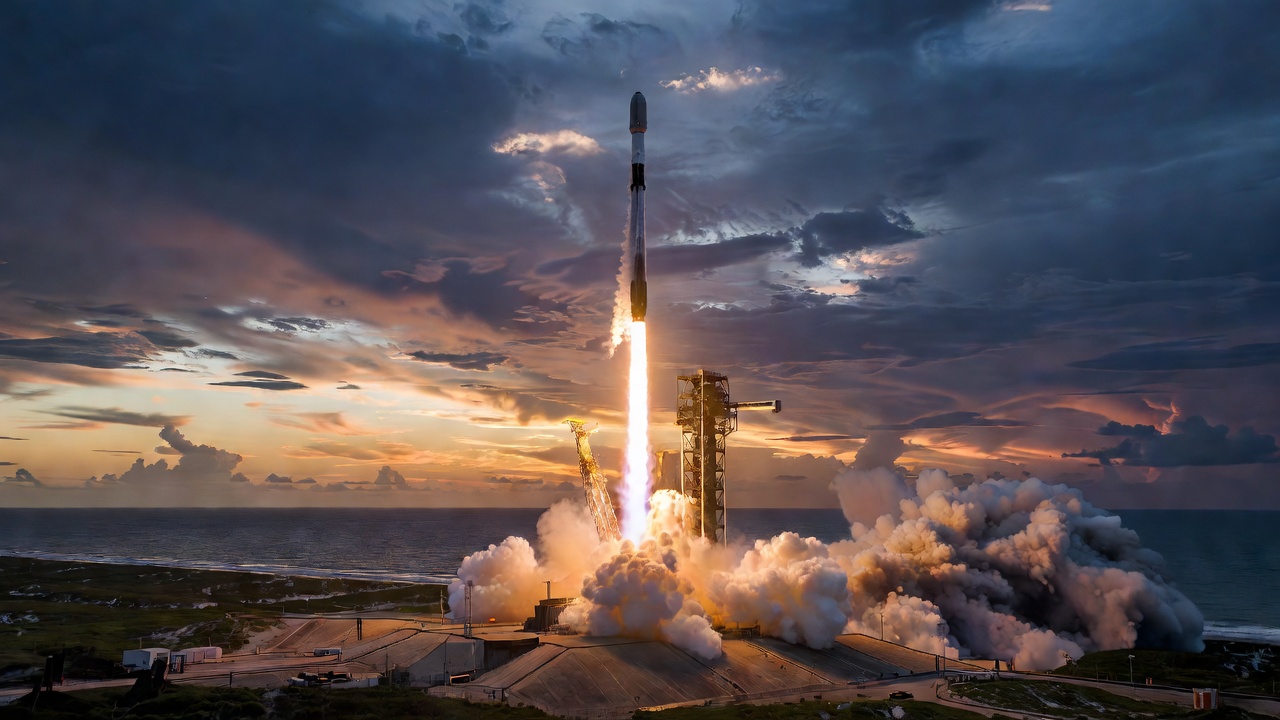
NASA picked SpaceX (SPCX) this week to launch StarBurst. StarBurst is a small satellite built to catch the first flash when two dead stars smash together. The agency's contract note puts a $1 billion figure next to the deal. That is the number flying around cable and social feeds.
My take is simple. The billion dollars is the shared ceiling on NASA's multi-company small-launch program, shared across many providers over years. What NASA ordered is a fixed price rideshare seat on a Falcon 9 Bandwagon flight. Lift-off is no earlier than 2028 from Cape Canaveral. For investors, the real story is that Falcon is still the default highway NASA uses when science can live with commercial launch risk.
What NASA actually bought
StarBurst sits under NASA's Pioneers program for lower-cost space science. The satellite watches the part of the sky Earth does not block. It hunts short gamma-ray bursts. Those are brief high-energy explosions that fire when neutron stars merge. Scientists want that first flash lined up with gravity-wave alerts and other telescopes. Several kinds of signals from the same cosmic crash. That is the science product.
The launch award is a task order under VADR. That is NASA's Venture-Class Acquisition of Dedicated and Rideshare contract. Think of VADR as a bulk account. NASA can keep issuing fixed-price task orders for small launches and rideshares over a long window. The September 17 release says the maximum total value is $1 billion across all contracts on that vehicle. SpaceX is one provider in a larger U.S. commercial pool. Over the life of the program that pool has also included Rocket Lab (RKLB), Blue Origin, Firefly, and others.
In kitchen terms, VADR is how NASA buys cheaper access for science that can handle more risk. StarBurst is one order on that account. NASA did not publish a separate public dollar amount for this single Falcon seat in the headline release. Treating the full program ceiling as SpaceX's haul for one science box is how headlines get drunk.
Why Falcon keeps winning this lane
NASA still needs cheap, frequent rides to orbit for small science and tech payloads. Falcon 9 has the flight rate. It has Cape and California pads. It already runs a rideshare product. When the agency wants a small astrophysics box up without a custom rocket story, Bandwagon-class seats are the easy path.
Rivals are still in the fight. Rocket Lab has been winning Electron science work. It is building Neutron as a medium-lift challenger. Blue Origin and others sit in the same small-launch and national-security talks. The honest read is heavy concentration today, with other firms still trying to make a true second provider real on cost, schedule, and flight rate. SpaceX owns the proven high-tempo commercial medium-lift lane right now.
If you own Space Exploration Technologies (SPCX), this task order is continuity at a giant public valuation. SpaceX is already a multi-trillion-dollar company after its June 2026 IPO. The stock recently traded near the mid-$150s, well off the post-IPO spike and still huge next to old-line aerospace names. Starlink, national security launch work, crew and cargo traffic, and Starship and Artemis work dwarf one Pioneers rideshare. This award reminds the market that NASA keeps coming back to Falcon when the mission fits commercial practice. That is infrastructure proof for holders. Size the company on the big engines of the business, not one science seat.
If you own the broader space complex, the seats split cleanly. SPCX holders care whether NASA and the Pentagon keep treating Falcon as the reliable on-ramp. Rocket Lab (RKLB) and other VADR names care whether task orders keep flowing to dedicated small vehicles instead of always riding Falcon. Suppliers and ground names care about launch tempo more than which logo sits on a single 2028 rideshare. One Bandwagon slot does not rewrite those ledgers by itself.
What would change my mind
I would soften the "default highway" line if NASA started steering most VADR-class science onto dedicated small vehicles and new medium-lift rockets with real flight history, on schedule, at competitive fixed prices. I would also rethink the continuity line if SpaceX ever guided that civil rideshare math was becoming a big earnings driver next to Starlink and national security. Neither is what this week's paperwork shows.
Bottom Line
NASA selected SpaceX to loft StarBurst on a Falcon 9 rideshare no earlier than 2028 under the VADR small-launch vehicle. The $1 billion figure in the release is the shared program ceiling across contractors. My verdict: Falcon remains NASA's commercial science on-ramp when the payload can live with higher risk and lower cost. For public SPCX holders, that is steady infrastructure confirmation at a giant valuation. Watch cadence, backlog, and the big revenue engines. One rideshare headline should not set how you size the whole company.

Comments
Log in or sign up to join the conversation.