

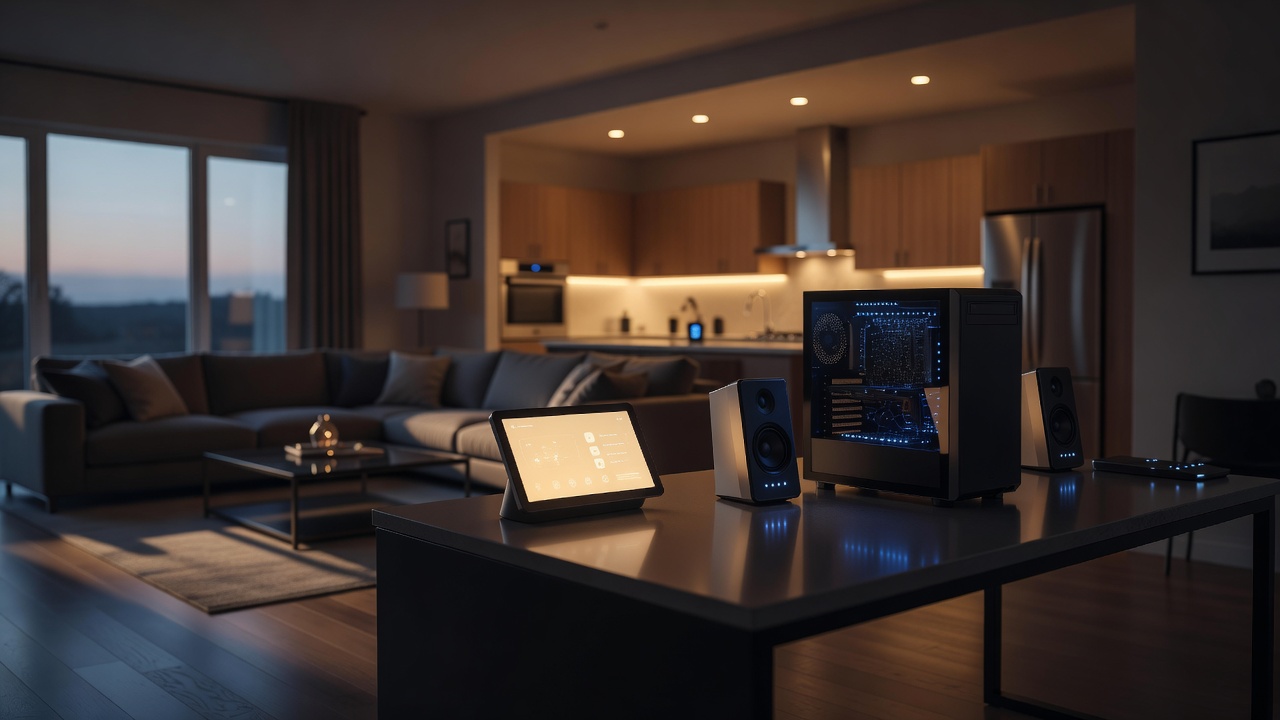
Wall Street still treats the living room like a gadget aisle.
That story is getting old fast.
Personal computers did not change America the day the first beige box hit a desk. They changed it when the house finally ran on software, files, and a machine people used every day. AI is making the same move now. The smart home is leaving memorized voice commands and entering a home superintelligence wave. Agents plan, coordinate, and act across rooms the way a PC once pulled work, mail, and media onto one platform.
My take
My take is simple. Phase 1 was a remote control with a microphone. Phase 2 is a household brain that already lives in speakers, TVs, appliances, phones, and a new class of personal AI computers. The companies set to benefit look a lot like the PC winners. They own the operating layer, sell the chips that make local intelligence cheap, or already sit in millions of kitchens with hardware people will not throw away.
What Phase 1 actually was
For a decade the pitch was the same. Buy a speaker. Name your lights. Hope the phrase lands. Amazon (AMZN) Echo, Google (GOOGL) Nest, and Apple (AAPL) HomeKit made the category real, and they also trained people to expect brittle routines and cloud-first answers.
That layer is getting rewritten in place. Alexa+ now handles multi-step home requests and natural routines, included for U.S. Prime members and about $19.99 a month without Prime. Google is pushing Gemini for Home across Nest gear and opening home control to outside agents through its Model Context Protocol, with richer features tied to a roughly $20-a-month premium home plan. Samsung (SSNLF) says SmartThings now reaches about 470 million registered users and keeps shipping Matter support so third-party gear can join the same map.
Useful? Yes. The full house brain people were promised in 2018? Still incomplete. Think improved remote, not the finished platform.
The product tells that Phase 2 is real
Apple is lining up a smart-home reveal around October 13 built around a screen hub widely called HomePad, plus refreshed HomePod mini and Apple TV hardware, all pointed at Siri AI as the center of the room. Reports describe a roughly six-inch display, on-device smarts, and a privacy posture that hides personal screens when strangers walk in. That is Apple trying to own the household interface the way it already owns the phone pocket.
Microsoft (MSFT) and Nvidia (NVDA) just put a different kind of home computer on the table. RTX Spark Windows systems, including Microsoft Surface models starting around $2,599, are sold as personal AI machines that can run serious local models and keep agents working without shipping every chore to a distant data center. That is the PC analogy without the nostalgia. The desk is becoming a private factory for household agents.
OpenAI is still the ghost in the room, with reporting on a portable home speaker in the $300 to $400 range and no OpenAI hardware shipping before the end of February 2027 at the earliest. Microsoft is also slipping into appliances through partners such as LG (LGEAF), putting speech agents into laundry and kitchen gear instead of only fighting for another countertop puck.
What this means if you own stocks
If you hold Apple, Amazon, Google, or Microsoft, the near-term story is still phones, ads, cloud, and Office. The medium-term home fight is who becomes the default agent people trust with locks, calendars, cameras, and shopping. Amazon already has the widest Alexa device footprint and a commerce loop. Google wants to be the plumbing other agents plug into. Apple wants the premium, private hub. Microsoft wants Windows and partners to host the agents that live beside you.
If you hold Nvidia, the home layer is a second demand engine under the data-center boom. Local inference on laptops, compact desktops, and edge hubs needs the same AI stack, just closer to the couch. Appliance platforms matter too when the brain ships as a firmware update on gear people already paid for. Pure gadget names without an agent, a chip seat, or an installed base are the also-rans of this cycle, the way clone boxes without an operating-system moat faded in the PC years.
I would ease off the home-superintelligence read if the new hubs stay novelty screens, subscriptions bounce, and agents still need a human to finish every multi-step chore. I would upgrade it if HomePad-class devices, Alexa+ and Gemini home agents, and local AI PCs start feeling like daily infrastructure instead of demo day.
Bottom Line
The home superintelligence wave is the PC moment returning through speakers, appliances, and personal AI computers, and the stocks set to benefit are the platform owners, the local-chip suppliers, and the companies already inside the house when the brain finally shows up.


Comments
Log in or sign up to join the conversation.