


Jared Dillian has a new book out called The Awesome Portfolio. Here's a podcast with Matt Zeigler to learn more.
In our parlance, the Awesome Portfolio is quadrant-inspired with five equally weighted sleeves. Dillian said he was not aware of the Permanent Portfolio when he came up with the idea but described his portfolio as a slight modification resulting in a huge improvement. It's similar to the cockroach portfolio from Jason Buck, but it's cheaper.
Equities
Bonds
Real Estate
Gold
Cash
For the most part, it's Vanguard ETF: VTI, BND, VNQ, GLD.
The underlying premise is focus on managing volatility. No stress and sleeping well are priorities. A Gemini search says that Jared backtested it to 1971, and in that time the portfolio has returned about 9% annualized versus 10% for the S&P 500, with half the volatility and smaller drawdowns.
Using testfol.io, there's no way to recreate the results going back to 1971 because there isn't a proxy for real estate (REITs) that goes back that far. But when you see 1971, what do you think of in terms of capital markets and the like? The US went off the gold standard that year, and over the course of the next decade +/-, gold went from $35 to about $800.
I asked Gemini if that created an unrepeatable, favorable skew? Gemini noted that there was a long, slow decline in gold after that massive rally but that the impact of the gain in the 70s had more influence than the subsequent long decline. Gemini found something from Bogleheads that figured the Awesome Portfolio's CAGR was closer to 6.5% if you strip out the massive run in gold from the 1970's.
Using ETFs, we can backtest back to late 2004, and in that run, it compounded at 7.37% versus 10.97% for SPY, and since the idea seems quadrant-inspired, the Permanent Portfolio Mutual Fund (PRPFX) compounded at 8.14%. The Awesome Portfolio was less volatile than SPY or PRPFX but not half as volatile.
I don't think REITs are a very reliable diversifier. Managed futures do a much better job. When we take out VNQ and add managed futures instead, we get about the same result as the Awesome Portfolio with much less volatility, much smaller drawdowns, half the beta, and no huge, unrepeatable skew from gold.
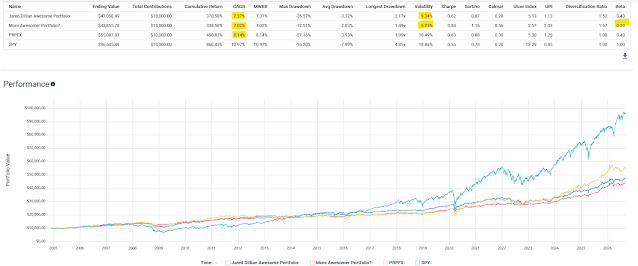

Using managed futures instead of VNQ resulted in consistently smaller drawdowns than in the Awesome Portfolio.
The only way I know to go back that far on testfol.io with managed futures is simulated DBMF. For anyone actually interested in putting 20% into managed futures, I'd suggest splitting that up across several funds. It's not as simple as just five funds total, but we've seen enough performance dispersion across managed futures funds that such a huge allocation to one fund could create the sort of stress Dillian is trying to avoid.
With the updated version that splits the managed futures between simulated DBMF, AQMIX, and ABYIX and removes BND in favor of FLOT to take out duration, it still looks competitive with the shorter time period. Dillian said that "the one vulnerability of the Awesome Portfolio is rapidly rising rates." He noted that bonds, stocks, and gold would probably get "killed." He said real estate would be ok but VNQ was down 26% in 2022. I've been saying for 20 years that REITs are not good protection against declines.
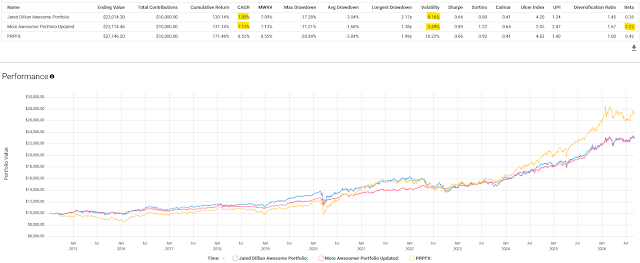
The much smaller drawdowns also hold up in this second study.
I used FLOT as I said, but there are now many more choices to split the FLOT slice and add a few more basis points of yield to the portfolio.
Can this continue into the future? There's no way to know, but if this is quadrant-inspired, then the expectation is that properly diversified, managed futures have been better than VNQ for mitigating downside volatility. There should always be at least one thing working in the Permanent Portfolio; that's the big idea, and I would suspect at least two things could always be working in the More Awesomer Portfolio. A caveat is that I don't think there's any way this concept keeps up with equities other than if we have another lost decade that skews the results for a while.
A quick follow-up: it looks like the FirstTrust BuyWrite Income ETF (FTHI) also pays out about 93-94% ROC as we've been looking over the last few days. Also, that fund is quite a bit older than most of the other ETFs in the space; it goes back to 2014 and has $2.5 billion in it. In its early years, it distributed about 5%, but for the last few years, more like 10% as interest rates have moved up. Side note: if you are going to dabble in derivative income funds, I would strongly encourage learning the role that interest rates play in options pricing.


Comments
Log in or sign up to join the conversation.