

IntroWhen most people hear the name Moderna, they probably think of one thing. COVID vaccines. But this week, Moderna made headlines for something very different. The company and Merck announced positive Phase 3 results for intismeran autogene, a personalised mRNA cancer treatment used alongside Merck's Keytruda. In more than 1,100 patients with high-risk melanoma, the combination significantly improved outcomes by reducing the risk of the cancer returning or spreading compared with Keytruda alone. The news sent Moderna shares soaring, with the stock more than doubling in a single day. For years, one of the biggest questions surrounding Moderna has been: What comes after COVID? This week's breakthrough suggests cancer treatment could potentially become part of the answer. FundamentalsModerna's financial position today looks very different from its pandemic peak. As demand for COVID vaccines declined, revenue and profits fell sharply. In Q2 2026, the company generated around $100 million in revenue and recorded an $800 million net loss, although management expects full-year revenue to grow around 10% to approximately $2.3 billion. Moderna is also building new sources of revenue beyond its original COVID vaccine, including vaccines targeting RSV and flu, with its standalone flu vaccine recently receiving FDA approval. The bigger long-term opportunity lies in whether Moderna can successfully turn its mRNA technology into a broader platform for treating multiple diseases. Its personalised cancer treatment is already being studied across lung, bladder, kidney, pancreatic and stomach cancers in addition to melanoma. If successful, these programs could open much larger markets for Moderna and help reduce its reliance on COVID-related revenue. For investors, that's the key fundamental story: Moderna isn't a consistently profitable company today, but its pipeline could determine whether it can successfully reinvent itself for its next phase of growth. Technical |
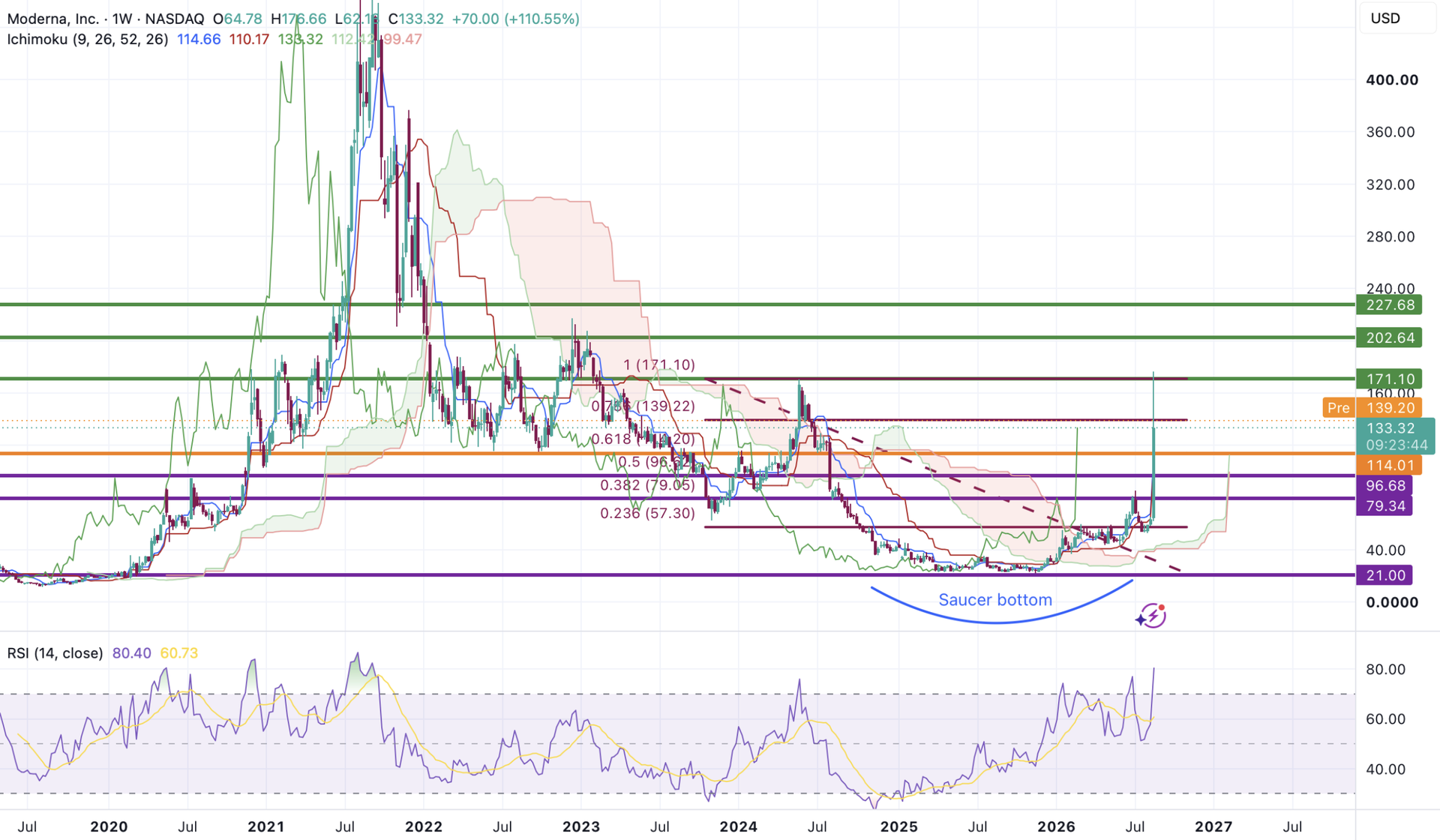 |
On the weekly chart, MRNA entered a prolonged bearish trend following its sharp rally in 2020-2021. More recently, however, a saucer bottom appears to have formed, signalling a potential shift from a bearish to a bullish trend. This was followed by the sharp surge in the share price this week following the positive Phase 3 results. The Ichimoku Cloud has also shifted from bearish to bullish, with the candles now trading above the cloud, which could act as a key support area. Following Moderna’s enormous rally this week, technical analysis becomes particularly important. Rather than chasing the stock after such a sharp move, investors may want to watch for a period of consolidation or a healthy pullback towards key Fibonacci, Ichimoku or previous support levels, which could provide more attractive entry opportunities. Buy Limit Ideas $114 (High Fill Probability) $96 (Moderate Fill Probability) $79 (Low Fill Probability) Profit Taking Ideas $171 (High Fill Probability) $202 (Moderate Fill Probability) $227 (Low Fill Probability) |
Risk Level: High |
Moderna remains a high-risk investment because it is still loss-making and much of its future growth depends on new treatments completing clinical trials and gaining regulatory approval. While the positive Phase 3 melanoma results are an important milestone, full results and longer-term survival data are still pending, and success in melanoma does not guarantee success in other cancers. Investor expectations have also risen sharply following the stock’s huge rally, increasing the risk of a pullback. However, if Moderna can successfully expand its mRNA technology into other cancers and diseases, it could become a much broader biotechnology company beyond COVID vaccines. SummaryModerna became famous for helping develop one of the world's COVID-19 vaccines, but its long-term investment story has always depended on whether its mRNA technology could do much more. This week's positive Phase 3 melanoma results provide an important step towards answering that question. Its personalised cancer treatment, developed with Merck and used alongside Keytruda, significantly reduced the recurrence and spread of melanoma compared with Keytruda alone, while Moderna and Merck are already investigating the technology across several other cancers. For Triple Compounding™ investors, Moderna demonstrates an important investing lesson: a breakthrough can dramatically change the future potential of a company, but that doesn't automatically mean investors should chase the stock after a huge rally. Unlike steadier businesses such as Waste Management, Moderna remains a higher-risk investment. The company is still loss-making, its future depends heavily on successful clinical trials and regulatory approvals, and the market is already placing considerable value on the possibility that its cancer technology succeeds beyond melanoma. But that's exactly what makes Moderna so interesting to follow. For years, the question has been: What comes after COVID? This week's results suggest one possible answer could be much bigger than another vaccine. Moderna may be trying to prove that mRNA isn't simply a technology for preventing infectious diseases - it could potentially become a new way of helping the immune system fight cancer. |

Comments
Log in or sign up to join the conversation.